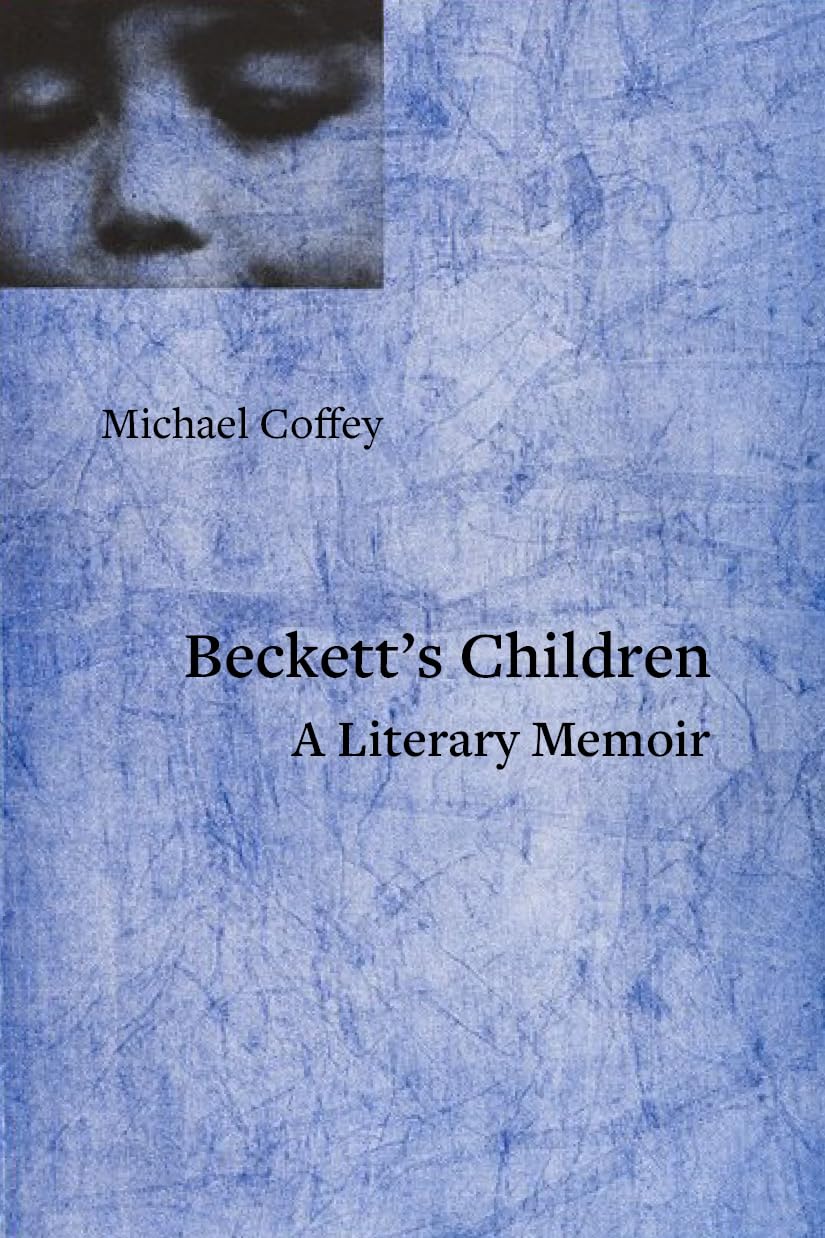
Reviewed by Dan Gunn

Every so often, though it seems more rarely than in the past, a book reaches out from a location that is not predetermined – by academic convention, by commercial viability, by authorial confidence, by generic cohesiveness – to challenge the reader to absorb it without the comforting reassurance that easily discernible origin and intention can offer. This is one such book: written on the margins of academic discourse, of poetic daring, of tolerable conditions for utterance; written from a refusal to turn away from what in speculation may be awkward or embarrassing, from a place of unmistakable pain to which words are attempting, falteringly and –appropriately in relation to the work of Samuel Beckett – failingly, to do justice.
If this sounds terribly abstract, Michael Coffey’s book is anything but. The central theme holding together the numerous fragments that make up his book is filiation, the very theme which so many narratives, from The Odyssey onwards, have explored – the novel form, supremely. And as Telemachus reminds us, the exploration begins at home, when the very notion of home has been rendered problematic from the outset, even before the outset, by the fact that the author here, is an adoptee who has never quite felt at home, whose surname is only belatedly ‘Coffey’.
The author charts his search for his own birth parents, and the predictable disappointment that his discoveries give rise to. More harrowingly, he charts his search for his own son – if search is the word – whose mother he left when his boy was still an infant, and whose subsequent life has been one long series of frustrations, mishaps, occasional highs but more frequent lows, leading through addiction to one state penitentiary after another. Throughout the son’s downwardly spiralling life, the father tries to atone for a primordial act of abandonment, about which he, the father, is mercilessly frank and self-incriminating. He assists in whatever small and not-so-small ways that are available to him, sending money to help with some new doomed harebrained scheme designed to bring the son to solvency, or delivering supplies to his new place of incarceration.
As in classical tragedy, the menace of a curse passed down through the generations, the damage it inflicts, is present here, in ways that link to the sharp edges of contemporary American culture, the lack of a social safety-net, the brutality of profit and loss – the world conveyed so poignantly by a TV series such as Breaking Bad, where there simply are no good guys. Perhaps the most moving section of the book is devoted to emailed exchanges between father and son, as the son tries once again, in his forties, to establish his independence, even while still calling for his father’s approbation and support. The sheer impossibility for the father to get it right, where help is both required and repudiated, coming as it ever does too late, is conveyed with immense tact and alarming frankness; the very act of writing these emails – and then of citing them here, in this book – becomes some sort of testament to an endeavour bound to fail. As the book ends, the son, Josh, is back in prison once again – still alive, still craving, still failing to find himself.
It is at the precise point where failure crosses paths with filiation that Coffey wishes to situate his reflections on the work of American poet Susan Howe and Irish writer Samuel Beckett. His admiration for both authors is immense, and on both he offers luminous insights. But where his work is most original and provocative is in his wish to think of these two writers together – and together with the notion that one might be the child of the other. Here, Coffey treads on terrain that in its own way is almost as mined and perilous as is his relation with his own son; he fully expects ‘banishment’ from ‘the wonderfully companionable community of Beckettians’ for his willingness to ‘go there’ – a there that comes into existence through his raising, in print, the issue of Beckett’s affair with Mary Manning Howe in 1936, which may or may not have given that other sort of issue, a child named Susan, born some nine months later in America (p.155).
Coffey is both forensic in his examination of the dates and possibilities and entirely willing to accept the official line, that DNA testing has proved Susan Howe not to be the child of Samuel Beckett: ‘All that concerns me here,’ he writes, ‘is the possibility that Irish-American artist and poet Susan Howe and Irish writer Samuel Beckett may both have developed their practices under the threat (or promise) of being daughter and father, and that their practices bear marks of the stress of not knowing beyond doubt something so crucial.’ Having worked for decades on Beckett’s letters, among which are those exchanged between Susan Howe and Beckett’s first biographer Deirdre Bair, I believe Coffey’s speculation to be valid, and that Mary may well, for reasons perhaps connected to her nostalgia for Ireland, have sometimes told her young daughter that she was Beckett’s child. And Coffey draws on his own experience as to why such fantasies of filiation can matter: ‘As I well know,’ he writes, ‘uncertainty as to parentage can make one wonder, actively ignore, deny, fantasize, rue. It can make one fashion a certain physical look, as some believe Howe did, and as Beckett did early, styling himself like his literary father, Joyce. It can make one lose his or her self in genealogies of artistic, historic, or philosophical influence and pretension, as Howe and Beckett both do. As I have done –’ (p.157).
Assembling his fragments – what he calls his ‘leaves’, his ‘stacks’, his ‘woods’ – Coffey constructs a book that defies taboo and evades expectation that it fit neatly into any pre-established genre: poetry, memoir, academic research, speculation, dream, fantasy, genealogy, all are mobilised into a fragile urgent venturing that can leave the reader reeling.
Dan Gunn teaches at the American University in Paris. He is the Paris director of the correspondence of Samuel Beckett, the international project based in Emory University.
 The Beckett Review
Leave a comment