
By Katherine Weiss

Jeni Jones is best known in Los Angeles as an award-winning director, actor, and producer of film and theatre. She earned her bachelor’s degree in Theatre Directing from Fordham University and her master’s degree from CalArts in Directing for Film, Theatre and Television. She has a penchant for challenging texts and has enjoyed a long career in entertainment as a film executive, performer, and rapper. She recently returned to her roots as a Beckettian director, actor, and producer.
She first encountered the works of Samuel Beckett as a teen attending community college. Since then, she has remained fascinated with Beckett’s work, directing other actors in Krapp’s Last Tape and Waiting for Godot, and plotting to one day liberate Beckett’s challenging female-driven texts from the physical and psychological restraints often placed on them. During the pandemic, she turned to Not I, identifying with Mouth’s relentless need to be heard and Auditor’s diminishing compassion.
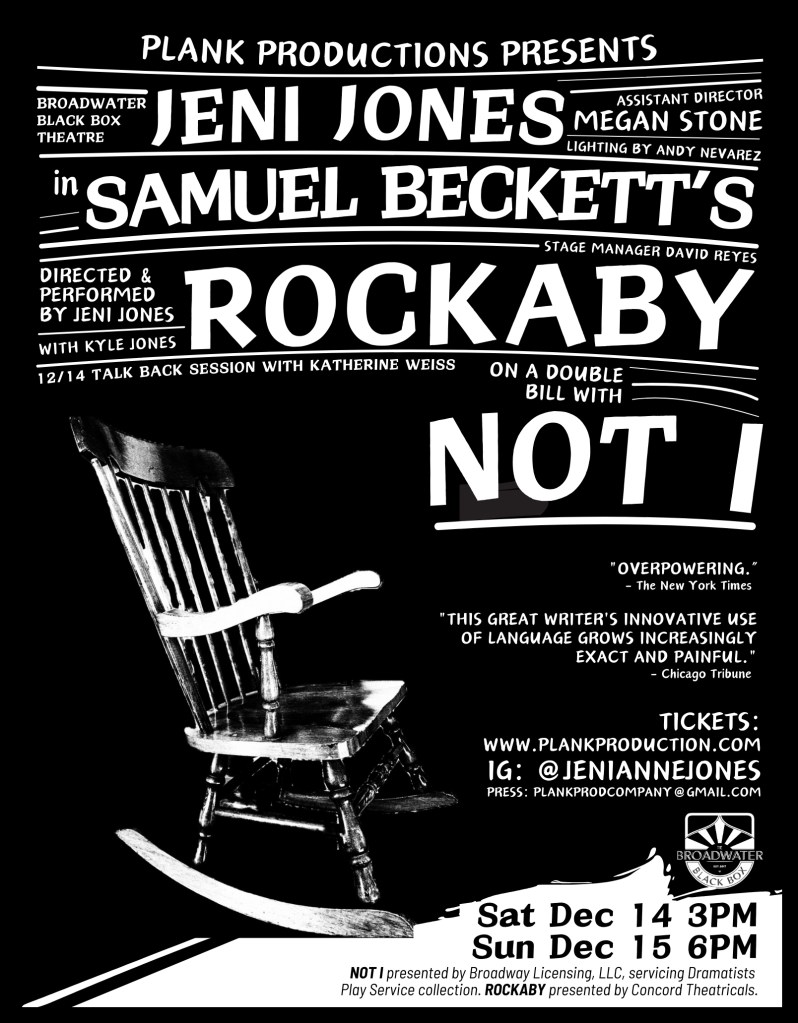
At last year’s Hollywood Fringe, Jones directed and performed Not I. Six months later, she produced, directed, and starred in a Not I and Rockaby at the Broadwater Theatre in Hollywood.
I met with Jones on December 18th for dinner at a local Pasadena Thai restaurant to discuss her recent production, the double bill of Not I and Rockaby. An excerpt of that interview is published here.
Katherine Weiss [KW]: Thank you for meeting with me. Allow me to congratulate you on a successful, albeit short run of Not I and Rockaby. You have a fearless spirit. A young actor who has chosen to take on Beckett’s extraordinarily difficult late works. And when and where were you first introduced to his work?
Jeni Jones [JJ]: Thank you for the kind words. I’m glad I maintain a facade of fearlessness. This work is scary. My first interaction with Beckett was at Orange Coast College around 1997. My very first directing teacher, Rick Golson, invited me to participate in a Beckett festival. He presented it in the sense of, do you know who Samuel Beckett is? I did not. I’d never heard of Beckett, but I loved theatre and was starting to direct.
I read most of the plays, devoured them and landed on Krapp’s Last Tape. I loved Krapp. I still do. I am Krapp. When I told Golson I wanted to direct Krapp’s Last Tape, he looked at me like I’d chosen the wrong one and said, do you understand that the play requires a reel-to-reel recorder? I did not. I quickly learned everything there was to learn about reel-to-reel sound design, and out of sheer ignorance, or fearlessness, I did the entire play practically with me splicing tape to record Krapp, and the actor manipulating the reels in real time. Krapp’s Last Tape ended up being on a double bill with Rockaby. That was my introduction to Beckett…Watching Krapp that I directed. Rockaby also blew my mind, and I clocked it as a ‘bucket list’ play to direct ‘someday.’ I never imagined I’d act in it.
The next Beckett play I directed was Waiting for Godot. When I first read Godot, I was about 19. I was enamored with the characters, the language, and the challenge of it. I immediately connected to Didi and Gogo.
I directed Godot at Fordham University. I remember when I told everyone that I was going to direct Godot, I got called into the head of the theatre department’s office, Lawrence Sacharow, an Obie Award winning director of works by Beckett and Albee. I had not yet met the man, but he called me into his office to persuade me not to direct Godot. As a young director, just starting off, this was another reason to do it. I thought, why is the play taboo? Or hard? Why don’t you want me to do it? What could go wrong?
KW: I didn’t realize you started off directing Beckett. When did you first act in Beckett’s plays?
JJ: This is my first time acting in Beckett’s plays. I’d seen Rockaby. I’d seen Not I. I always thought, I’ll just direct someone else in these plays. One day. When I’m older. Not me. Someone else. Then, Covid hit.
I’m also a rapper, and I perform as an emcee in the underground hip hop scene in LA. During Covid, I was on stage in a mask rapping in front of an audience. I had conditioned myself to rap in a mask by running with my mask on and shouting my whole hip hop set, full volume for 45 minutes.
There was a moment on stage, mid-song, where I realized: I am Mouth! It was in this moment I realized I can do Not I. I’m the most qualified, reliable actor I know for this role. Plus, I’m willing to rehearse forever.
KW: Congratulations on a remarkable performance of both Not I and Rockaby. You first performed Not I for the Hollywood Fringe last June. I was impressed by the precision of the language and your speed, but also in the emotion that comes from the performance even though you are not emoting.
Would you talk about your rehearsal process?
JJ: When I start any project, especially one in which I’m wearing many hats like this, I start from the global perspective as a producer. As the producer, I must justify putting up these plays. Why produce these two plays together? That was my first look at the material. I saw that they worked as a double bill. These two pieces speak to each other in a concrete way, but they also speak to each other in terms of an actor being able to play both roles. I really felt both plays should be played by the same actor, whether it was me or someone else. Again, I cast myself because I happened to be willing, available and capable of memorizing the text.
Then, as a director and dramaturg, I watch and read everything. I went to San Diego to research the Alan Schneider papers. I read everything that’s ever been written about these two plays. I watched every version online I could. I went back to Knowlson’s biography of Beckett and read every excerpt referencing either of these plays. The parts that stick, really stick, and everything else falls away. I did what I normally do as a director, which is to over-prepare for questions any actor or collaborator might have during our rehearsal process. Obviously, I never know everything, but I streamline the rehearsal process by knowing as much as I can and having a clear vision.
Then I flipped on the actor switch. For better or worse, I can compartmentalize roles while playing multiple roles. While in actor mode, I must forget everything I read as a director. I forget all the research I did. I have to forget all the scholars and all the performances, and then I have to dive into the text.
I focus on the words. I feel. To get off book on Not I, I broke the script into segments. Obviously, there’s the four movements of the play, but then I broke it into what I consider parts of the story. I’d keep small sections with me and do it over and over and over again until I got it. Another tool I used in terms of memorization was recording myself saying the words slowly. I call it my ‘Tai Chi’ version. I’m a martial artist, which also informs how I work. When I practice forms in martial arts, there’s the fast version, and then there’s the slow version. I recorded myself reading the play both ways, then I’d ‘rap’ along in my car, on my runs, in my sleep to exercise my mouth.
As an actor, after you get to a certain point in any Beckett play, all of a sudden everything starts collapsing in on you. The text loops back on itself, and you completely get lost in the center of the text. Like a blizzard. At that point, I used rapping. I’d put on a beat and freestyle the entire play over beats. I’d put on beats and go into a flow state and rap the whole Not I monologue. Fortunately, I didn’t have to think about breathing during Not I because it’s part of what I do as a rapper, martial artist, and dancer.
Both pieces are very musical. For Rockaby, because I’m a music producer, I did all of my own sound design. I keep thinking how far I’ve come since splicing reels for Krapp back in the nineties. I was able to make my rocking chair rock like a hip hop beat and recorded it as a beat. I was able to perform the text to the chair’s rocks. Part of my skillset as an emcee is to go offbeat, to meander into a jazz rhythm and then return to the beat. I did all my own sound design, and I could sit in my chair and rock, play with it again, sit in the chair and rock, rerecord. Try again tomorrow. I went through numerous versions, and in doing that specific work, I was able to see where in the third stanza, the rhythm breaks apart. That revelation informed my performance in a way I wouldn’t have discovered otherwise. Because you see, rhythmically, it gets completely wonky. It’s like the lullaby falls apart. Back when Billie Whitelaw did the play, or when I first directed Krapp on tape, we didn’t have the luxury of endless takes.
KW: I imagine that your expertise and talent as a hip hop and martial arts artist helps with the ability to enunciate regardless of the speed of Not I. Even if the audience can’t always piece the story together, they hear the words distinctly.
JJ: People shouldn’t misunderstand because of my articulation. If they do, it should be because of the speed. I have the added edge of being a rapper and having the ability to go into a flow state where I tap into the universe and let the words flow without judgment.
KW: Without judgment, that positions Mouth also as Auditor to become whole, to get past the trauma. It has to be without judgment.
During the post-show talk, you said that it’s your mission to liberate Beckett’s text from technical and psychological constraints that you see as often hindering performances. Can you elaborate on this?
JJ: A lot of the dialogue and scholarship around Beckett’s plays points towards negative things that could happen because of the technical constraints. Early on, anytime I said I was going to produce or direct a Beckett play, people would ask me technical questions. I kept thinking, that’s not how it has to be done. There’s nothing in these texts that says it has to be done that way.
People who’ve done these plays before have made the plays tech heavy and more complicated than they need to be.
When I hear people talk about the psychological constraints, I think, but in Not I it’s just your mouth. You just sit there, and you do not move. When you tell people that an actor must be ‘strapped in,’ they start inventing a contraption. But if you tell an actor that they just can’t move, well then, they just don’t move. As a dancer, I knew from the beginning of my process that I was capable of not moving my body at all. I love moving. I also love being still. Complete stillness is harder than dancing or martial arts. It is meditation.
Often, directors omit the Auditor because they can’t figure out how to light him, and they can’t figure out the distance from the stage and other technical specifications. I get it. But my understanding of the play and passion for it relies on the Auditor. I wouldn’t have done the play without the Auditor. It doesn’t make any sense to me. There’s no point in doing it without the Auditor. As a producer, the Auditor was critical in terms of meaning, and what I wanted people to take away from this production.
When I think of Rockaby, for example, the rocking chair itself, I read letters back and forth between Alan Schneider and a designer discussing the various contraptions. There are all these pictures and sketches and creations of this chair. All of this had nothing to do with the performance and didn’t have anything to do with the end result on stage. I kept thinking: It’s a rocking chair. Just rock it. People rock in rocking chairs all day. The point is that the audience shouldn’t see the chair being manipulated, which can be achieved any number of ways. It doesn’t need to be mechanical.
KW: We certainly create narratives about work, and our narratives influence future productions, sometimes steering people away from doing them rather than getting our hands dirty by exploring them. The narratives can become a self-fulfilling prophecy.
JJ: The result is that a lot of audiences who would benefit from seeing these plays don’t get to see them because people think they’re too hard to produce or too hard to travel into unconventional venues. I wanted to free them up so that they could travel into spaces that would not typically get to see them. With every choice, I’d think what’s the simplest and least stressful version? And again, it goes back to preserving the actor’s performance. How do ‘we’ the production not stress ‘me’ the actor out? Since I’m the actor, this level of self care for my sanity and performance was the hardest part. It’s easier for me to care for other actors.
As the producer and director making decisions, I thought: How can these plays go on the plane? The subway in New York? And truthfully, aside from a rocking chair, which I cannot easily carry, I could do these plays anywhere. I carry a spare Not I mask at all times in case the opportunity to perform it presents itself.
KW: Can you say more about what led you to decide to include the Auditor?
JJ: As I mentioned, to me, the play doesn’t make sense without the Auditor. It’s just a woman talking. I love that there’s thought. I love that she speaks at the speed of thought. I approach every play as a director asking, ‘Why is today different than every other day?’ For me, the reason is, today is the day the Auditor finally gives up his ‘helpless compassion.’ It’s the day that someone who is trying to give compassion to someone finally gives up because that person will not own their story. They will not even say that they were there. Her vehement refusal to relinquish third person.
Of course, the Auditor could be, and has been, interpreted as many things, from the omnipresent male gaze to a monitor of our inner thoughts. It could be how I monitor what I’m saying right now. However, in the actual physical action of the play, the directions are ‘helpless compassion,’ and every time it decreases. Every time Mouth says ‘she,’ Auditor tries desperately to get her to own her narrative. By the end, he gives up. He says, no more. I have no more compassion for you because you won’t even say it’s you. In a nutshell, Not I is about how difficult it is to have compassion for people when they refuse to take responsibility or ownership of their lives.
KW: What you say about Auditor poses the question as to whether Beckett is asking the audience not to give up, not to be Auditor. Or do you think that Beckett is stating that there is ‘nothing to be done’?
JJ: I think what he’s asking of the audience is to think about how we all are Mouth. I hear Mouth every day in my life. When performing it, sometimes other people’s voices get channeled through me. How many of us experience people in our lives, where it’s always about ‘THEY did this’ or ‘THEY did that.’ At some point, you cannot process it anymore. You stop processing it, and you are like fine, fine, fine, you’re right. You are not the bad guy in your story. I get it. You win. Everybody else is the bad guy. And maybe you give up on them. But that’s not how we want to be as people. We don’t want to give up.
I do think Beckett wants us to have hope and wants us to exercise compassion and wants us to be there for people. But the irony is when you read Not I, it’s like Mouth feels like she won. The irony being that in the end nobody cares about her anymore. She goes into black and back into the oblivion with her thoughts.
And it’s sad because she had someone there listening all along, and that person doesn’t want to hear it. And how many people in our lives, or maybe even sometimes us, maybe me, they don’t want to hear it anymore. They’re done with my story. They’ve heard it ten times.
KW: When I was rereading James Knowlson’s discussion of the artworks that influenced Rockaby in Damned to Fame, I found a new appreciation of just how deeply connected the image of a rocking chair is with women, and how gendered that image is. What do you think of Beckett’s representation of women?
JJ: Both plays point towards Beckett’s understanding of how women feel in this world. They feel relevant to being a woman of probably any generation. He understood how women think, feel, and sound, but also the objectification of women. The plays point towards his ability to understand the patriarchal systems that women faced on a regular basis and still face today.
KW: Was there something that an audience member said to you that took you by surprise?
JJ: My childhood friend brought her teenage daughter. Afterwards she said, ‘I hope you don’t mind me saying this, but when the lights came on, I saw Nan (my grandmother) sitting up there in the chair.’ In that mind-bending moment I looked at her, then looked at her teen daughter, and then her seeing my grandma sitting there embodied in me rocking in this chair…I understood Rockaby on a different level. It took my breath away.
One day, on pure impulse, I took scissors and cut and set the long gray wig I had originally envisioned. When I was a kid, I’d seen my grandma and great aunt set their hair. The fact that my friend recognized the hair looked exactly like my grandmother’s was powerful to me because I consciously did not do that.
When I was conceiving of makeup for Rockaby, I asked how do I feel beautiful as this character? I bought makeup from the drugstore on a budget, thinking maybe she only has $20 to get makeup versus buying stage makeup.
When selecting the dress for Rockaby, I thought about it as ‘mother’s’ dress. Mother also sat in this dress. It was her ‘best black’, and it was her mother’s dress. I thought what if you had this beautiful Victorian dress with beautiful fabric, but over decades, everybody added a little more to it. Maybe it went to a prom, and so someone added a little bit of sequin. I started with a baseline Victorian dress, and I added things from the 80s and 90s to give it a timeless feel. This dress lived through several generations, everyone leaving their own mark.
KW: Can you speak to your costume choice for Not I?
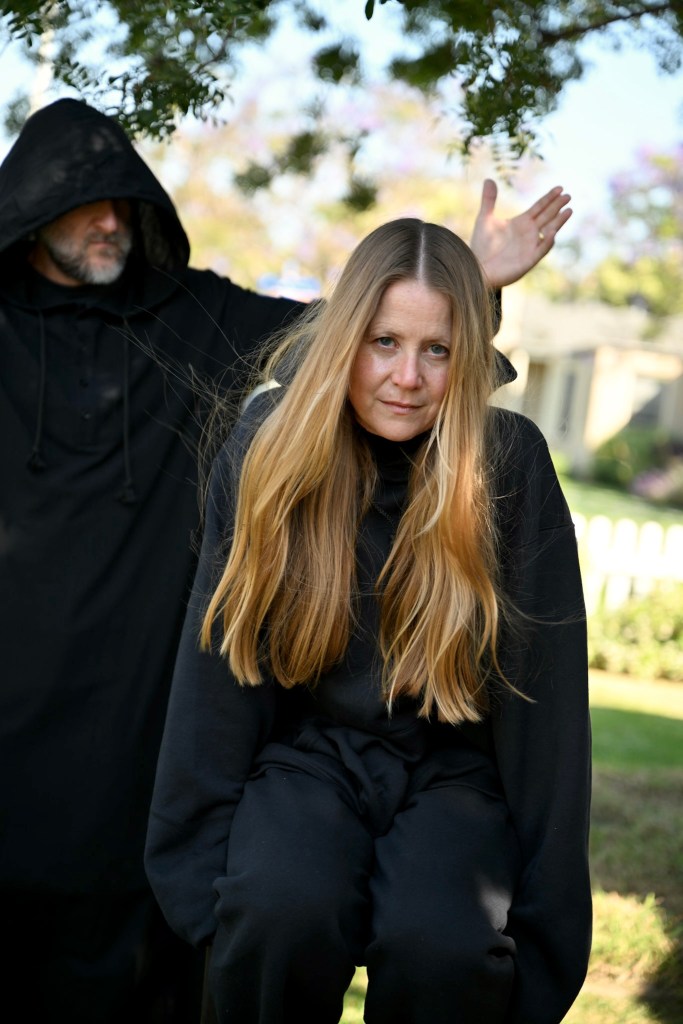
JJ: I knew I had to wear all black. My first question was, how do I, as a woman, disappear in this world? And the answer is I put on a hoodie. I hide my long hair under a hoodie, and then suddenly I become the predator. While living in New York this was revelatory. In fact, many times late at night, if I have my hoodie on for protection, I’ll have to call out to another woman on the street when I see her pace increase, ‘Hey, I’m a girl too! I’m walking to my car! Don’t worry.’ They think I’m a man walking behind them. Sadly, I know this feeling very well.
I chose to wear a custom mask that covers everything except my mouth. Over that I wear a black hoodie and black sweatpants to be shapeless and formless. The play operates on many levels, but one of the levels is the to-be-looked-at-ness of women. Women always exist under the male gaze. Even when I’m trying to disappear, I can’t because something about me simply existing invites me to be the object of someone’s gaze. My baggy clothes help but don’t solve the problem.
I wear socks for both characters. You don’t see my feet in Rockaby or Not I. It was important for me to have the opposite of shoes. When creating a character, I often think about their shoes, and I want their shoes at rehearsal because then I can walk like them. I needed the opposite of that, to feel like I never touch the ground. I was never grounded. I’m floating. And in fact, I feel like I’m floating when I do both plays. Even though I’m not constrained or attached to anything, I feel like I’m free and floating around the theatre.
KW: What I admire about your work on Beckett is that you don’t let the perceived barriers stop you.
JJ: When people talk about Beckett’s plays in a certain way, it puts the texts in a glass bubble that makes them inaccessible for others. I understand the impulse as an artist: ‘I’m the only one who can do this. I am the chosen interpreter. Or it’s too hard for anyone else so don’t even try.’
When I first mention these plays, people usually name three actors, and they talk about the versions that didn’t work. I’m more like, why aren’t hundreds of women doing these plays? They’re brilliant, beautiful plays that deserve to be free. I feel this way about all of Beckett’s plays and aim to continue this specific work. Free the text!
Katherine Weiss, Associate Dean of the College of Arts and Letters at Cal State LA, has published widely on Beckett and modern theatre. Her publications include Samuel Beckett: History, Memory, Archive (co-edited with Seán Kennedy, 2009), The Plays of Samuel Beckett (2013), Samuel Beckett and Contemporary Art (co-edited with Robert Reginio and David Houston Jones, 2017), and Simply Beckett (2020). She is a member of the Samuel Beckett Society and, most recently, organized the 9th Annual Samuel Beckett Society Conference.
 The Beckett Review
Leave a comment