

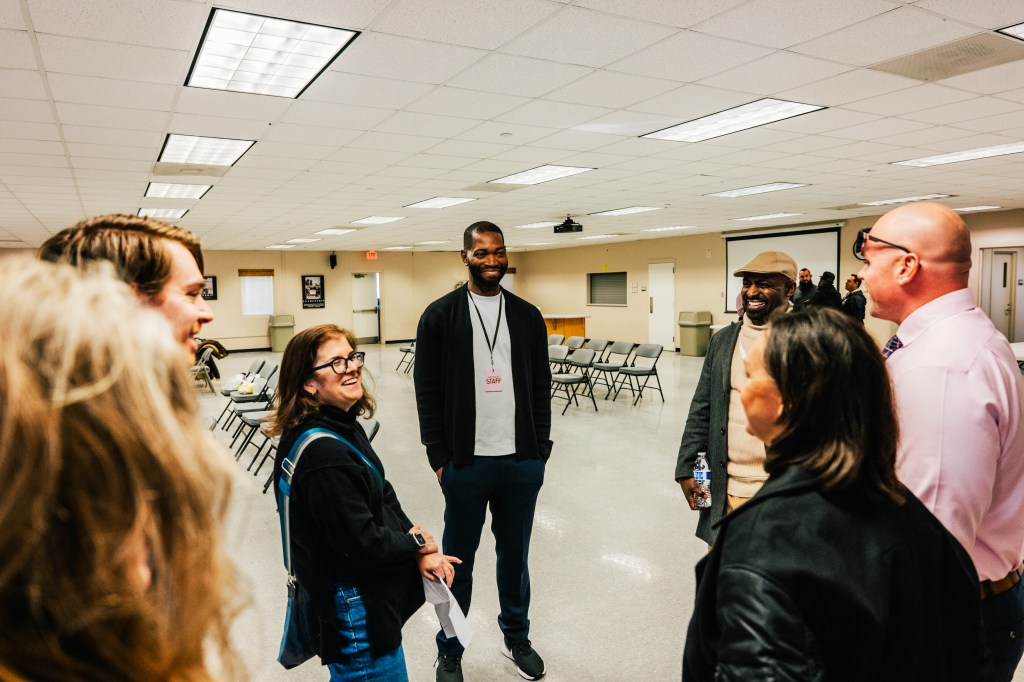
In the darkness of an early December morning, I drove across the vast City of Angels to join the cast, director, and other creatives from the Geffen Playhouse and Gare St. Lazare Ireland’s Waiting for Godot. We would be traveling together to one of California’s largest prisons, the Federal Correctional Institution in Victorville, California. From the affluence of west Los Angeles, we drove just over two hours on a charter bus to the prison complex, consisting of several low standing buildings in a color that mirrors the pale tan hues of the California desert. The actors, Rainn Wilson (Vladimir), Aasif Mandvi (Estragon), Adam Stein (Lucky), and Conor Lovett (Pozzo) were preparing to perform the first act of the play (just before the Boy enters) to the women’s camp at FCI Victorville. This Waiting for Godot, led by the award-winning director Judy Hegarty Lovett, is now part of a long history of Beckett inside California correctional institutions.
As early as 1957, Waiting for Godot has been performed in carceral environments. The San Francisco Actor’s Workshop famously brought their production of Waiting for Godot inside San Quentin Rehabilitation Center (California’s oldest prison). The theatre company’s managing director, Alan Mandell as well as the cast, were deeply moved by the experience of witnessing and performing for roughly 1,400 incarcerated men.[1] The experience, too, was transformative for Rick Cluchey, who was serving time at San Quentin. Cluchey became a founding member of the San Quentin Drama Workshop, and upon being released in 1966 continued acting whilst remaining committed to social justice. More than 60 years later, the cast and crew would vividly recall the experience with documentary filmmaker Jake Adams in The Impossible Itself.
In 1988 Swedish director Jan Jonson was granted permission to direct Godot inside San Quentin with a cast of incarcerated men. Jonson spent months with the men, teaching them the Stanislavsky technique and taking them through the rehearsal process. Spoon Jackson, who was cast as Pozzo, has spoken and written about his experience. He ‘learned to develop trust in the rehearsal process’ (Baker-Nauman and Jackson 285), and went from being an inward, silent poet to an actor and activist. Jonson, also transformed by the experience, has written and performed a one-man show testifying to his admiration for both Beckett and Jackson.
Gare St. Lazare Ireland approached The Geffen Playhouse with the idea of bringing the performance to a prison. The Geffen Playhouse’s new artistic director and founder of Theater as a Lens for Justice, Tarell Alvin McCraney, committed to working with populations impacted by incarceration, supported the idea as it aligned with his own work and mission. His interest in serving this population is personal, as he told the Los Angeles Times: ‘As a young person growing up whose family was affected by the justice system, whose brother was incarcerated, whose mother was in rehab, I didn’t get access to theater’ (Ducassi 2024). And, in the Geffen Playhouse’s playbill for Waiting for Godot, McCraney notes that ‘For many Californians the concept of justice feels deeply out of reach. According to Prison Policy Initiative, nearly 200,000 individuals are incarcerated at any given time in our state with about 35,000 incarcerated people released each year. Those numbers are sobering. They are made worse when we remember that the families connected to those individuals are not counted in those statistics. But their lives too are affected by incarceration’ (5). With a passion for justice and a keen awareness of the transformative power of theatre, McCraney led and inspired the creative team to venture a performance at FCI Victorville.


Despite the rich history of Beckett being performed inside prisons, I do not know of any production in California that has been staged for incarcerated women. That is until Gare St. Lazare Ireland (GSLI) and the Geffen Playhouse, in collaboration with Theater as a Lens for Justice and UCLA’s Prison Education Program, brought Waiting for Godot to the women’s camp at FCI Victorville. The women, all dressed in drab brown prison uniforms, ranged in age, race, ethnicity, and physical ability, watched with an intense presence.
Upon arriving at Victorville, we entered a sparse recreational room used for personnel training. On the walls hung posters that promoted ethical working practices. There was no raised platform to use as the stage and no ‘backstage’ in which an actor can disappear. Before a small playing space designated for the performance sat between 100-120 women and behind them sat and stood about 15 guards and prison officials. Each incarcerated audience member held a clear plastic bag of popcorn which rustled ‘[l]ike leaves’ (Beckett 58), mixing in with the sound of the keys on the guards’ belts knocking against each other. The women were excused from the room for a short while so that the actors could warm up and do their ‘fight call.’ Judy Hegarty Lovett, no stranger to directing Beckett’s work with an eye towards minimalism,[2] saw a portable small dry erase board in the room which she gained permission to use as the tree. The stone, upon which Estragon sits and Lucky stands on, was a simple wooden box.
Whilst the actors were in their full costumes, some changes were dictated by prison regulation. The whip was forbidden. The absence of the prop, however, made the menace of the whip no less real. The Stage Manager told the audience prior to the play’s beginning that Lovett (Pozzo) would mime and sound the crack of the whip. What is more, Lucky’s rope was tied around his waist instead of his neck, another deviance mandated by the correctional facility, at again no loss to the play.
There was real delight and laughter during the performance, particularly at Vladimir and Estragon’s antics. The comic chemistry between Wilson and Mandvi, who until this production of Waiting for Godot had never shared the stage or screen, was present. And, the restrictions placed on us visitors, particularly not being permitted to touch any of the women, not even to shake hands, intensified Vladimir and Estragon’s embrace. The audience recognized the deep friendship between the men with many in agreement when Wilson, during the talkback, said of the two protagonists: ‘They’re like an old married couple.’
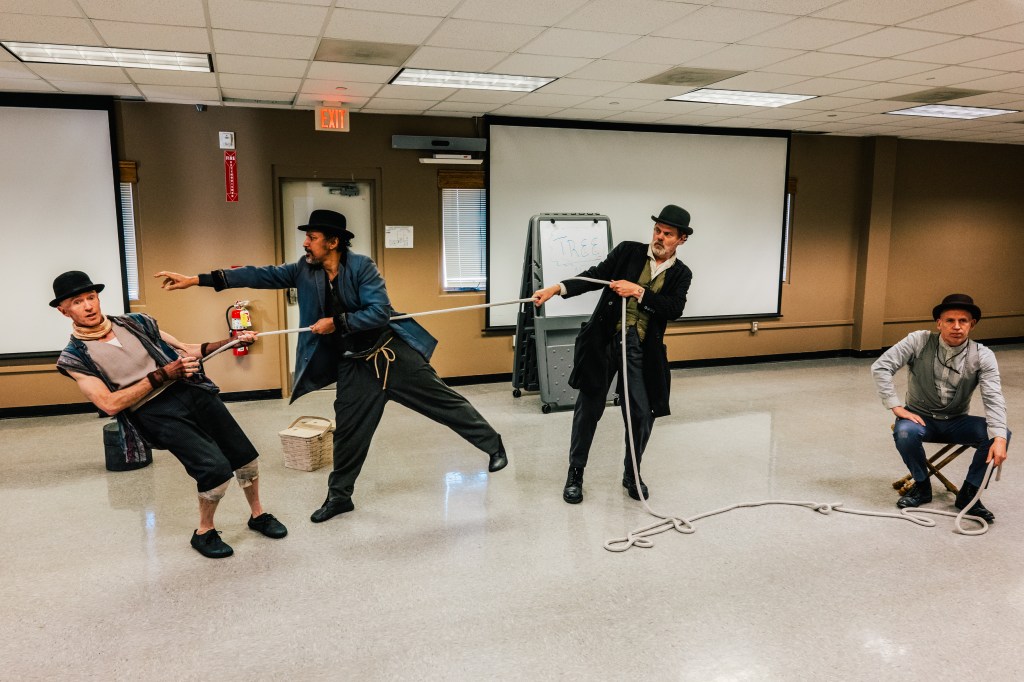
When Pozzo and Lucky entered, the audience’s good humor appeared to diminish, but their attention to the play did not. Still thoroughly engaged, but clearly not finding Pozzo and Lucky as humorous as Vladimir and Estragon, the women looked on in silence and occasional uneasy laughter. I wonder if for them Pozzo was less of an insecure master who needed reassurance and more of a manipulator making us think he is insecure. Did the experiences of the audience and the carceral environment in which the performance took place give Pozzo new meaning? Lovett’s performance with his eerily high pitched laughter was menacing in a way I have not seen Beckett performed.
The most startling difference between the play as performed in a theatre and the play as performed in a prison is that the house lights in a prison must remain on, and, as such, the actors see the audience at all times. Lovett (Pozzo) admitted during the talkback that he was aware of every reaction from the audience; he could see their faces. It is, however, also the lights that brought us together in community, a new awareness that was not broken even after we boarded our bus.
After the performance, Jai Williams, UCLA Prison Education Program Manager, moderated a talkback which allowed the audience to ask questions of the performers, director, and myself. The engagement of the audience surprised the cast and director, for all of whom this was their first performance in a carceral environment. What stood out during the talkback was the interest Lucky held for the audience. They wanted to know about his character and Adam Stein’s brilliantly agile performance. One member of the audience asked why Lucky needs his bags to balance himself after he has fallen. Stein shared that he believes that ‘Lucky does not exist without his burdens.’ Many audience members, women who have had their share of troubles, nodded in agreement.
Interestingly, the audience felt more compelled by the friendship between Vladimir and Estragon and the power dynamics between Pozzo and Lucky than they did about the theme of waiting. It is often assumed that it is the waiting that connects incarcerated individuals with Beckett, but for these women the weight of one’s hardships and power of friendship far exceeded the theme of waiting. One woman poignantly asked, ‘If Godot is not coming, why bother waiting for him.’ And, although the characters do not know that Godot will not come, the women thought that Vladimir and Estragon should realize the futility of waiting after doing so day after day.
The act of sharing Waiting for Godot with the women at FCI Victorville did its small part to break down social and power barriers by providing a space for us to sit, watch, and laugh together. One woman asked if there is a recording of the production which she can share with her family. Her longing to share her experience of watching Waiting for Godot touched me deeply. It reminded me of Hegarty Lovett’s words in the playbill: ‘Waiting for Godot is a truly accessible play. … Somehow and somewhere along the way it was believed to be a play for intellectuals, and that’s a great pity, because it’s a play written for everybody’ (19-20). Theatre, the experience reaffirmed, is communal. It is an experience that is shared with people — all humanity — reminding us that the women at FCI Victorville are not inmates, but rather women with families and communities; they are women who long for friendship and embraces.
Works Cited
Baker-Naumann, Lynn and Spoon Jackson, ‘Gaining Freedom and Healing Through Theatre.’ Into Abolitionist Theatre: A Guidebook for Liberator Theatre-making, ed. Rick’s Eckert. New York: Routledge, 2024. 283-301.
Beckett, Samuel. Waiting for Godot. The Complete Dramatic Works. London: Faber and Faber, 1990. 7-88.
Ducassi, Nickolas. ‘Kendrick, Questlove and Justice: The Geffen’s Tarell Alvin McCraney has Big Dreams for L.A. Theater.’ The Los Angeles Time. 28 August 2024.
Playbill. Geffen Playhouse: Waiting for Godot. November/December 2024.
[1] Alan Mandell’s archives, including photographs and documents commemorating the production, are housed at University of California, Los Angeles.
[2] Hegarty Lovett recalled in the Playbill that they had no budget for props in their first production of Waiting for Godot in 1991.
Katherine Weiss, Associate Dean of the College of Arts and Letters at Cal State LA, has published widely on Beckett and modern theatre. Her publications include Samuel Beckett: History, Memory, Archive (co-edited with Seán Kennedy, 2009), The Plays of Samuel Beckett (2013), Samuel Beckett and Contemporary Art (co-edited with Robert Reginio and David Houston Jones, 2017), and Simply Beckett (2020). She is a member of the Samuel Beckett Society and, most recently, organized the 9th Annual Samuel Beckett Society Conference.
 The Beckett Review
Leave a comment