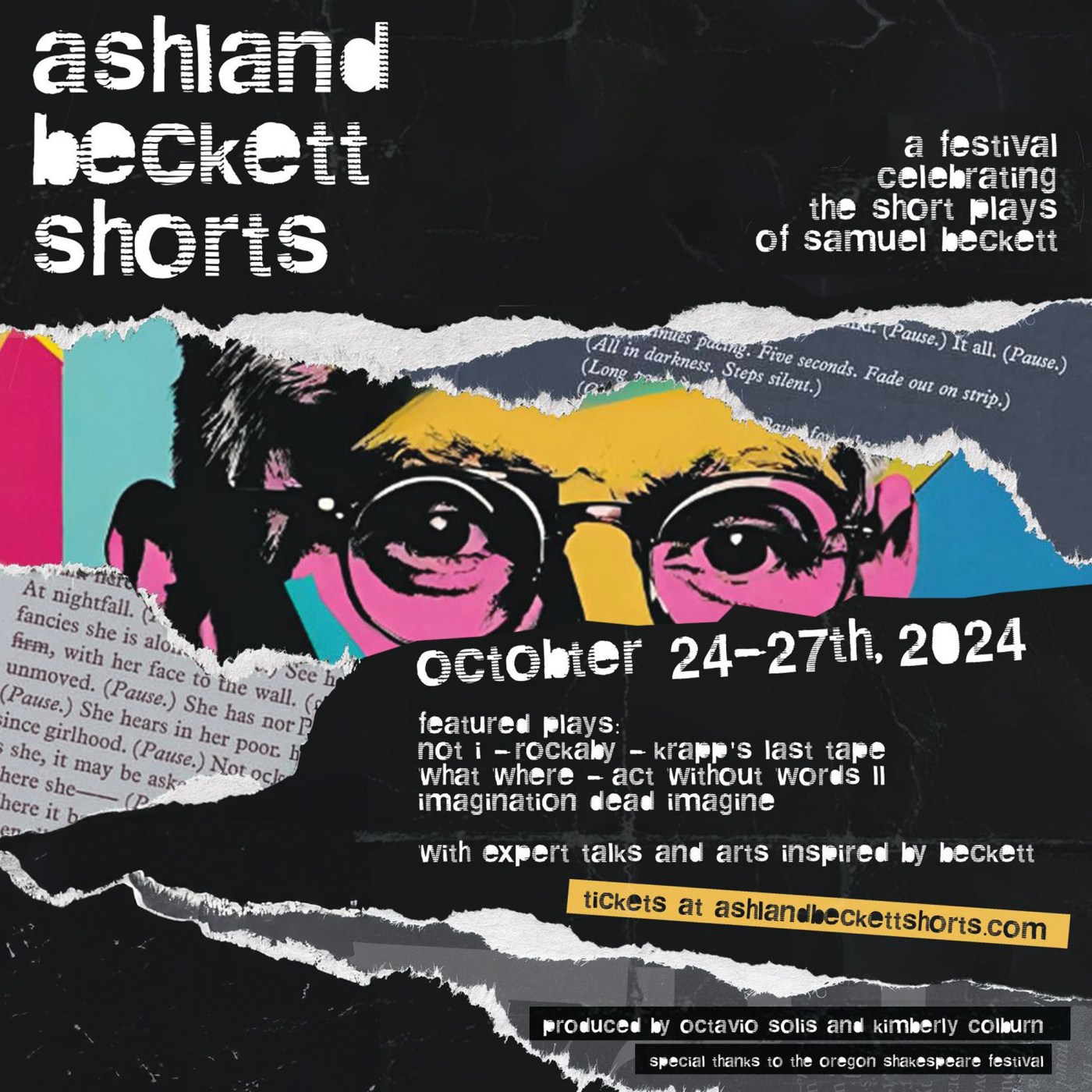
Directed by Octavio Solis
Featuring Amanda Moody (Not I), Dee Maaske (Rockaby), Steven Sapp (Krapp’s Last Tape), Puppeteers for Fears (What Where), James Donlon, Alina Cenal, Angel Villalobos (Act Without Words II), Quartet Nouveau (Imagination Dead Imagine) October 24 to October 27 2024
Review by Geoff Ridden
The writer and director Octavio Solis has a long-held association with the Oregon Shakespeare Festival (OSF) in Ashland, Oregon. Feelings of isolation during the lockdown of 2020 led him, like many others, to revisit Beckett’s works, and inspired him to produce Ashland Beckett Shorts, a festival of six pieces, staged in promenade form, in a variety of non-traditional theatre spaces in and around the OSF campus on four consecutive evenings in late October 2024.
Each evening began with an introduction to an invited audience by Solis himself and by Beckett scholar Katherine Weiss, which set out the origins of the festival, and emphasised the tension in Beckett’s work between quest and containment.
The first theatrical event was a staging of Krapp’s Last Tape, seen by the audience as a whole, after which we were divided into groups to see the next four productions in different sequences before being re-assembled to experience together the final piece, Imagination Dead Imagine. On the evening on which I saw the festival, the audience was smaller than the intended maximum of one hundred and twenty, and we were divided into only two groups rather than the possible four; the whole evening lasted some four hours, including walking time between venues.
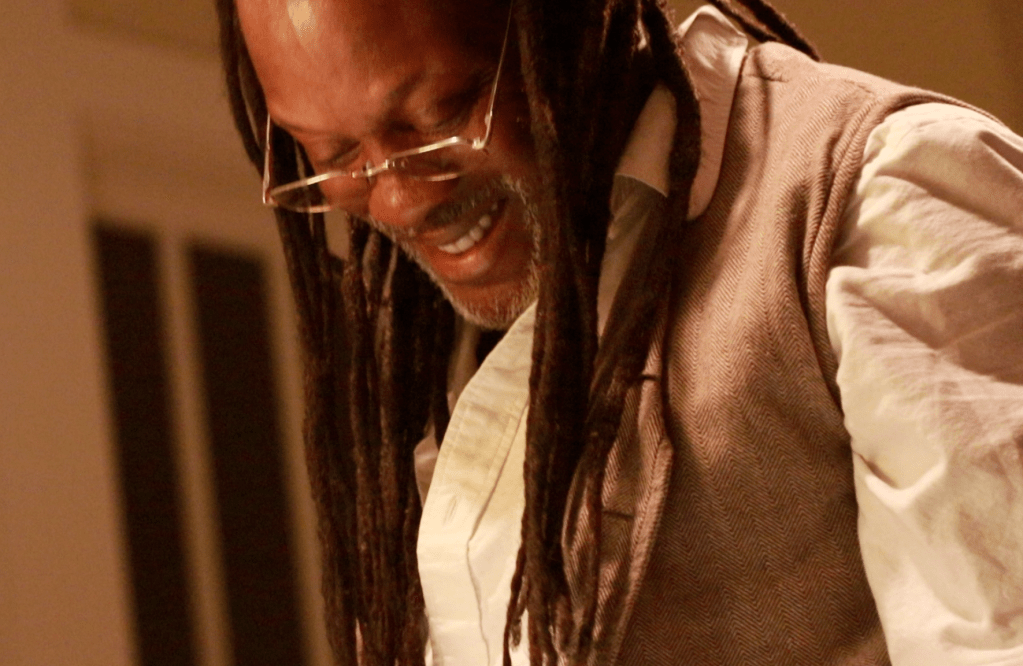
Krapp’s Last Tape was directed by Mildred Ruiz Sapp and performed by Steven Sapp, both members of the New York ensemble, Universes who were at OSF for seven seasons. The actor was already on stage and in action as the audience came in, sampling music on tapes, CDs and radio stations before accessing a recording of his own voice on a laptop. This was clearly an updating of Beckett’s original, which immediately raised the issue of whether this was to be the common practice for the event as a whole.
The introduction had alerted us to the fact that these pieces would not have conventional closures – no bows or curtain calls – and it fell to Octavio Solis to signal the end of this opening short, and to send us off on our different journeys. We were provided with no playbill, and so relied upon the instructions and information given to us on the night, together with what we might have gleaned from the internet.
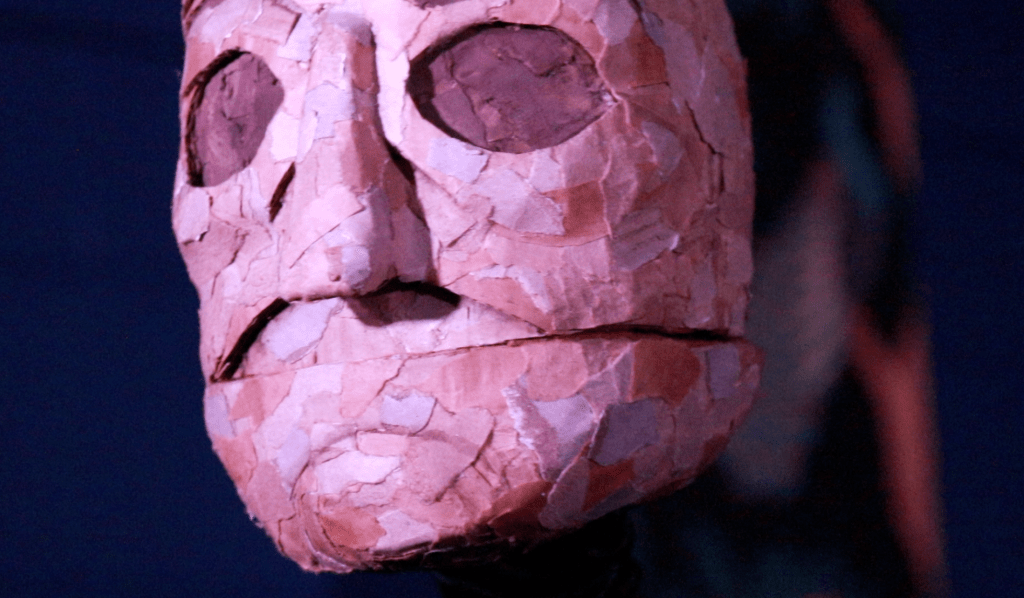
My group was first led across town, braving traffic lights, to the Beat Farm Co+op, a subterranean music space, where the group Puppeteers for Fears presented Beckett’s final dramatic work, the rarely-performed eight-minute piece What Where. This was a performance of considerable menace, all the more threatening by the use of life-sized puppets rather than human actors. The sinister, repetitive dialogue was underscored by drumming which mirrored the beat of the interrogation, and the piece made its point effectively and economically in a minimalist setting: I was strongly reminded of Pinter’s political one-act play, Mountain Language. My only reservation about this performance was that the sightlines were poor, especially for members of the audience not in the front row.
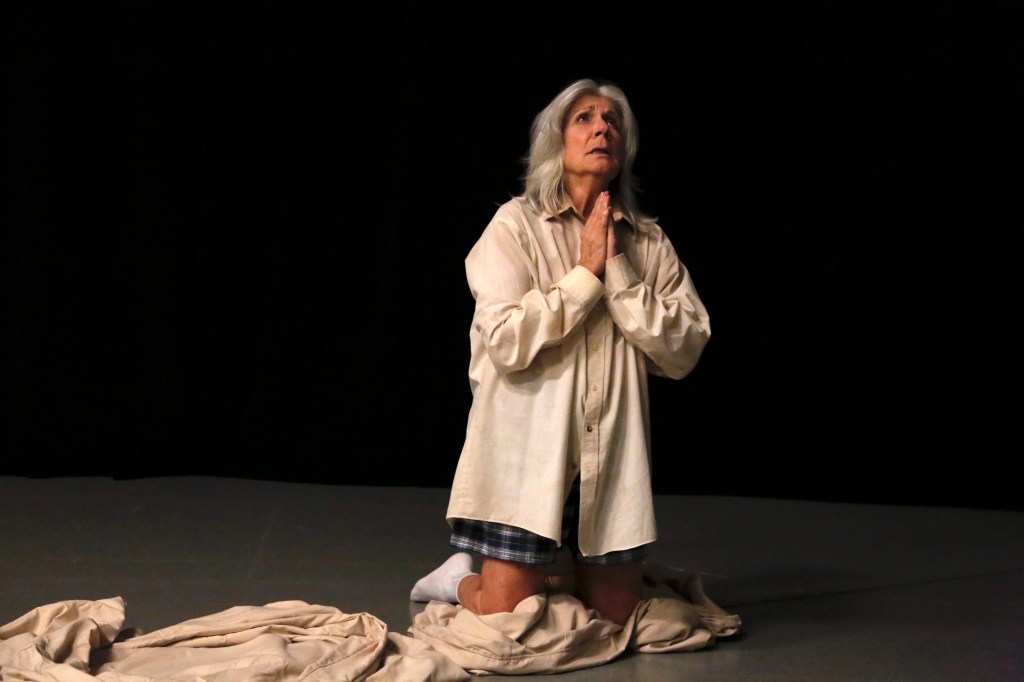
And so we journeyed on, back to the OSF campus and to the only outdoor performance space for this festival to see Not I, which had as its stage the advertising marquee at the side of one of the theatres. This piece, directed by Octavio Solis and performed by Amanda Moody, was very much a re-interpretation of Beckett, rather than a production of his original work. We were presented not with a disembodied mouth, but with a fully corporeal being who moved, lay down and stood up, made gestures and reacted with her whole body. It was impossible, however, not to be impressed by the voice of the actor, her use of the flashlight to focus attention on her mouth, and by her command of the Irish accent – the only one we heard all evening. It was somewhat ironic that the frequent textual references to “the buzzing” were matched by the reality of the street lighting around us.
We were grateful to return indoors to an OSF rehearsal space for Act Without Words II, directed by Jackie Apodaca and performed by Alina Cenal, James Donlon and Angel Villalobos. This mime piece, the earliest of Beckett’s works to be part of this festival, brought welcome humour and laughter to the evening, much to the delight of the audience. But, whereas the original version of the piece has two men as its central figures, this production had a woman and a man, which subtly changed the dynamic. However, there was a suggestion in this production, as in the original, that the two figures might actually be moving across the stage, away from the prodding of the goad (in this case, a goad which did not require the support of wheels to help it). And finally, although the piece might have ended with a simple blackout, we had to be told that the work had come to its end, as one performer started on her daily routine once more: travelling yet eternally trapped.
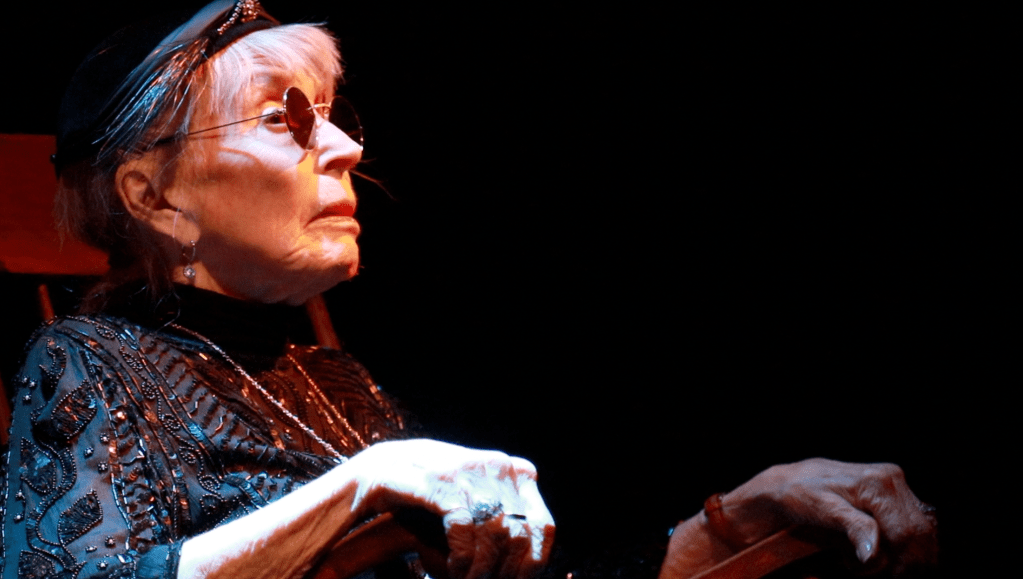
Then we moved to a different rehearsal space, for Rockaby, directed by Octavio Solis and performed by Dee Maaske, who was an OSF company member for twenty-one seasons. This time, the seating had been arranged thoughtfully so that everyone had a clear view of the actor, who, in her dark glasses and beret, bore a striking resemblance to recent photos of Joni Mitchell. My only cavil with this moving piece, for which Dee Maaske took a well-deserved bow, was that the pronunciation of the repeated “More”, because it was said in a US rather than an Irish accent, did not allow the possibility of a pun on “maw” or “Ma”.

And so we reconvened in the New Place, until recently the site of OSF’s Gift Shop, for the final event of this festival. The composer Michael Roth sought and obtained Beckett’s permission to write a setting of the 1965 prose piece Imagination Dead Imagine for voices and string quartet. The work had its premiere in 2017, and those original musicians, the Quartet Nouveau, closed the Ashland Beckett Shorts each night of the festival. This proved a challenging piece, some thirty minutes in length, especially so at the end of a long evening. Whilst the recordings of the voices, fragmented and repetitive, took us back to the performance of Krapp’s Last Tape several hours before, it might have been preferable to have had this musical offering as a separate event.
At the time of writing, it is not clear whether there will be a future festival of this kind in Ashland. I would hope that there would be, and that the success of the 2024 festival will generate interest and attract a wider audience. If the next festival could be staged at a different time of year, that might help: the organisers were fortunate that the rain on the final day abated before the evening. The length of the OSF season might make it difficult to have a festival like this on their campus in September, but there are other possible venues in town, and this event has clearly demonstrated that Beckett’s short works can be produced with minimal staging, and may be all the better for that.
Geoff Ridden taught in universities in England, West Africa and the USA for over forty years. As an actor, his roles included Estragon in a 2020 production of Waiting for Godot. From 2008 to 2022 he reviewed the productions of the Oregon Shakespeare Company.
 The Beckett Review
Leave a comment