
Directed by Victor Sobchak
Featuring Catharine Humphrys (Winnie) and Chris Diacopoulos (Willie)
11 December 2024
Review by Stiene Thillmann
Even though I would call myself a well-travelled London theatregoer, I’d never been to East London’s Arcola Theatre. Based in an old paint factory just off Kingsland Road, Dalston’s main artery, the Arcola is a charming theatre with exposed brick walls and toilets that look like what I picture when I think of a space toilet. (They’re actually sustainable two-in-one units in which the basin doubles as the toilet cistern – an environmentalist’s dream, a plumber’s nightmare?). Theatre Collection London’s production of Samuel Beckett’s Happy Days, with direction, sound and lighting design by Victor Sobchak, takes place in Studio 2, the smaller sibling of the main performance space.
The audience enters the theatre from stage left and crosses the stage to get to their seats, which offers a good look at the mound, created by A-Level student Freya Mallia. This production’s mound is meant to resemble a landfill – the design isn’t quite akin to Beckett’s instruction of “maximum of simplicity and symmetry”, but it draws the eye in and works well in the intimate space of Studio 2. The mound is almost entirely made up of cardboard and other repurposed recyclables, giving us an endearing glance into the habits and preferences of Freya’s household. My favourite elements included: the wrapper of a “rich & creamy” Saint Agur blue cheese, a Sainsbury’s Classic Panettone box, and a gift tag which said “Hey love, this is just a little something for you. Love you, Katie.” I wonder what Katie gave Freya and hope it was something more exciting than the empty packet of Strepsils the tag was stuck to.
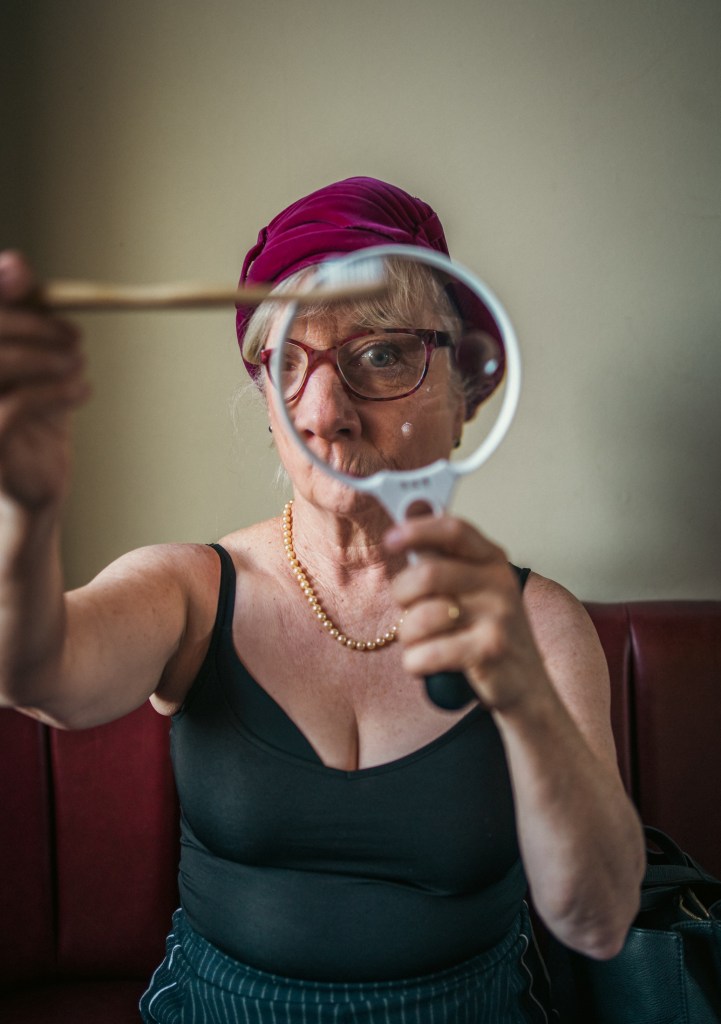
Winnie and Willie, played by Catharine Humphrys and Chris Diacopoulos, are in position in and next to the mound. Humphrys, who is also listed as co-producer, set designer, poster image designer and press contact, plays Winnie beautifully – with fervour, heart and a complex understanding of the bewildering situation her character finds herself in. Sobchak’s Happy Days shines when Winnie reminisces on her days of yore: she closes her eyes, the lights go a soft, warm yellow, and gentle, bright music swells, evoking her nostalgia for a world bursting with life, “[t]he tangles of bast” and “[t]he shadows deepening among the rafters”. These images are conjured as easily as they’re taken away: when Winnie snaps out of it, the “blazing light” of a destructive sun and silence of a lifeless landscape return, and we’re hurled right back with her.
Sound contributes to this production’s strengths, but it’s also what makes it lose its focus and momentum. Where subtle music first seemed to appear only during moments of reminiscence, bursts of jazzy piano and other whimsical tunes kept intruding on the silence that gives Winnie’s compulsive words their depth and meaning. I’ve only ever seen one production of a Beckett play which doesn’t fully stick to the text and stage directions (Touretteshero’s Not I), and while I don’t advocate for interpretative rigidity or any type of restriction when producing Beckett’s work, it can be quite discombobulating to watch a production when you don’t know it’s going to stray from the text. When I watched Willie get up and sing “The working class can kiss my arse, I’ve got the PM’s job at last” to the tune of “O Tannenbaum”, I remember thinking “hmm, I don’t recall that part.” (Google tells me this is a modification of a rugby song called “The Foreman’s Job”, which is itself a parody of the socialist song “The Red Flag”.)
Willie gains prominence in this production and Diacopoulos is happy to make him bigger. He plays Willie as a “proper English bloke” and a rugby-loving veteran (he dons a military jacket and beret near the end). This provides the character with a – not unwelcome – touch of backstory that isn’t related to Winnie and is all his own. Sobchak gives him some of Winnie’s lines in the second act, which he performs to the audience, spotlit. In two asides, he relays the questions asked by Mr and Mrs Shower or Cooker, presenting the audience’s own thoughts back to them: “why doesn’t he dig her out?” and “does she have legs?”. This production’s Willie is bigger, but only for the audience, not for Winnie, who sits in blackout during Willie’s moments in the spotlight. It adds a dimension of cruelty: Willie possesses a rich interior world which Winnie isn’t privy to or aware of. I would normally see Winnie and Willie as united in their helplessness, but Sobchak’s Happy Days makes him seem villainous at times.

When the lights dimmed after the second act, my friend and I looked at each other, slightly confused, slowly starting to join the rest of an equally confused audience in applause as the lights came on again and Diacopoulos started to help Humphrys out from under the mound. With a billed running time of c.100 minutes, the show we’d just watched had clocked in at around 60. I read through some of the text later on, trying to figure out what was left out. I decided that it didn’t matter – this production was definitively and comfortably its own thing.
I came out of this show confused and critical, making hurried notes about song lyrics and costume choices during my final visit to the space toilets. Although some of the technical design elements hold this production back, Sobchak’s Happy Days has grown on me. The mound, along with the costumes, textual changes and musical additions come together to create a subtly contemporary and very English version of the play – directed by a Russian and here reviewed by a Belgian. Winnie always relentlessly keeps up appearances, but specific notions of class and social mobility (or possibly social climbing) add an interesting dimension to this interpretation, recalling the themes and characters of the sitcom Keeping Up Appearances. The real test here is whether Winnie would pronounce Samuel Beckett as Samuel Becqet – but I guess that’s something we’ll never know.
Stiene Thillmann holds a master’s degree in Modern Literature from Goldsmiths, University of London. Her dissertation focused on the use and behaviour of sound and silence in Samuel Beckett’s Endgame and the matter of noise during live theatre performance and intermedial adaptation. She works in the Development department at RADA and continues to pursue her research interests as an independent scholar.
 The Beckett Review
Leave a comment