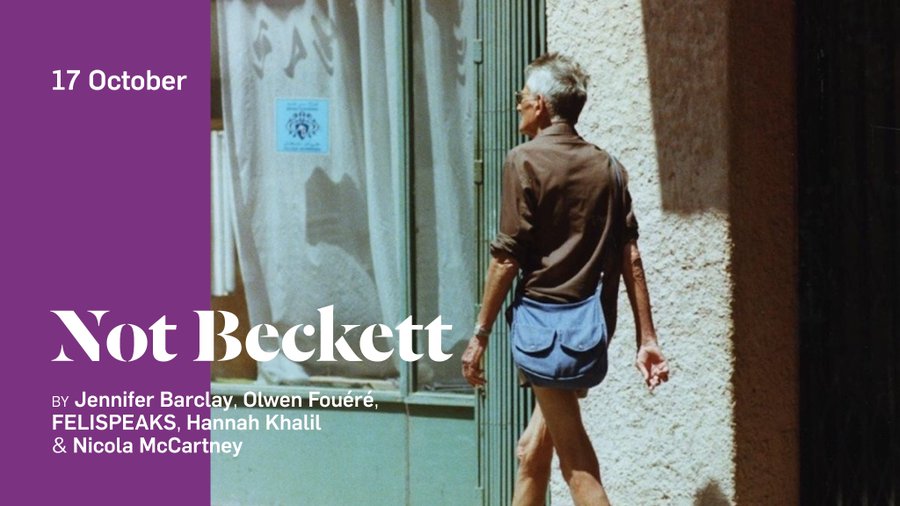
Duet by Olwen Fouéré, Never Apologize by Jennifer Barclay, Wait by FELISPEAKS, I Can’t Remember by Nicola McCartney, and The Lighthouse Keeper’s Son by Hannah Khalil
Thursday 17 October 2024
Review by Jonathan McAllister
I left early but arrived late. I thought I knew where I was going. But I had walked past the door and on. Now I was at the wrong end of Jermyn Street. I walked back towards the Piccadilly rush. A huddle of Beckett scholars told me I’d arrived. Don’t misunderstand me: I’d been here before, to see Beckett no less. But—squeezed between a restaurant and a suit shop—it’s easy to miss. The studio used to be a staff changing room; before that, a tavern cellar. Now I was here to see Not Beckett. The editor said it was the London premiere: a collection of five short plays, written by femme-identifying and non-binary playwrights of Irish descent. They are, I was told, inspired by Beckett. I knew little else besides. But the little theatre struck me as apt for the occasion. In both his writing and direction, Beckett had been drawn to small spaces. I thought of All Strange Away and Imagination Dead Imagine, of the Théâtre de Babylone and the Schiller-Theater Werkstatt. In this subterranean space, I had seen Niall Buggy and James Hayes, heard Siân Phillips and Lisa Dwan. They had been the clumsy Gorman, the wearish Krapp, the prematurely old Woman, and a hypnotic, strangling voice. A friend, I think, told me the plays were ghosted by Beckett. That’s what he said, ghosted. I wondered what that meant.

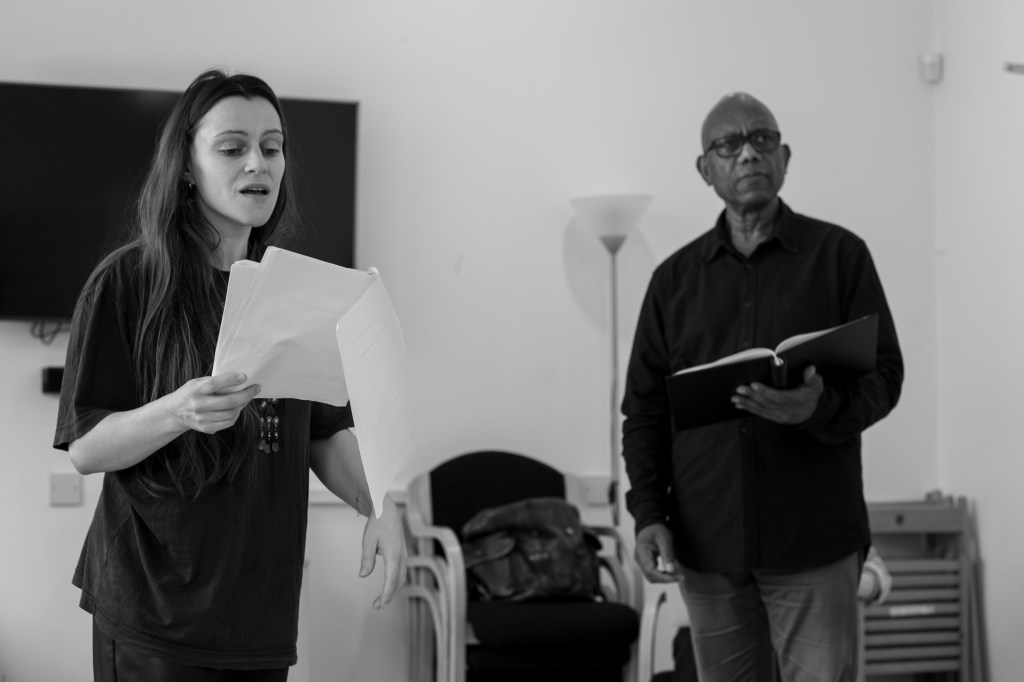
It began with two actors, A and B—a dialogue, Duet, by Olwen Fouéré. They are suspended in time and space, both on and not on a boat. Their words cannot quite grasp their situation: ‘This… This. All this…’ They seek refuge, dream of the Samphire coast, but find only bones and ghosts. The duo dance; they hear music. It drifts away, and they can no longer sing. The sea is calm on its surface, but this is the Mediterranean. ‘They say it’s a human soup’. It’s an unexpected, tragic shift in tone. The boat, the boredom, the blue was leading to… to this, ‘All this…Trailing ghosts’. They inhale; then exhale to the end of their breath. The play is richly textured with allusions to Beckett, both textual and structural. I think specifically of ‘that sad and comic dramatic structure Beckett called the pseudo-couple’. They exist one for the other, a fragile co-dependency of weakened subjectivities. They speak to the tragedy of the refugee crisis, the lack of political will that leaves thousands dead in the sea. I hear Vladimir: ‘Was I sleeping, while the others suffered?’. The play, I find, engages with a Beckettian politics by speaking to rather than for the suffering. Yet, by naming the Mediterranean, it remains context-bound, insists on the urgency of the current crisis.
A blackout. Then three actors form a triangle—one standing, one limping, one sitting. This is Never Apologize, by Jennifer Barclay. The actors wear sports bibs; they dribble a basketball. Their speech is taut, breathy, and rapid; they sway, motion, and bob. ‘The rhythm of the ball was my rhythm’, says #2. Each player struggles with athletic anxieties: about their abilities, their bodies, their ages. The triangle rotates—each player has their moment, speaks to the exhilaration and exhaustion of their game. It is Come and Go on the court, except each character’s pain, angst, and injury are spoken aloud. But ‘I cannot not play’. I’m reminded of Beckett’s direction: ‘In your moving you must give the impression that you are trying to walk but can’t’. I cannot not go on. The play speaks to this negative, compulsive energy of Beckettian movement: the need to play when play is, or nearly is, over. The frenetic and constant dipping, rocking, and shifting of the actors convey the need for endurance in play, for going beyond, or, rather, up to, a limit. Steven Connor: ‘Beckett’s works are concerned with and generated from ordeal, test, trial, striving and struggle’. What this play responds to in Beckett is an aspect often overlooked in critical responses to his work: the athletic, sporting tenor of the stage plays. I think of the exertion and tenacity of Billie Whitelaw, Jean Martin, and Deryk Mendel. They would understand: ‘My body knows what to do’.
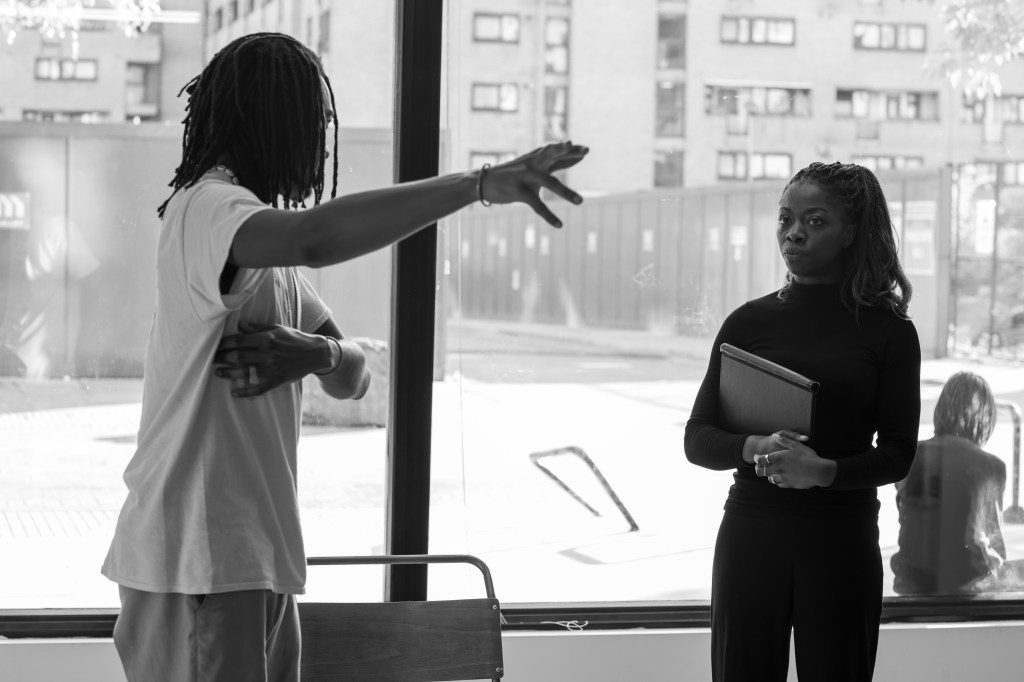
A table is placed (stage right). A Black woman, Comfort, stands alone (stage left). She is lit by a single spot. This is a monologue, Wait, by FELISPEAKS. Comfort speaks directly to the audience but is speaking to her husband. He is about to board a plane from Nigeria to the UK. It is a play about migration: the hopes and promises, the disruptions and traumas of a migrant woman. We witness her aspire to a better future for her family, negotiate life with children in an immigration centre, and reject her duplicitous husband for a new start. I think of Happy Days: the monologue of a vulnerable yet defiant woman who refuses to relinquish to suffering and deceit her desire, however tenuous, to go on. The immigration holding centre brings to mind the confined, claustrophobic spaces and interrogative authority figures of Beckett’s prose and stage work. But a more pertinent reference point are those women in Beckett—Mouth (Not I), May (Footfalls), and Voice (Eh Joe)—who ask to be witnessed as they tell their stories of trauma, lost lives, and betrayal in a language or space that resists them. FELISPEAKS: ‘What is more absurd than entering spaces that aren’t designed to understand or accommodate you or your stories?’. Wait ends, nonetheless, on an emphatically bold and affirmative tone: ‘I CAN DREAM. WITHOUT YOU’.
Three women walk onto the stage. They are looking for an important, though now lost, object, but don’t remember, or were never told, where or how to find it—I Can’t Remember The, by Nicola McCartney. ‘They didn’t prepare us for this. Any of it.’ The search holds memories of childhood, and the lost object the promise of an unknown future. But their familial closeness and shared pasts lead to tense arguments over how to proceed, and conflicts over the veracity of memories. Indeed, one woman doubts the reality of the lost object entirely: ‘I’ve been convinced for some time that it probably isn’t even here’. The three players have no script for searching, and they keep going over ground already covered. One suggests they try dividing the space into squares, like a grid: ‘#1 begins to pace the space, dividing it into sections. #3 follows’. Inevitably, the exasperating and hopeless scenario leads to violent outbursts, with one player punching another to the floor; unable to bear the futility of their situation any longer, one woman throws herself at a door and falls unconscious. Just at that moment, the other two find what they were looking for: a key. As they place it in the locked door, the lights fail. I am reminded, particularly, of Beckett’s mimes: the frustrations of Act without words I, the failed systematisation of ‘J. M. Mime’, the square playing space of Quad, the keys and locked doors of ‘Mongrel Mime’. In their searching, the players point, bend, pace, and breathe; they mime sorting through boxes, feeling the rain on their hand, and holding aloft the found object.
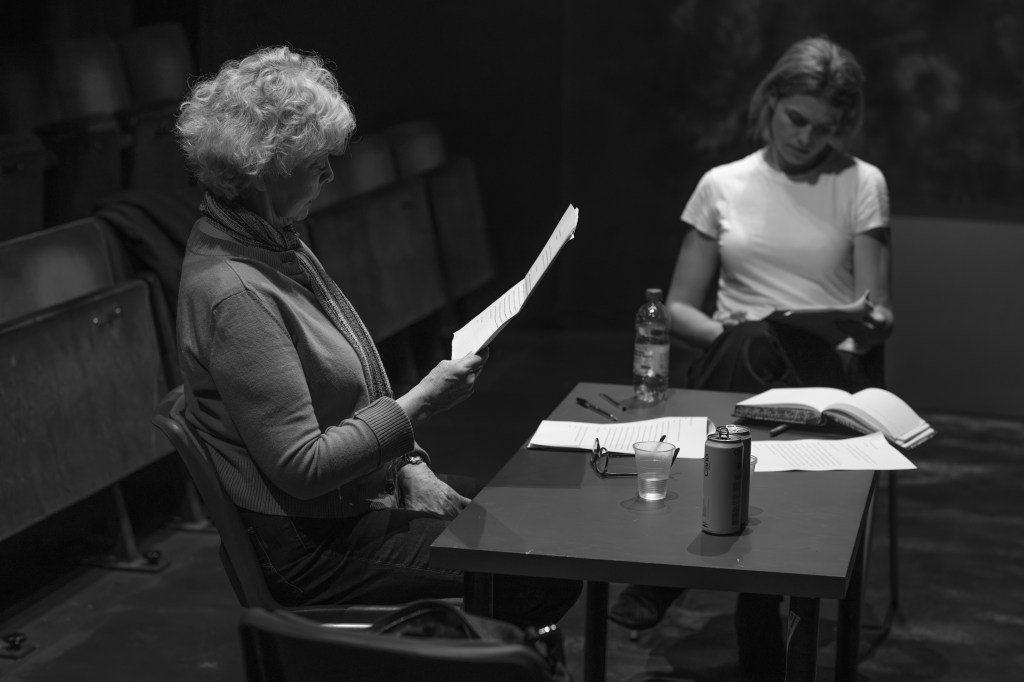
A chair and a bed are placed on stage. In the chair sits a woman; the bed remains empty. This is the monologue of a lone woman—The Lighthouse Keeper’s Son, by Hannah Khalil. The short passage of Beckett’s The Calmative, from which the play takes its title, refers to a story told by the protagonist’s father. But this woman instead speaks of a mother—‘Yes mother. I said mother’. Her story explores the relationship between a rebellious son who ‘rejected his mother tongue’ and the single mother who raised him. The boy forms interspecies relations with the gulls, the seals, and the fish, refusing the ways of his mother. He becomes obsessed with a dream of his father drowning in a shipwreck; one day he sees the boat, swims out to rescue his father, and drowns in the waves. ‘I know that’s not how it ends. But I’m saying it’, Mother insists. The monologue is brisk, poetic, and recursive, reminiscent of the storytelling of Winnie in Happy Days (‘There is my story of course, when all else fails’) and Nagg in Endgame (‘Will I tell you the story of the tailor?’). Seated in her chair, Mother looks to me like the woman in Rockaby, except she is no longer the child: she is telling the story. I can see her speaking, there. ‘I’m telling it. I don’t want a dead woman. I want a dead man’. The monologue plays with ideas of motherhood, language, storytelling, and family from a distinctly feminine perspective, offering a counterpoint to what we find in the Beckett novella.
I took the tube from Piccadilly Circus to King’s Cross. I thought about the review I would write, the question I would ask of these plays: how do they respond to, and go beyond, Beckett? I had heard the inflections, rhythms, and syntax of Beckett’s prose insinuate themselves into the monologues and dialogues; I had seen the minimalism, physicality, and resonance of Beckett’s images inscribe themselves into the spaces and bodies. The plays were, I felt, distinctly related to Beckett; but they looked aslant at the oeuvre, looked back with a peculiar eye. Each play found a way of responding to Beckett that brought out, and reimagined, something already at play. By responding dramatically, Not Beckett managed to speak to Beckett in his own language, to reveal a simultaneously familiar and unfamiliar slant. They showed me, partially, what I thought I already knew but had not yet seen. Something that still waits to be seen—sometime, somewhere.
Jonny McAllister was awarded a PhD in English Studies at the University of Cambridge in 2024. His research focuses on twentieth-century theatre and performance, with a particular interest in the politics, aesthetics, and philosophies of the body. He is currently writing his first book, Beckett, Performance and the Miming Body in Theatre, Film, and Television, for the ‘Other Becketts’ series published by Edinburgh University Press. He has contributed theatre and book reviews to the Journal of Beckett Studies, The Theatre Review, and British Association of Modernist Studies.
 The Beckett Review
Leave a comment