Directed by Ciarán O’Reilly
Featuring F. Murray Abraham (Krapp’s Last Tape), Roger Dominic Casey, Kate Forbes, Sarah Street (Play), Sarah Street (Not I)
Saturday 25 January 2025
Review by Michael Coffey
The Irish Repertory Theatre, the cozy house on 22nd Street in Manhattan, is just what its name implies: a theatre dedicated to building a repertory of Irish and Irish-American plays. Founded in 1988 by Ciarán O’Reilly and Charlotte Moore, it has of course done a heaping share of Yeats, Lady Gregory, O’Casey, Friel, and, increasingly, Samuel Beckett. With the founders often assuming directorial duties, a signature style has inevitably emerged.1
O’Reilly’s handling of the three Beckett plays—two major works and a knotty middle-period one—were slyly subversive, in this sense that Beckett’s preferences for lighting and pacing were in some instances subverted, however gently and cleverly and, I would argue, in the spirit of accessibility and intelligibility. How this was pulled off is clear in some respects, as I will describe, and a bit of a wondrous mystery in another, pertaining to the evening’s first offering.
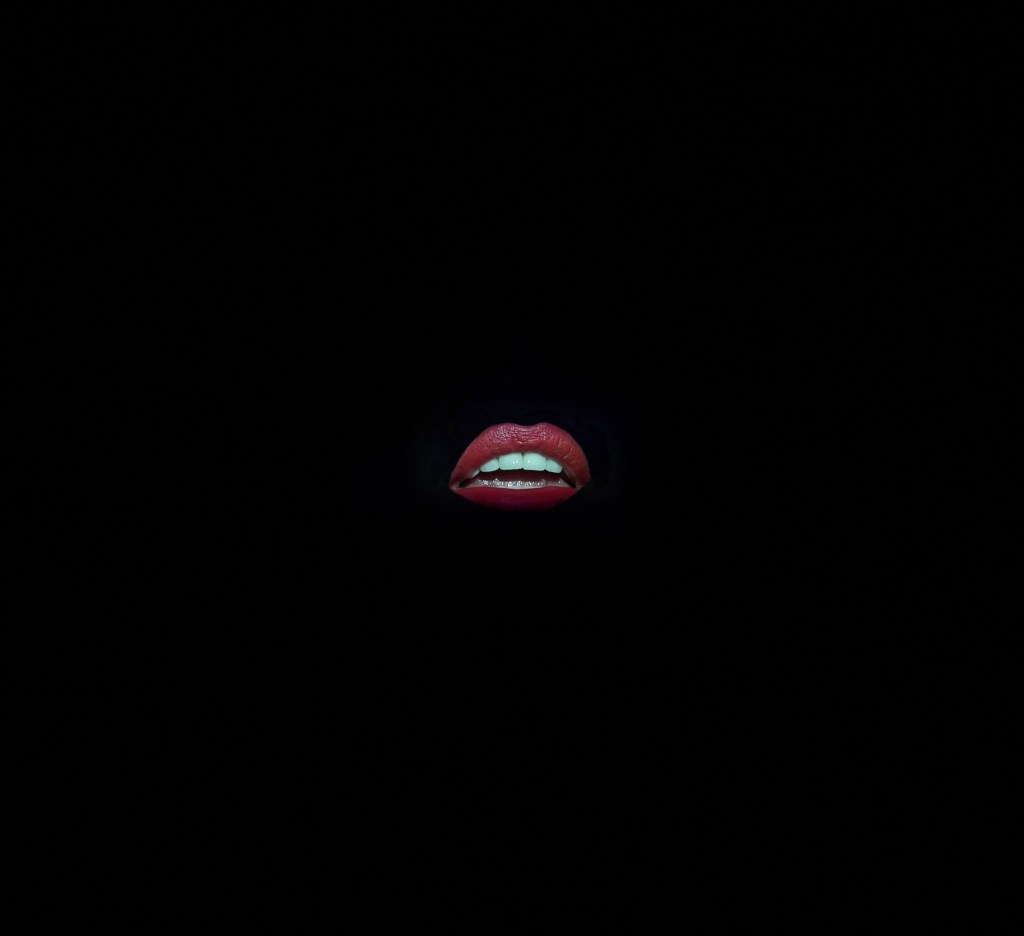
The three plays—collectively called Briefs here—were presented in reverse compositional order. Not I (1973) started the evening. Although this production is among those that omits the Auditor (as of course Beckett accepted he could ‘do without’ given the staging problems it posed),2 to be sure it took place in the requisite complete darkness, all lights extinguished but for the spotlight on lips, teeth, and tongue of Mouth (slightly errant in previews, later corrected). Sarah Street gave a recitation of the notoriously difficult text from high in the dark but with what at first and second viewing appeared to be a slower pace that enhanced intelligibility. Whereas Beckett, as is well known, instructed Jessica Tandy to adopt a frantic pace, to ‘work on the nerves of the audience, not the intellect’, Street and O’Reilly reversed that, and played upon the intellect—perhaps even the heartstrings.3 Or did they? Upon a third viewing, a stopwatch surreptitiously deployed in the dark revealed a 10-and-a-half-minute performance, nearly as quick as Lisa Dwan’s famous 9-minute sprint and considerably faster than Billie Whitelaw’s 14.4 And yet, somehow, the recitation by Street, a Cork City native, settled into clarity, a clear flow of language evincing her terror at referring to herself in the first person (indeed, not a single ‘I’ is in the text), her disassociated third-person ‘She!’ dramatically punctuated five times with a chilling echo (sound design by Ryan Rumery). Speed plus clarity is a neat trick, so neat in fact, that I suspected that some text had been omitted, but the theater’s production reports assured me that no such thing had happened. Street’s tone throughout was not agitated, but rather often poised, composed, nearly conversational. In such fashion Mouth’s story gets told, a tale of breaking out into voice after years of speechlessness, decades of silence and suffering, owing to what seems to have been abandonment at birth, an orphaned childhood raised with ‘other waifs’, ‘no love of any kind’. Hearing Mouth’s account as a story in whole rather than splintered into incomprehension seems a welcome development. As the curtain began its descent, birdsong was mentioned: ‘April morning … face in the grass … nothing but the larks’. This was nice to hear.
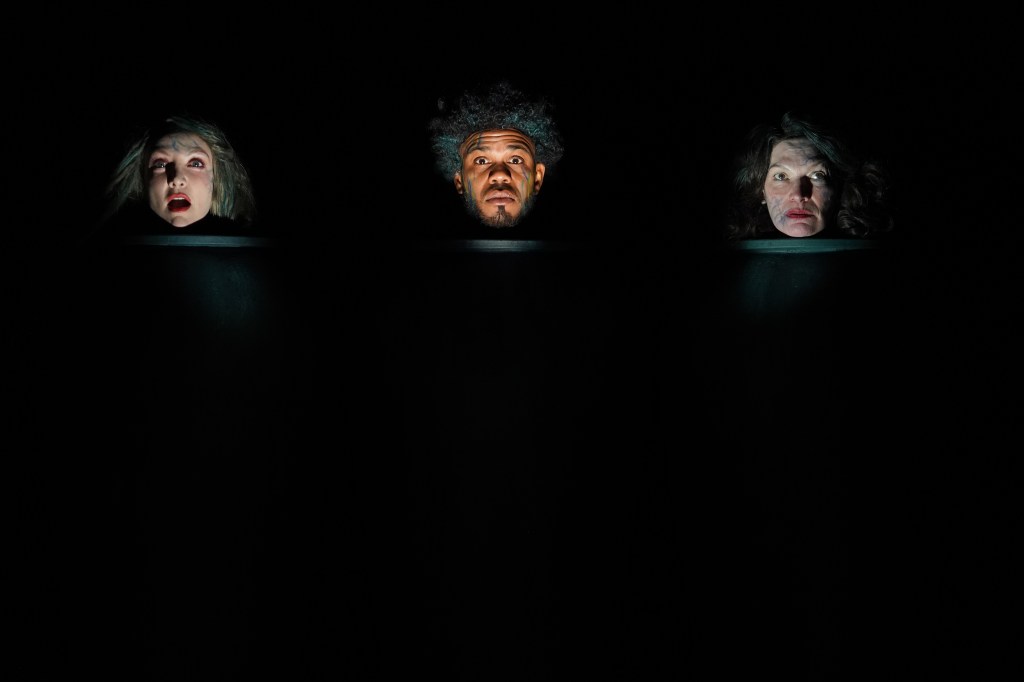
Play, from 1963, featuring two women and a man, each in neck-high urns, three abreast, is a Beckett work less well known and an anomaly in an admittedly diverse canon, for it is now considered the rare work that stages something deeply rooted in Beckett’s personal life, a love-triangle drama involving Beckett, the esteemed translator Barbara Bray, and Beckett’s wife, Suzanne Déchevaux-Dumesnil.5 Whatever this suggests about Beckett’s authorial intentions, private or public, we have but the raw stage directions and the text to go on: ‘… touching one another, three identical grey urns about one yard high. From each a head protrudes, the neck held within the urn’s mouth…. Faces so lost to age and aspect as to seem almost part of the urns‘. The three actors speak as a choir and then singly only when a kind of interrogator’s spotlight is full upon him or her, and go silent when not. The spotlight controls the order and pace of the dialogue: ‘Faces impassive…. Voices toneless…. Rapid tempo throughout‘.
However, under O’Reilly’s hand, the faces are not ‘lost to age and aspect’, nor barely discernible from their urns; they are not grayed with chalk as, for example, in Anthony Minghella’s purgatorial Play in the RTÉ/Channel 4 Beckett on Film series. Rather, Sarah Street, here as Woman 2, Roger Dominic Casey as Man, and Kate Forbes as Woman 1, exist in a kind of murk till one or the other is in full klieg glare, and their faces are readable as alive, with bluish-gray lines lightly marking their features, as perhaps in a children’s play (lighting design by Michael Gottlieb). And, as with Not I, the pace of Play was intelligible, counter to some of Beckett’s expressed wishes.6 As a result, the outlines of the argument about romantic loyalties become clear—no one is happy, the man least, the women in league against him. ‘Am I as much as being seen?’ he laments toward the very end, seeming abandoned… and self-pitying. The accessibility of the performances is heightened at the second listen, Beckett’s audacious da capo, the first half of the play being repeated more or less word for word. By then, one feels closer to the characters, the actors, and the text. O’Reilly’s Play is warm rather than alienating.

F. Murray Abraham’s Krapp in Krapp’s Last Tape (1958) was the main dish here. Now 85, Abraham, who played Pozzo in the 1998 Mike Nichols–directed Waiting for Godot, opposite Robin Williams, Steve Martin, and Bill Irwin, has worked steadily for 60 years on Broadway and in film, winning an Oscar for this role as Salieri in Miloš Forman’s Amadeus. Jonathan Kalb, author of the foundational Beckett in Performance, wrote on his Theater Matters blog that Abraham was ‘truly born to play this role’.7 Hard to argue with that, as the actor in this masterpiece seemed less tormented than is often the case (think the misery of Patrick McGee or John Hurt’s anguished performance). Rather than being steadily tormented by loss and audio evidence of a youthful idealism, Abraham’s Krapp revels in the stories of his younger self: ‘The voice! Jesus! And the aspirations. [Brief laugh in which Krapp joins.]’– and joins heartily, I might add. In this instance, the aforementioned Irish Rep touch is in full harmony with the changes Beckett himself brought to the production, granting light and access to the stage, the surround beyond Krapp’s desk not ‘in darkness’ as Beckett originally called for but rather with the light he added in his Schiller Theater-Werkstatt production;8 here you see a well-lighted, shabby bookcase behind Krapp, not dwarfing him, bursting with folders, loose papers, and boxes. Krapp does not go backstage ‘into darkness. Ten seconds. Loud pop of cork’ etc., but rather repairs to a visible closet space upstage left, as in the Schiller production, with liquor bottles from which he drinks directly, and later, even a rocks glass to facilitate the last seen of many guzzles. Nothing hidden.
Abraham inhabits the small den on the Irish Rep’s small stage like a colossus, dressed as Beckett intended, but for the “surprising” dirty white shoes (here they are merely brown). The business with the bananas is by the book, with a particularly elegant touch of the erotic that Beckett may have considered was a bit ‘fatuous’,9 but Abraham played it for all it was worth even adding an audible yelp when slipping on his own banana peel. The audience was with Krapp in his evident enjoyment of the banana and Abraham’s schtick. This Krapp does not have quite the ‘wearish’ quality Beckett calls for but something more of vigor and strength. He kicks things out of the way rather than stumbling or staggering. And his affection for the tape deck evinces an arguable tenderness for his former self. Krapp’s ‘Be again, be again’ lands with force and survives the bitter self-rebuke that follows—’Once was not enough for you’.
There were a few other touches that tied the three plays together in those ways that are testament to the deep imagery that Beckett employs. These three works are seldom (if ever?) seen together. One notices, for example, that Mouth and Krapp are the nearly same age (“coming up to seventy,” says Mouth); the cowslips she wishes to make into a ball echo the black ball Krapp had been tossing to a small white dog while awaiting his mother’s death near the canal. Krapp recalls, in the most moving passages, the punt on the upper lake with a woman, while the Man in Play recalls a ‘dinghy’ with similar affection and faded promise. And of course all three plays are about love as an experience coldly foreclosed. Perhaps there is more to explore in shaping Beckett evenings, where the cross-referencing of Beckett imagery inevitably reveals itself.
Whether such a gentle if slightly subversive treatment of Beckett, erring on the side of intelligibility and light, is a good idea is a matter of taste. Given the full houses at the Rep (and an extended run), it seems that even some of the more difficult works are being made palatable to an audience in an evening less about dark and silence than about being seen and heard.
Michael Coffey, also coming up to 70, lives in New York. His most recent book is Beckett’s Children: A Literary Memoir (which is reviewed here in the Beckett Review -ed).
[1] The style can be described as warm and welcoming, even with the darkest material. For example, a recent Endgame featured a consummately comic and clownish Clov, played by Bill Irwin, and a Nag played by an impish Joe Grifaci. The New York Times review commented on “the room for humanness” Beckett left in the play, which the Irish Rep production filled with “laughter [and] hope.” https://www.nytimes.com/2023/02/02/theater/endgame-review.html, [accessed 27 February 2025].
[2] Quoted in C. J. Ackerley and S. E. Gontarski, The Grove Companion to Samuel Beckett: A Reader’s Guide to His Work, Life, and Thought (New York: Grove Press, 2004), p. 30.
[3] Beckett was not “unduly concerned with intelligibility,” as he told actor Jessica Tandy, but rather wanted to “play upon the nerves.” Enoch Brater, “The I in Beckett’s Not I,” Twentieth Century Literature 20, no. 3, July (1974), p. 202.
[4] Tim Masters, “Not I: Lisa Dwan’s record speed Beckett”, BBC News, May 12 2013. Masters details Dwan’s 9-minute performance of Not I, and also mentions Jessica Tandy’s 22-minute performance in New York in 1972, and Billie Whitelaw’s Beckett-coached 14 minutes at the Royal Court in 1973. https://www.bbc.co.uk/news/entertainment-arts-22397436. [accessed 5 March 2025].
[5] James Knowlson made it clear that there was a biographical element in Play in his Damned to Fame: The Life of Samuel Beckett (New York: Grove Press, 1996), p. 430.
[6] “He wanted it spoken with the speed of a machine gun,” actor Michaël Lonsdale said of Beckett’s instructions for a French performance. Ackerley and Gontarski, The Grove Companion, p. 444.
[7] Jonathan Kalb, “Getting Known,”, 26 January 2025, https://www.jonathankalb.com/ [accessed March 1, 2025].
[8] James Knowlson, ed., The Theatrical Notebooks of Samuel Beckett: Krapp’s Last Tape (New York: Grove Atlantic, 2021), pp. xiv–xv.
[9] In the The Theatrical Notebooks, Knowlson points out that Beckett, in the Schiller-Werkstatt production, omitted the “rather fatuous sexual innuendo” involving the second banana, p. xv.
 The Beckett Review
Leave a comment