Jack Sheen: conductor (For Samuel Beckett), and co-director (Quad)
Rowland Hill: co-director (Quad)
London Sinfonietta with members of the Royal Academy of Music’s Manson Ensemble.
Dancers (Trinity Laban students and alumni): Kaya Blumenthal-Rothchild, Sandy Hoi Shan Yip, Mary Sweetnam, Timea Szalontayoya
Friday 29th November, 2024
Review by Catherine Laws
‘Refracted Sound’ paired Samuel Beckett’s Quad (both parts, I and II) with Morton Feldman’s extended chamber ensemble composition, For Samuel Beckett (1987). Neither piece is much performed and the event was sold out, with plenty of audience members keen enough to arrive early for the pre-concert discussion between directors Jack Sheen and Rowland Hill and music writer Tim Rutherford-Johnson.
The wordless Quad – a ‘crazy invention’ of a ‘piece for four players, light and percussion’ – was commissioned by Süddeutscher Rundfunk for television, and broadcast in 1981. Feldman’s direct connection with Beckett started in 1976: he requested a meeting, having long admired Beckett’s work (and having recently incorporated some lines from the script of Film into one of his compositions). After their meeting, Beckett sent Feldman a short text, Neither, upon which Feldman composed his extremely unconventional opera of the same name (1977). Nearly a decade later, Beckett suggested Feldman to Everett Frost, the director of the American Beckett Festival of Radio Plays, as a possible composer for the Festival’s new production of Words and Music. This was produced in 1987, and shortly afterwards Feldman completed For Samuel Beckett, his penultimate composition before his death later that year. For Samuel Beckett is a purely musical composition – there is no Beckett text used here. As a result, the juxtaposition of pieces in ‘Refracted Sound’ offered an unusual opportunity not just to experience these extraordinary works but also, perhaps, to consider the relationships between their artistic preoccupations.
The ‘Refracted Sound’ production of Quad achieved the mesmerising relentlessness that is fundamental to the effect of the play. To me, when Quad I is performed at speed and with precisely-timed movement, as in the SDR production but also here, the play is at once quite beautiful, perhaps even soothing, in the seamless coordination of the moving bodies and the working out of their possible combinations, but equally desolate, bleak, and even brutal with the confined movement set in a surrounding void, the disciplining of these barely differentiated figures, and the apparent endlessness of the situation. The first few instances of the near-miss at the centre can seem comic; I find that students often laugh at these moments, at first, when shown the SDR production. But this dissipates. Quad II inevitably reinforces the darker perspective, with all colour bleached out, the energy exhausted, and the sound reduced to nothing but quiet, dragging steps.
All of this was apparent in the ‘Refracted Sound’ production. The percussion sounds were distinct but delicate, with continuous iteration rather than defined rhythms – to my ears, they were probably: a cowbell tremolo played with a soft mallet; a rubber beater dragging across (most likely) a drumskin; a very quiet, shaken bell; and a soft brush (or a sheet of paper) sweeping over a surface (possibly another drumskin). The playing stayed at a very low dynamic – perhaps too low at the very beginning, since, to me, only the footsteps were audible for a while after the first walker entered, but this settled down and the levels were very effective as the sounds built up, never drowning out the soft steps.
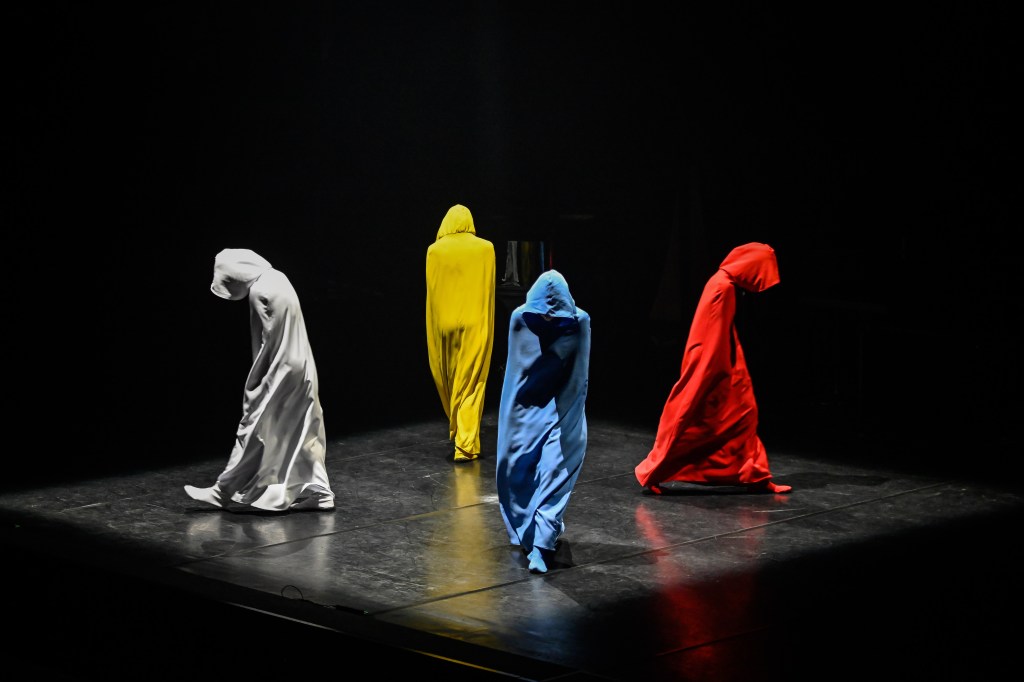
In the pre-concert talk, Rowland Hill commented on how, in a play as stripped back as Quad, every tiny detail of performance ‘reads’: with four walkers in simple, single-colour robes, moving at the same pace, the minutiae of posture, body angle, and movement-style all gain significance. We can read resignation or defiance into the degree to which a head is bowed; despair or exuberance in the speed and angle at which a walker’s leg rises and falls. The production had been designed and produced with meticulous care and attention in this respect, to great effect. There was one choice that, to me, seemed less effective: the robes were made of a fluid, somewhat clinging fabric that caught the light and enhanced the colours successfully, but also revealed the shapes and movements of the bodies perhaps a little too well; more so than with a stiffer fabric, which would define the bodies less precisely. Throughout, and especially in Quad II, these were perhaps too strikingly and obviously the lithe, energetic, trained bodies of dancers. Of course, the piece requires great bodily control and, in Quad I, energy, but the choice of fabric can either emphasise or disguise the quality of that physicality. Simply slowing the pace for Quad II is perhaps not quite enough if the movement is visibly agile and energetic and the costumes emphasise that liveliness. Nevertheless, this barely detracted from the power of the performance.
In producing Quad for TV, it was possible to define the square with the lighting: the figures appear from and disappear into a void of darkness. On stage, and perhaps especially on a concert stage – of different shape and with different technical facilities from theatre stages – this is harder, perhaps impossible, to achieve. The performers have to start walking some distance from the square, judging the speed and length of their paces as they traverse the stage to enter the quad seamlessly. Additionally, in this performance, the performers stood still, in the shadows to the sides of the square, when waiting to enter. Given the impossibility of creating blackness in this hall, it might have been more effective to have the figures leave the stage completely, rather than remaining visibly waiting; more difficult to achieve, but not impossible (and I have seen this work well, elsewhere).
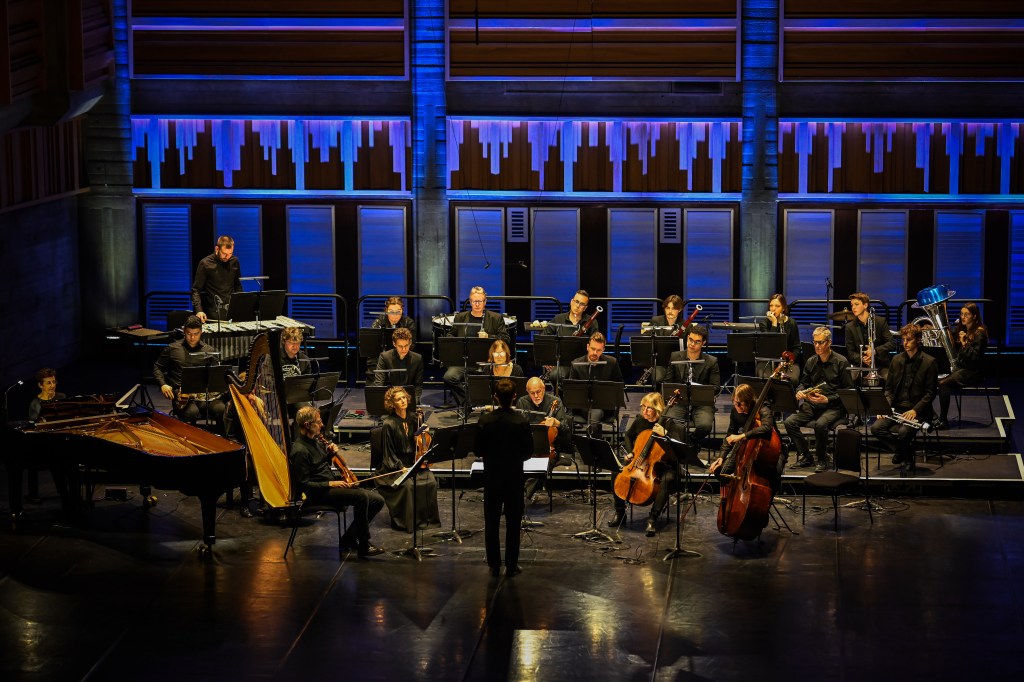
Quad was set in the front section of the stage, with the musicians seated in their playing positions, behind the square. This avoided the cumbersome entry and exit of performers between the two pieces – there was no interval – but it meant that the musicians were visible throughout Quad, watching silently. I rather liked this additional, shadowy audience, except for the fact that the musicians were holding their instruments, therefore giving the impression of waiting to play. Had their instruments been placed next to them, more out of view, and had they turned slightly to face Quad and the (paying) audience, rather than sitting at their usual conductor-oriented angles, their watching would have felt intentionally composed into the experience: rather than signifying a practical necessity, it might have produced a somewhat Beckett-like effect, each group of watchers watching the other, in the periphery of the walking.

After Quad, the walkers left the stage and we listened to For Samuel Beckett. Feldman’s music focuses attention on the timbre and sonority, resonance and decay of instrumental sound. It is predominantly very quiet, and his pieces of the 1970s and 1980s are often long – generally over thirty minutes without a break, but often much longer. Strongly influenced by the almost regular patterns of the Anatolian rugs that he collected, and by the similar slightly varied patterning in Jasper Johns’s cross-hatch paintings, Feldman’s later music comprises not-quite-exact repetitions of fragmented musical modules. For Samuel Beckett is typical: it unfolds softly over approximately fifty minutes by means of a tapestry of continuities and tiny discontinuities. The effect is simultaneously static but restless, systematic yet disorienting: things never quite settle, and the patterns can never quite be grasped, due to the endless tiny changes. Memory is invoked but is evaded and inevitably fails. Feldman hoped that with this approach to dynamic, duration and patterning, listeners would stop expecting contrast and drama, instead drawn into the qualities of sounds patterned in time in these ‘crippled symmetries’ (to borrow the title of one of Feldman’s pieces and also one of his essays). As a result, audiences tend to find this music either extremely boring or – as seemed apparent on this occasion, from the attentive focus of the audience – wholly absorbing: mesmeric but never quite stable.
The orchestration is at once brilliantly imaginative and horribly difficult to realise. The unusual sonic textures involve the ensemble working in three timbrally-defined sections: the fifteen wind and brass instruments – the latter muted – repeat groups of pianissimo chords in almost-patterns; the piano and vibraphone produce short rising and falling figures or small sets of chords, punctuated by harp harmonics; and the muted strings reiterate (or slightly vary) unison chords, mostly comprising harmonics. This soundworld is simultaneously damped down in quality – both in volume, due to the continuous softness, and in timbre and sonority, from the use of mutes, which reduce the resonant overtones – and yet also quietly luminous, due to the string and harp harmonics, the metallic tone of the vibraphone, and the confining of the piano to mid-high range pitches. Balancing all this is extraordinarily challenging. There are, in conventional terms, too many brass and wind instruments relative to the strings, and to articulate the tones precisely, but as quietly as possible, over a long period of time, is very hard indeed. Moreover, the job of each player is to fit individual notes or chords into the machinery of the patterns, matching the dynamics and tonal colours of their ensemble unit. As Jack Sheen put it in the pre-concert talk, this requires the conductor to work by trying to take the personality out of the players’ sounds, somewhat, reducing their idiosyncrasies so as to weave an even fabric of sound: the timbres are at once precise and distinct and yet must fit together without any one instrument dominating.
The musicians achieved this effect quite remarkably over the course of the performance. Early on, the vibraphone, piano, and harp seemed just a little too quiet, relative to the other instruments: their sparse phrases and single tones were audible, but only just. However, whether due to the wind and brass players needing to warm up (or down!) to playing at the softest level, or to the rebalancing effect when the piano and vibraphone shifted to chordal materials, this settled down: it did not take long for the equilibrium to be found. In contrast to the problem of too strongly individuated playing, the converse danger is one of excessive textural sameness: the patterns lose their effect if the playing lacks sufficient, if minimal, articulation and differentiation. Occasionally this happened – perhaps around thirty minutes in, though it is hard to have a sense of temporality in this piece – but not for long.
In writing about this, it is hard not to think of the almost-sameness of the patterns of For Samuel Beckett as similar to the minimised individuation of Quad. Both require a radical sublimation of performer subjectivity in service of a combined, coordinated effect. And both, on one level, expose the very impossibility of eradicating differentiation: with each, the more similar the performers’ actions, the more we perceive the tiny differences. These parallels were beautifully exposed by the juxtaposition of the pieces. But distinctions were also apparent: compositionally, Beckett’s play text articulates pure repetition, sequence, and combination – it is only in its embodiment that individuation emerges – whereas Feldman carefully designs the tiny variations in his patterns, crippling his own symmetries, with the inevitable tiny differences in sound production from one musician to another supplementing those composed-in deviations.
Quad is, on one level, nothing but pacing. Not long before composing For Samuel Beckett, Feldman described the complex rhythmic almost-patterns of his recent music as an ‘imitation of pacing’, also linking this to a ‘translation’ of the ebb and flow of breathing. A relationship between footsteps and breath is, of course, repeatedly invoked in Beckett’s work, but For Samuel Beckett also iterates a kind of limping pulsation, at once step- and breath-like. Notably, at the time of writing Neither to send to Feldman, Beckett was also working on Footfalls: the oxymoronic ‘unheard footfalls only sound’ of Neither (and likewise the ‘steps sole sound … then no sound’ of ‘Roundelay’, also from this time) are echoed in Quad – especially Quad II, where sound almost disappears. They are similarly, if differently, embedded in Feldman’s own ‘revolving of it all’: almost, but never quite, exhausted.
Catherine Laws is a Professor of Music at the University of York and a Senior Artistic Research Fellow at the Orpheus Institute, Ghent. Her practice-led research as a pianist is focused on aspects of embodiment, subjectivity, and collaboration in performance practices. Recent outcomes of this work include her solo multimedia performance piece, Player Piano, and the publication Voices, Bodies, Practices: Performing Musical Subjectivities (Leuven University Press, 2019). Her musicological work examines the relationship between music, language and meaning, focusing especially music and musicality in the work of Samuel Beckett. Her book, Headaches Among the Overtones: Music in Beckett/ Beckett in Music, came out in 2013.
 The Beckett Review
Leave a comment