
Directed by Judy Hegarty Lovett
Performed by Natasha Everitt, Simon Jermyn, Conor Lovett, Lux Hegarty Lovett, Trey Lyford, Seán Mac Erlaine and Julia Spanu
28 September 2024
Review by James Baxter
In the 1929 essay ‘Dante…Bruno.Vico..Joyce,’ Samuel Beckett invokes a vision of purgatory – quite separate from the sombre eminence of his most famous dramatic images – defined by uncontainable movement and restlessness. Between the polar stasis of paradise and damnation, purgatory, it turns out, is a remarkably vigorous affair – ‘a continuous purgatorial process,’ Beckett writes, issuing from the dynamic energy of colliding opposites. Such is the spirit of Gare St Lazare Ireland’s latest experiment, Shades Through a Shade, (playing as part of the Dublin Theatre Festival), an eccentric performance of words and music in which Beckett’s lively processes achieve often bewildering form. Centring on the uncanny recurrences of Belacqua across the centuries, from a relatively minor character in Dante Alighieri’s Divine Comedy to a key figure of modernist torpor in Herman Melville’s ‘Bartleby’ and Beckett’s early shorts, the performance invites the question: what can creative people expect to take from Beckett’s options for purgatory? – from works in which beginnings and endings blur into obscurity, leaving a no-man’s land of competing voices and dizzying activity.
For enthusiasts of Beckett performance, Gare St Lazare Ireland need little introduction by this point. Named by the New York Times as ‘unparalleled Beckett champions’ in the theatre, GSLI, co-founded by co-artistic directors Judy Hegarty Lovett and Conor Lovett, is renowned for its unique fondness for the altogether more unruly novels and short prose works. Notably, the theatre troupe succeeded in adapting the titanic How It Is: Part 1 (2018) and Part 2 (2019) (featuring Conor Lovett, Stephen Dillane, and composition from Mel Mercier), subsequently screened as a galling 6-hour film of three parts in 2021. As of writing, Hegarty Lovett has directed 27 Beckett productions and Lovett has over 20 credits to his name, having also delivered a much-celebrated performance as the moribund ‘Lucky’ in the Gate Theatre’s 50-year anniversary performance of Waiting for Godot. Under Hegarty Lovett’s expert direction, Shades Through a Shade once more inhabits the tonal discordances of Beckett’s writing; however, like the most striking adaptations of hallowed texts, the performance appears unafraid of mutating and branching-off unexpectedly. Invoking Anne Carson, the players of Shades Through a Shade remind us that this is equally a matter of ‘de-creation,’ taking Beckett and company as opportunities to set forth on giddy lines of flight.
In fact, just like Belacqua from Beckett’s short story ‘Ding Dong’ – shifting ‘constantly from place to place,’ to sites which ‘disappeared as soon as he came to rest in them’ – there are no settled positions in the loose theatrical collage of Shades Through a Shade. Instead, the performance regularly runs afoul of the essential organising divisions of traditional theatre: between performance and rehearsal, stage and audience, music and speech. The result is a frequently hilarious if, at times, quite tiring experience.
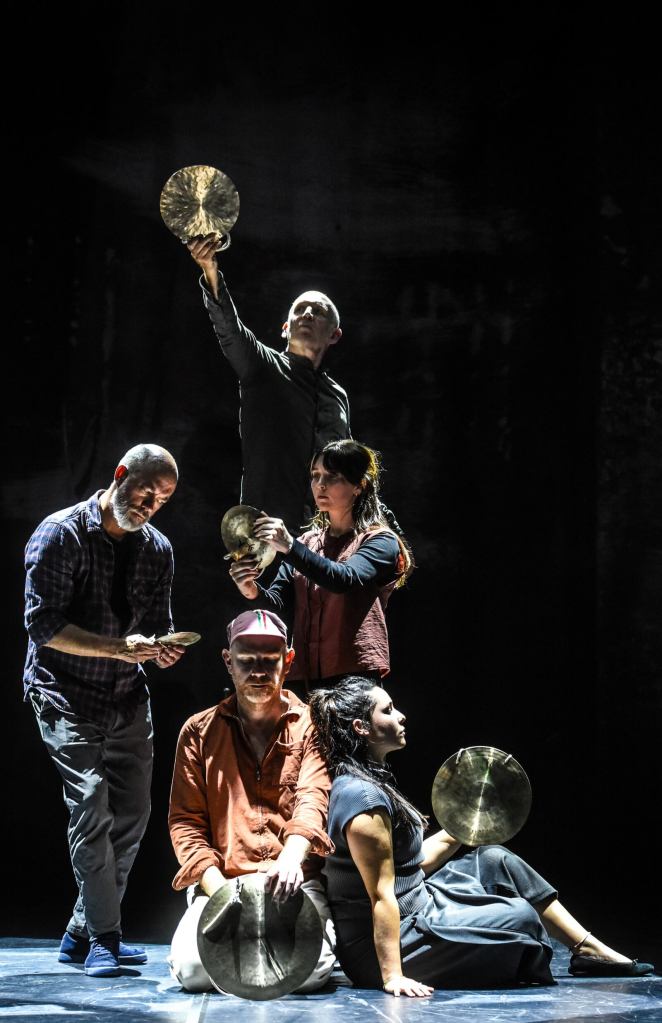
It is difficult to fully account for the sheer quantity of metatheatrical flourishes and wacky goings-on in Shades Through a Shade so here is an abbreviated list of some of the things that happen: the pre-show safety announcement is revealed as a gag by one of the performers; lines are flubbed and corrected in ad hoc fashion; pratfalls abound, with players either tripping onto stage or breaking into dance; more than once, the performance is interrupted so an email can be read concerning the practical challenges of transporting musical equipment across borders; Lux Hegarty Lovett delivers a straight reading of ‘Bartleby’ while Natasha Everitt devours handfuls of paper; Trey Lyford enters through the fire exit, briefly turning on the lights to the entire theatre. The organising principle, such as there is one, becomes a kind of lint roller in which bits and pieces are caught up and absorbed. Under these circumstances, the texts delivered – from Beckett, Melville, and Dante, but also from the wider tapestry of modern philosophy and art writing – become more like familiar riffs, taken up and put away. Whether excerpts from Dante or letters from Beckett to close intimates, it all gets swallowed up. Everything is fair game.
However, throughout the performance, there are occasional sequences or individual images that do arrest the attention and allow the proceedings to settle amid the hyperactive stream of activity. Conor Lovett monologues from the tirade at the end of The Unnamable, alongside dance by Natasha Everitt. Elsewhere, a cloaked and monstrous figure prowls the stage in a haunting piece of visual invention. The strange tableaux are accompanied by musical backing from Simon Jermyn, Seán Mac Erlaine, and Julia Spanu as a continuous and tense counterpoint to the performance on display. The band are easily one of the highlights of the performance, contributing tonal colour, as well as a loose sense of structure to the players’ comings and goings. The composition by Benedict Schlepper-Connolly covers an astounding range, from low humming feedback to surging heavy metal guitars, from noodling keyboards to arresting vocal passages. Delivered with expert precision, it all makes for a superb addition to the sonorous landscape of Shades Through a Shade, a fitting analogue to the polyphonic texture of the play’s general conceit.
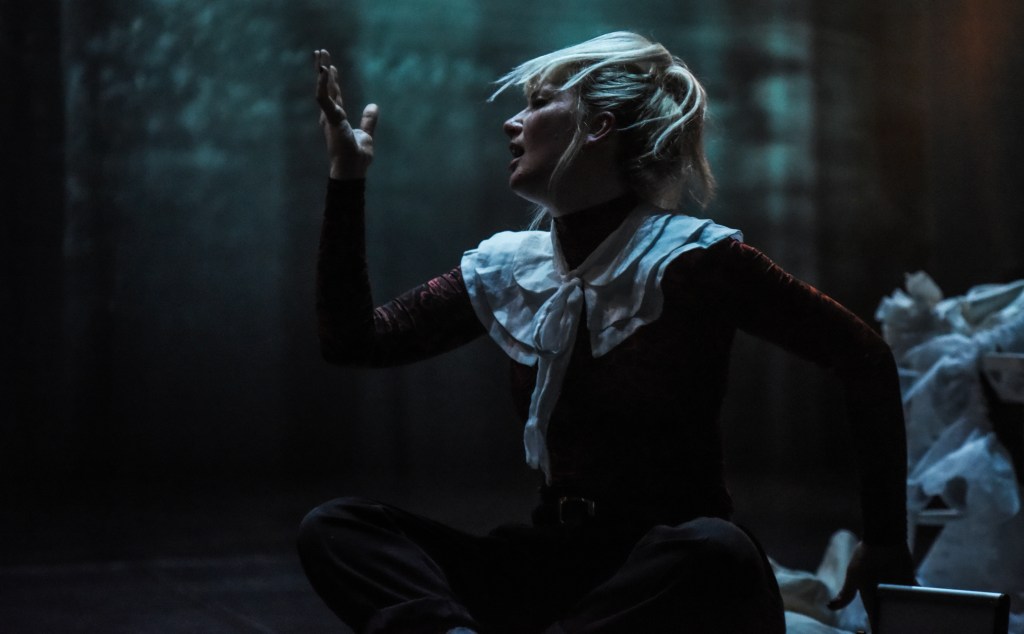
A further highlight comes nearer the end, as we approach the closing sequence of the performance, where the actors conduct what can only be described as a ‘speed-run’ of the proceedings up to that point. With remarkable dexterity, the players rush through the main beats and motifs of the performance, giving everybody the all-singing all-dancing works. Moreover, this neat sequence of absurdist humour and actorly stamina serves as a welcome reminder of the strange temporality that so often affects Beckett’s best prose works, in which yawning emptiness imperceptibly slips into imminent ending. Where Beckett’s unfortunates so often start with self-imposed rules and routines to lazily fill the time, there occurs a dawning moment of recognition somewhere down the line, leading to the panicked attempt to account for as much as possible before the final end.
In short, Shades Through a Shade has ideas to spare. Having thrown everything at the wall, the performance offers no shortage of prankster-ish experiments and madcap notions to fill the time. Gare St Lazare Ireland successfully transforms indolence into something explosive and surprising at the drop of a hat. This undoubtedly accounts for both the anarchic appeal and occasional downside to the performance which sometimes risks falling into supreme incoherence. Despite the final image of shaky unity between the company, one is left feeling that Shades Through a Shade should probably have stopped while it was ahead, shortly after the hilarious and manic ‘speed run,’ where the performance succeeds in both affirming and undoing itself. Nevertheless, GSLI – channelling their literary touchstones – recognises the path forward is rarely the easy one, littered with indignities, pitfalls, and convolution. And so, as with Beckett’s purgatory, the end is never really the end but generates its own disorderly route onwards.
Dr. James Baxter is a teaching assistant at Trinity College Dublin. He holds a PhD in English Literature from the University of Reading and is the author of Samuel Beckett’s Legacies in American Fiction: Problems in Postmodernism (Palgrave, 2021).He is currently working on a book project concerning the ‘big little magazine’ and the literary marketplace in the mid-century United States.
 The Beckett Review
Leave a comment