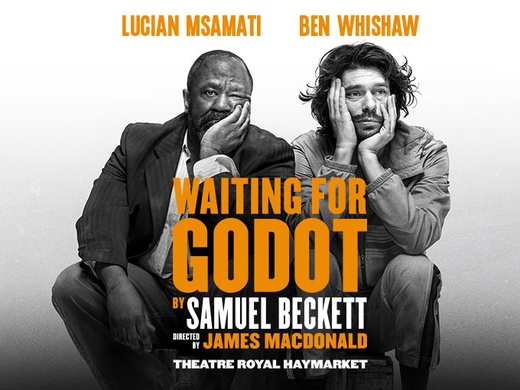
Directed by James Macdonald
Featuring Ben Whishaw (Vladimir), Lucian Msamati (Estragon), Tom Edden (Lucky), Jonathan Slinger (Pozzo), Luca Fone/Alexander Joseph/Ellis Pang (Boy)
Monday 23 September 2024
Review by Rosaleen Maprayil
Beckett’s plays are often staged at moments of crisis. Waiting for Godot, a work that is shaped by Beckett’s experiences of war, has been subject to a number of site responsive stagings intersecting with moments of socio-political upheaval. In one of the essays that accompanies the play programme, Fintan O’Toole argues that, in Waiting for Godot, Beckett grapples with a paradox: ‘the obligation to express what he had not experienced, to be a witness to what he had not seen’. More than 70 years after it first premiered in post-war Paris, James Macdonald’s highly anticipated production brings Beckett’s work to an audience eager to see how such an iconic play would translate to the London stage in 2024.
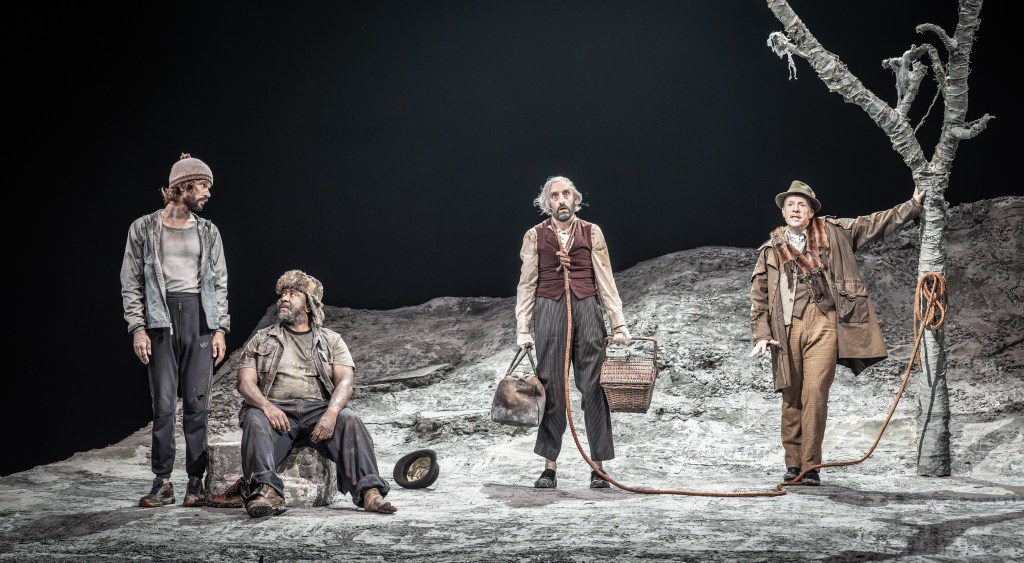
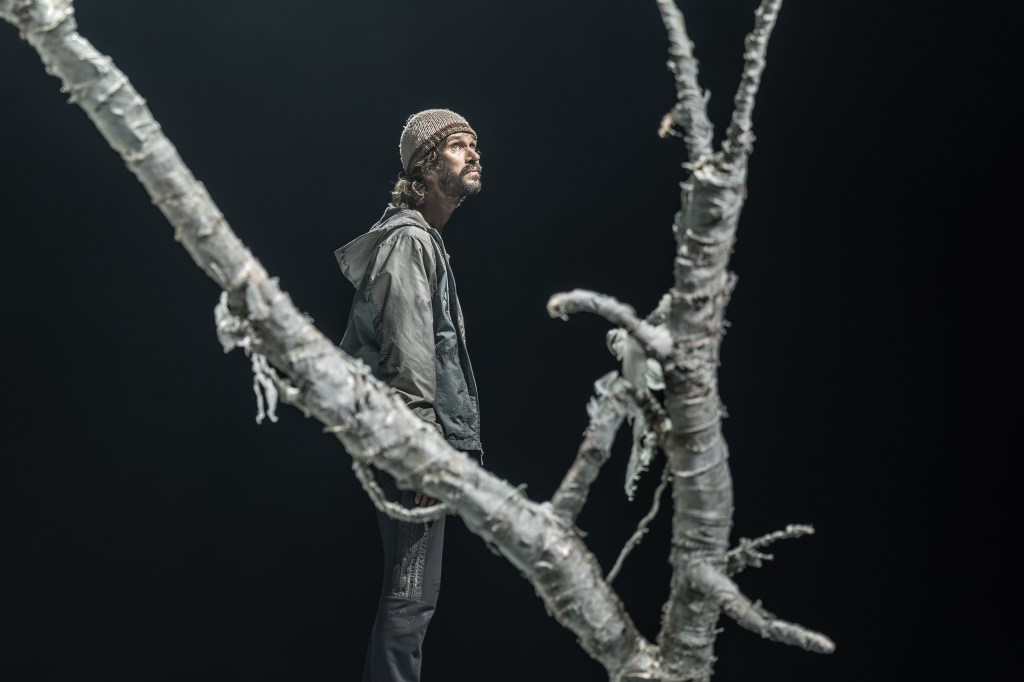
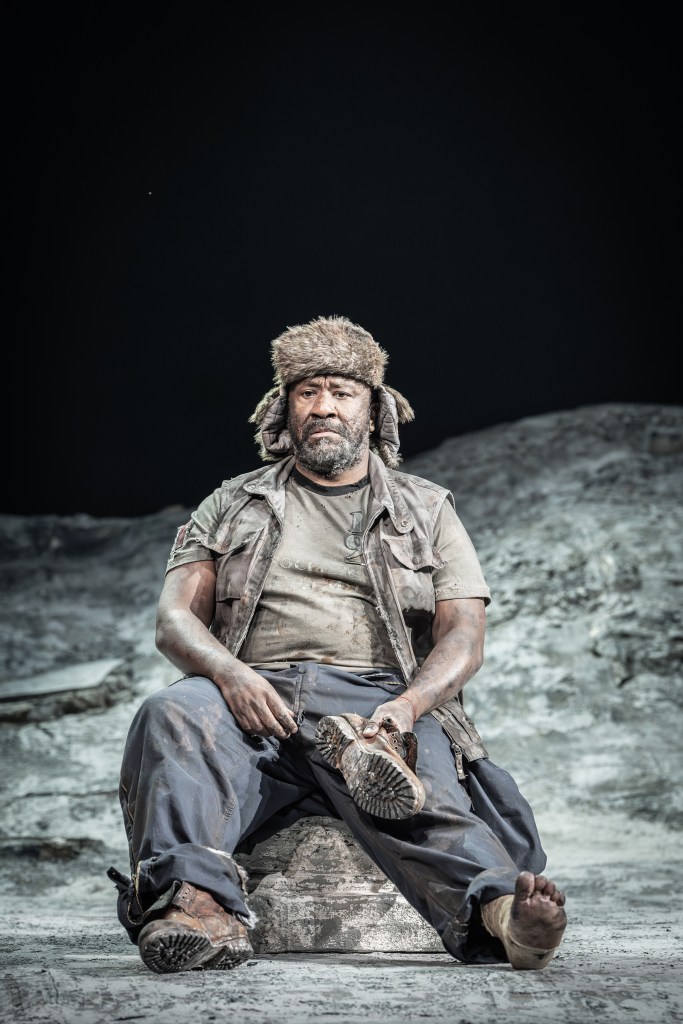
When the curtain opened, Rae Smith’s design presented a country road that was scorched, grey and upturned while Bruno Poet’s stark, spectral illumination steeped the surroundings in the deepest black so that the scene appeared disconnected from anything we might recognise as a country road. The incline created a hill devoid of nature, taking the characters up to the ‘top’ of the lane, into the unknown, creating an island of abandonment – a floating postage stamp in the abyss. Smith and Poet’s collaboration rendered the staging with a texture of unease, manifesting a world that was not simply hostile but seemed actively sinister. When darkness fell, the lunar quality of the staging was evoked by a luminosity that highlighted the unrelenting bleakness of the landscape, emphasising the sense of isolation and fragility of the bodies that occupied it.
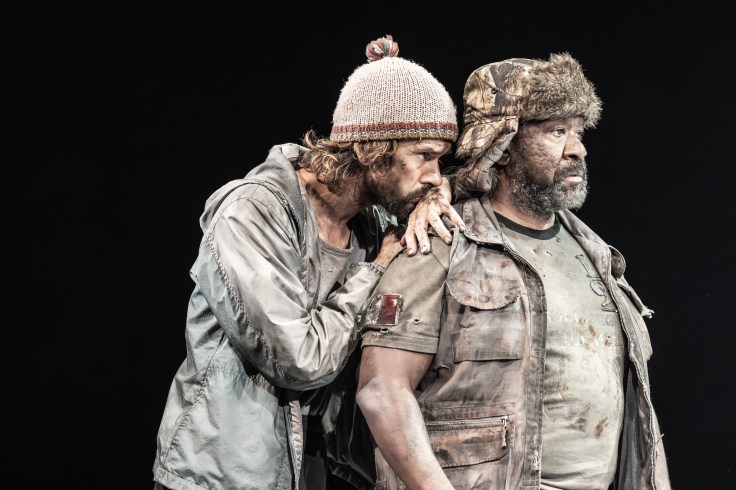
The tree embodied nature’s attempts to persist in the midst of devastation. Its bark was bound by what appeared to be bandages across its trunk and boughs, bringing to mind the brutality captured by Paul Nash’s depictions of battlefield trees. The mound, presented as a singular breeze block, reasserted the sense of loneliness and human alienation, utilising its materiality to represent an environment of aftermath and absence. Vladimir, clad in a beanie, t-shirt and tracksuit bottoms, Estragon in a trapper hat with dungarees slung around his waist, were both soiled with the marks of living outdoors, unwashed and worn down. If they’d been costumed in the old suits of the original production, it might have suggested they’d emerged from the old world of the Theatre Royal, time travellers from a Victorian heyday, thrown into a world in which they are ill-equipped. Instead, their contemporary, casual clothes conveyed something much more harrowing – the familiar juxtaposed against a cold and brutal landscape that spoke to the vulnerability of ordinary lives.
What makes this production stand out is the level of connection that Msamati and Whishaw bring to their portrayal of two old friends and their ability to endure the unbearable. Whishaw’s Vladimir straddles the border between strength and vulnerability alongside the stoic pessimism of Msamati’s Estragon. Both actors draw on their physicality, and as they look up or down to one another there is a tenderness between them that manifests in the way they touch or hold one another – Whishaw’s hands in particular reach for his friend in ways that speak to an easy intimacy borne of years spent on the road together. What might sometimes be interpreted as a certain loftiness in Vladimir’s character, Whishaw conveys as sensitivity, from his movements and gestures to the timbre and cadence of his voice. Macdonald’s direction exposes the uncertainty and innocence that prevails even in the face of endless disappointment that explains Vladimir’s need for Estragon, his desperation for Godot to arrive and a longing for things to finally make sense. Msamati’s Estragon conveys the genuine affection and affinity between them even when he is like a petulant child; sulky, fed up or flat – expressing the reality of any long-term partnership. At times, watching from the audience almost feels like a breach of their privacy as they try to navigate an existence in which, despite being together, one can often feel alone.
Jonathan Slinger’s portrayal of Pozzo had a chilling edge, his cruelty even more alarming because of his easy repartee. Draped in a fox pelt and donning a tweed jacket beneath his Barbour, his costume signalled privilege, his delivery jovial and at times even sporting. Slinger’s charm captured what can be so alarming about those who eschew empathic connection in their desire for power – their seeming un-remarkability – his embodiment of Pozzo highlighting that oppressors and bullies rarely advertise themselves as monsters. Tom Edden’s Lucky wasn’t a gibbering wreck nor did he have the shock of white hair or artificially whitened face that audiences may have come to associate with the character, decisions that made Lucky seem more human and less symbolic. It meant that when Pozzo declared that ‘The tears of the world are a constant quantity’, we are reminded that chance and circumstance are all it takes to throw one into an existence where survival at any cost becomes the focus of the everyday.
As war rages around the world, the timing of Macdonald’s production resonates with Beckett’s need to write the play in the first place, articulating something about the human condition that appears to be arbitrary, violent and senseless. In the play’s final scenes, Vladimir wonders, in a somewhat passive state of horror, ‘Was I sleeping, while others suffered?’, and this reflection lingers long after the curtain falls. What this production seems to highlight through its performances is the power we all hold when we awaken to this realisation. The small gestures, looks and movements between Whishaw and Msamati are a portrayal of friendship against the odds and a testament to the need for bodies to connect, to touch, for hands to have something to reach out for when the business of being alive doesn’t turn out as expected. When the boy makes his appearance each time at the close of the evening, Vladimir climbs without hesitation to the precipice, desperate to know if they are seen. Why does this play continue to captivate us? Perhaps because, more than ever, it reminds us that every life should have a witness and that when we are in need, those who have the power to make a difference should not look away.
Rosaleen Maprayil completed her PhD at the University of Reading in 2024. Her work explores Beckett’s plays in performance using the frameworks of the phenomenology of objects and scenography to explore ideas about home and domesticity alongside gender, environment and landscape from a socio-political perspective. She has had work published in the Journal of Beckett Studies and Samuel Beckett Today/Aujourd’hui and has an essay on the Irish Language production of Happy Days – Laethanta Sona, in Beckett and Ecology (2025).
 The Beckett Review
Leave a comment