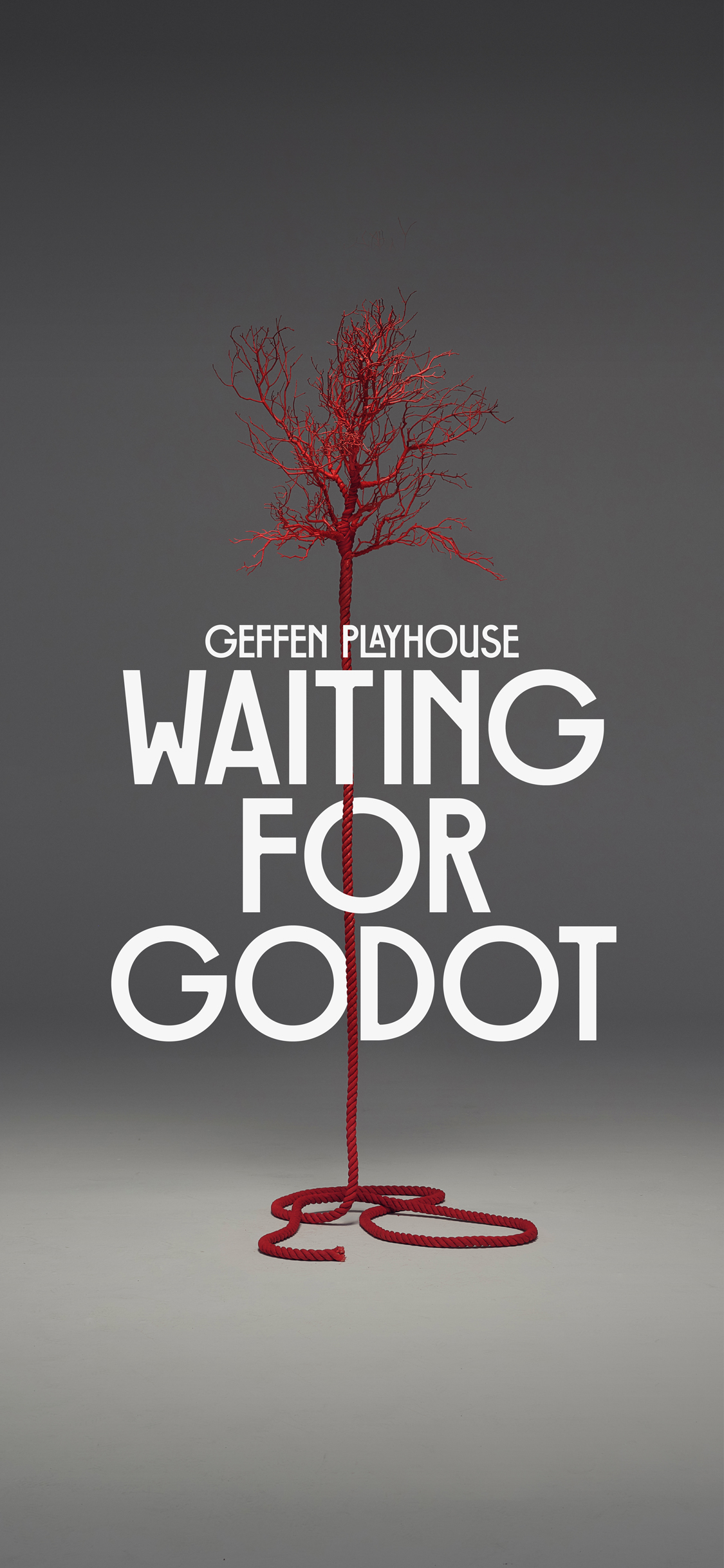
Directed by Judy Hegarty Lovett
Featuring: Rainn Wilson (Vladimir), Aasif Mandvi (Estragon), Conor Lovett (Pozzo), Adam Stein (Lucky), Lincoln Bonilla/Jack McSherry (Boy)
3 November 2024
Review by Patrick Bixby
Los Angeles (my hometown, I must confess) may have a reputation for superficiality, crass commercialism, and cloying celebrity worship, not least because the Hollywood entertainment industry often seems to overshadow all other artistic pursuits in the town. But like most bad reputations, this one isn’t entirely fair. Certainly, it encourages us to overlook quite a vibrant theater scene, founded on major regional theaters like the Mark Taper Forum and Ahmanson Theatre, along with a variety of smaller, more experimental ones scattered across the urban sprawl of La La Land. Some fortunate members of the Samuel Beckett Society know this firsthand, having been treated to a rousing production of Happy Days (featuring the impeccable Monica Horan) at the 65-seat Independent Shakespeare Co. in Atwater Village last summer, during our annual conference. Last fall, Angelenos had another opportunity to see Beckett’s work reimagined: this time in a major production of Waiting for Godot, featuring TV stars Rainn Wilson and Asif Mandvi, at the Geffen Playhouse in Westwood. Located just across the street from the UCLA campus, the theater has gradually become one of LA’s most significant cultural institutions over the last thirty years by balancing artistic ambition with mainstream appeal.
The recent production came together at the prompting of Wilson himself, who considered Godot a “bucket list” item for his theatrical career. In fact, the actor – best known for his role as the lovably eccentric Dwight Schrute on the US version of The Office – has had a long acquaintance with the play, dating all the way back to an acting class at the University of Washington in 1986. His scene partner then, Holiday Reinhorn, would later become (and still is) his wife. Wilson began his professional life on the stage in New York but, rather ironically, migrated back west to Los Angeles in an effort to enhance his theatrical career: “The entire reason I came to Los Angeles, and I am not even exaggerating one iota,” he told the Los Angeles Times, “is I knew that if I ever wanted to play Mercutio at the Public Theater, I was gonna need to be on a TV show. That’s just the reality of New York theater. They want to sell tickets.” Staying on in LA and achieving TV stardom has given him the opportunity to play a number of stage roles in recent years, including Jimmy in the 2018 Steppenwolf Theatre Company production of Matthew-Lee Erlbach’s The Doppelgänger.

It was a previous role at the Geffen, starring in Will Eno’s Thom Pain, that would eventually lead Wilson to play Vladimir in Westwood. When he mentioned his long-held desire to perform in Godot, Eno gave him some astute counsel: the only company to work with would be Gare St. Lazare Ireland (GSLI). Since its foundation in 1996 by Samuel Beckett Society members, Judy Hegarty Lovett and Conor Lovett, GSLI has become well-known and greatly-admired among Beckett aficionados for their tour de force productions, which have also earned them the title of “unparalleled Beckett champions” from the New York Times. This reputation has been forged in large part through their innovative adaptations of Beckett’s prose works for the stage, with Lovett delivering unforgettable performances of Molloy, Malone Dies, The Unnamable, How It is, and other texts. But even before founding the company, the couple began their careers with a production of Godot in a small studio theater in the First Arrondissement, shortly after they relocated from Ireland to France in 1991. So the Geffen Playhouse production also represented a return to roots for the co-founders of the GSLI, who collaborated to bring Beckett’s work to audiences around the world in the intervening years.
Their LA production of Godot opened at a rather fraught moment in the US, a week after the 2024 Presidential election, as the reality of a second Trump term was just setting in. Rehearsals had proceeded through the closing stages of the contentious campaign as the national mood turned increasingly toward anxiety and anticipation, which promised that the Geffen run would take place against the backdrop of a national tragicomedy. This would not be an overtly politicized production like, say, Paul Chan’s free open-air Waiting for Godot in the flood-ravaged Lower 9th Ward, two years after Hurricane Katrina as residents of the area continued to await FEMA relief – or other memorable stagings of the play in Palestine, Sarajevo, and South Africa during periods of widespread strife and unrest. But with Trump taking a victory lap before adulating crowds at Mar-a-Lago, congratulating himself and announcing his cabinet picks, it would be difficult to keep the reverberations entirely beyond the walls of the Geffen when the opening-night audience gathered inside the theater. The festive atmosphere of the LA premiere, with cast members from The Office and Hollywood-types of all sorts traipsing the red carpet, nonetheless offered something of a reprieve from the constant drumbeat of disconcerting news from the world of politics. Godot might not seem like escapist fare, but for an audience desperate for distraction, it might offer a just bit of that.
To be sure, both the light and dark shades of the play were enhanced by the rather unsettling circumstances of the Geffen performances. In promotional interviews for the production, Wilson mused on his long attraction to the play and the questions it poses for an actor: “How funny can you make it? And how heart-wrenching can you make it?” Given his acclaimed television work, the opening-night audience came to Westwood expecting plenty of the former and they were not disappointed as Wilson’s performance evoked many big laughs, some just where you’d expect them and others where you wouldn’t. But it was the sincerity and even vulnerability of his Vladimir that was less anticipated and therefore more pleasing for seasoned Beckett fans. When famed comedic actors from film and television have taken on Godot in the past, the results have been mixed, to put it kindly. One thinks of the often lukewarm, and sometimes openly hostile, reception given to revivals featuring the likes of Robin Williams and Steve Martin or Nathan Lane and John Goodman. But under the skilled direction of Hegarty Lovett, the Geffen Godot avoided the pitfalls of overly broad delivery or mere slapstick clowning. This was evident in Mandvi’s subtle interpretation of Estragon (a significant departure from his best-known role as a sardonic faux reporter on The Daily Show), whose distracted gaze imbued his quotidian trials, however comic and clumsy, with a mournfulness that brought out the gloomier tones of the play.
These tones were also enhanced by the pacing of the play, which stretched the performance well past two and a half hours. One of the few quibbles that local theater critics had with the production was its rather measured tempo, but this unhurried quality also provided the more manic moments of the play with a bit of extra shock value (and, frankly, what better way to impress upon an audience the experience of waiting than by not rushing through the performance).

Of course, many of those manic moments arrive when Pozzo and Lucky appear on stage. In the roles, Lovett and Adam Stein risked stealing the show with performances that provided additional grit and gravitas to the proceedings, even if Pozzo’s comically egocentric moments evoked every bit as much laughter as the exchanges between Didi and Gogo. Lovett’s deft handling of Pozzo’s monologue, born from his years of experience with Beckett’s prose, added just the right dose of menace to his performance, which slowly ebbed away into pathos as he attempted to impress his counterparts. His abuse of Lucky was sometimes played for laughs, but it nonetheless maintained the unnerving quality that it possess in the best performances of Beckett’s masterpiece. Heightening this effect (and complicating the relationships between the two pseudo-couples in the play), Hegarty Lovett’s choreography made full use of the stage-space and the dire possibilities of the rope tied around Lucky’s neck. But this maneuvering, sliding from naturalism to stylization and back again, had its most powerful effect in the unfortunate servant’s frantic movements as he delivered his infamous “tirade” in Act One: Stein’s physical interpretation of this verbal outpouring gave the speech a wearying, nearly shattering, quality seldom achieved by other actors in the role.
One of the most striking features of the Geffen Godot were the images produced on stage by its ingenious blocking and the radically minimalist stage design by Kaye Voyce. Evoking Mark Rothko more than Jack Yeats or Caspar David Friedrich, the gray bands of the backdrop blended into a coolly lit stage that contained only a delicate crystalline tree and rounded black rock. With Simon Bennison’s lighting, the backdrop transitions slowly from night to day and back again over the course of the two acts, tracking the movement of time and the duration of waiting, which were also marked by the slow emergence of the moon through the hazy sky. These subtle variations were accompanied by Mel Mercier’s restrained sound design compositions, which resonated in the background like a distant, haunting wind during both acts, though they grew louder and more ominous during the intermission. The overall effect of sound and image was mesmerizing. If a few critics found it a bit too beautiful for the more ragged realities of the play, most appreciated its modulation between void and dreamscape, which lent a certain solemnity to the proceedings, even though laughter often pervaded the theater during the performance.
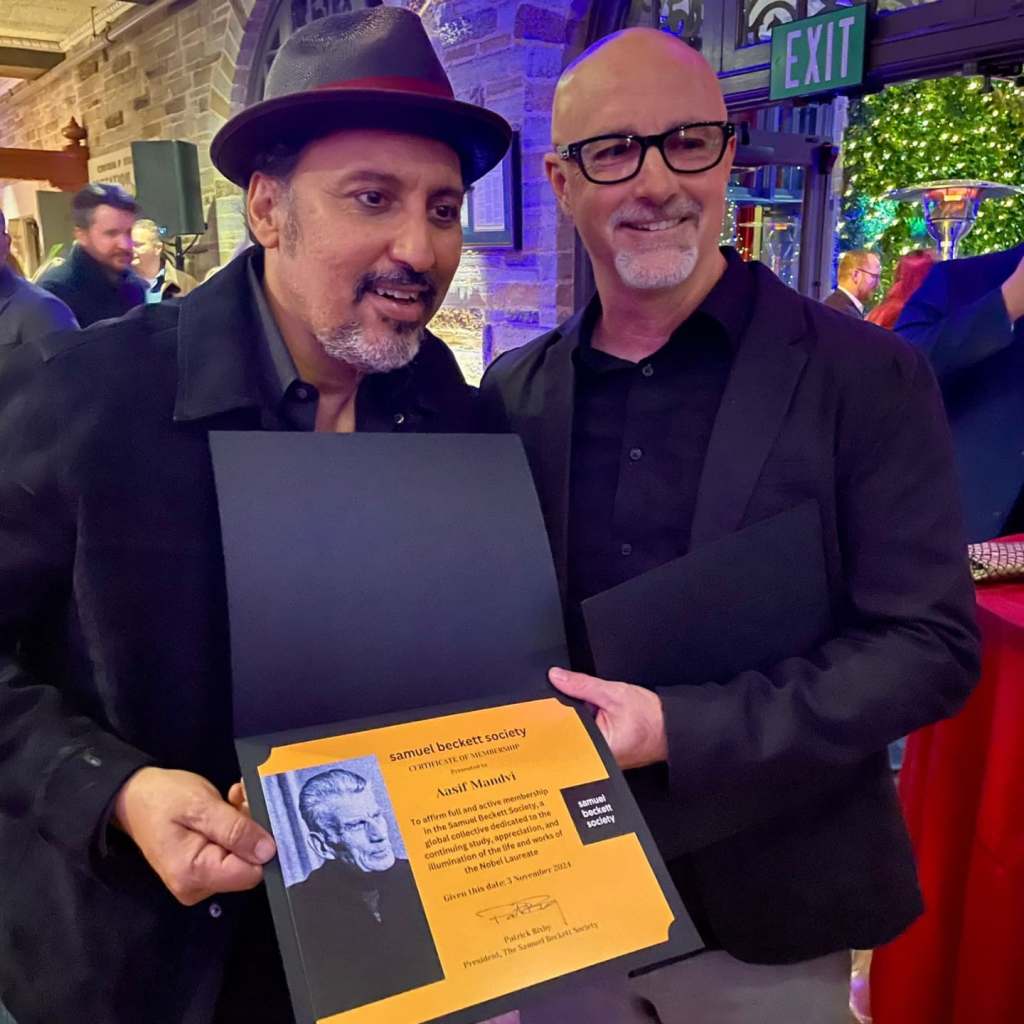
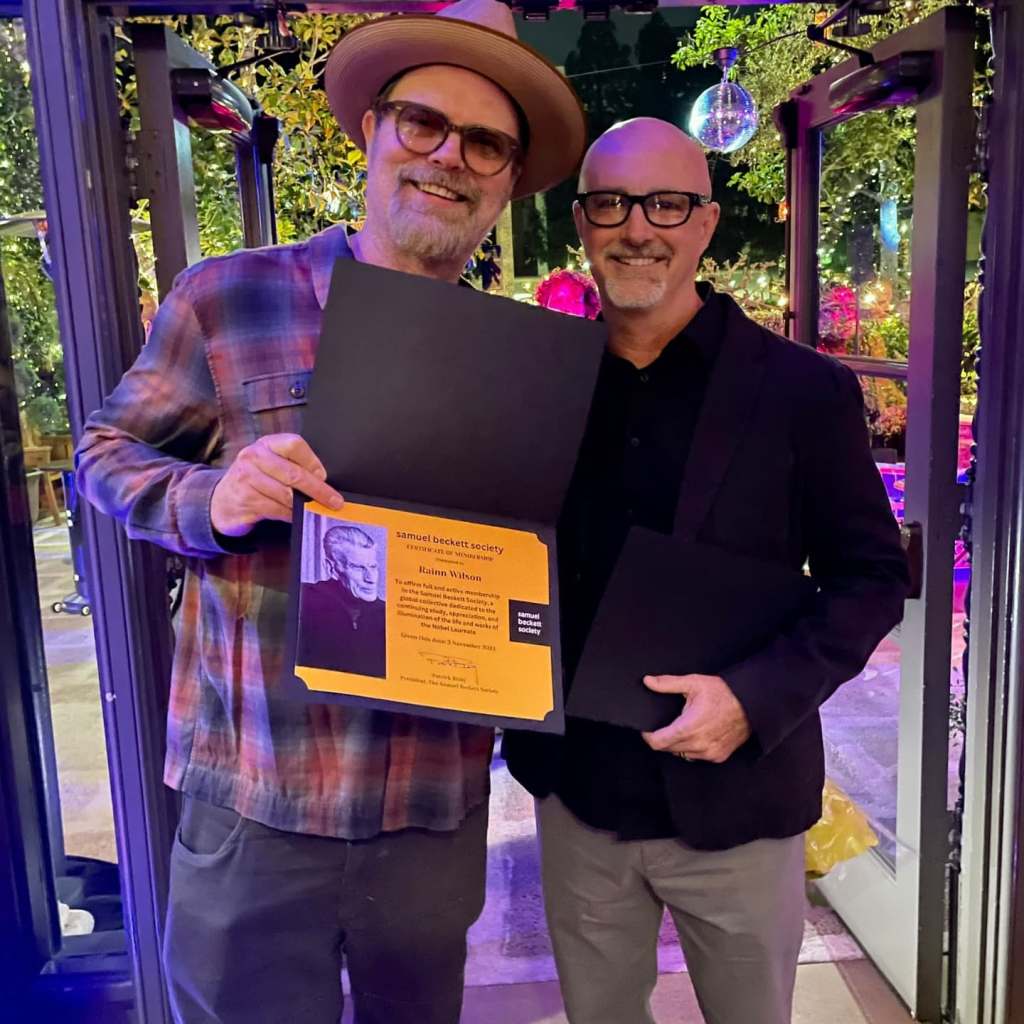
LA critics were duly impressed by the production and lavished it with superlatives; LA audiences, in turn, filled the house night after night and prompted an extended run to the brink of the Christmas holiday. GSLI and the LA-based stars managed to appeal to both constituencies with a production that achieved that elusive balance between tragedy and comedy, at a moment when both modes seemed to be hard at work on the national scene. The opening night audience, made up of Geffen members, friends of the cast, industry insiders, So Cal culture vultures, and even a few Beckett scholars, responded to the amusements on offer with rousing laughter, disconcerted gasps, and generous applause. But they could not entirely drown out the rumblings from Mar-a-Lago. One exchange, in particular, evoked more of a knowing, nervous titter than mere amusement:
ESTRAGON: We’ve no rights any more?
Laugh of Vladimir, stifled as before, less the smile.
VLADIMIR: You’d make me laugh if it wasn’t prohibited.
ESTRAGON: We’ve lost our rights?
VLADIMIR: (distinctly). We got rid of them.
With brilliant comic tone and timing, Wilson and Mandvi brought out the various shades of the play in a single exchange and reminded the audience how Beckett continues to speak to us in myriad ways. The rise of authoritarianism and the loss of freedoms need not require some violent overthrow, but rather a series of small surrenders and the normalization of restrictions and oppressions. To stifle a laugh in these circumstances is perhaps only to grimly accept the situation. In conversation at the cast party, Mandvi told me how these lines had gradually acquired weight and significance during the course of rehearsals. By the time the play opened, they had amassed an almost cathartic force insofar as they bound the players and the spectators together in a moment of mutual recognition; and, in the midst of this impressive production, they suggest the potential for theatrical experiences to both create and call forth a temporary community of dissent, even in La La Land.
Patrick Bixby is a past President of the Samuel Beckett Society
 The Beckett Review
Leave a comment