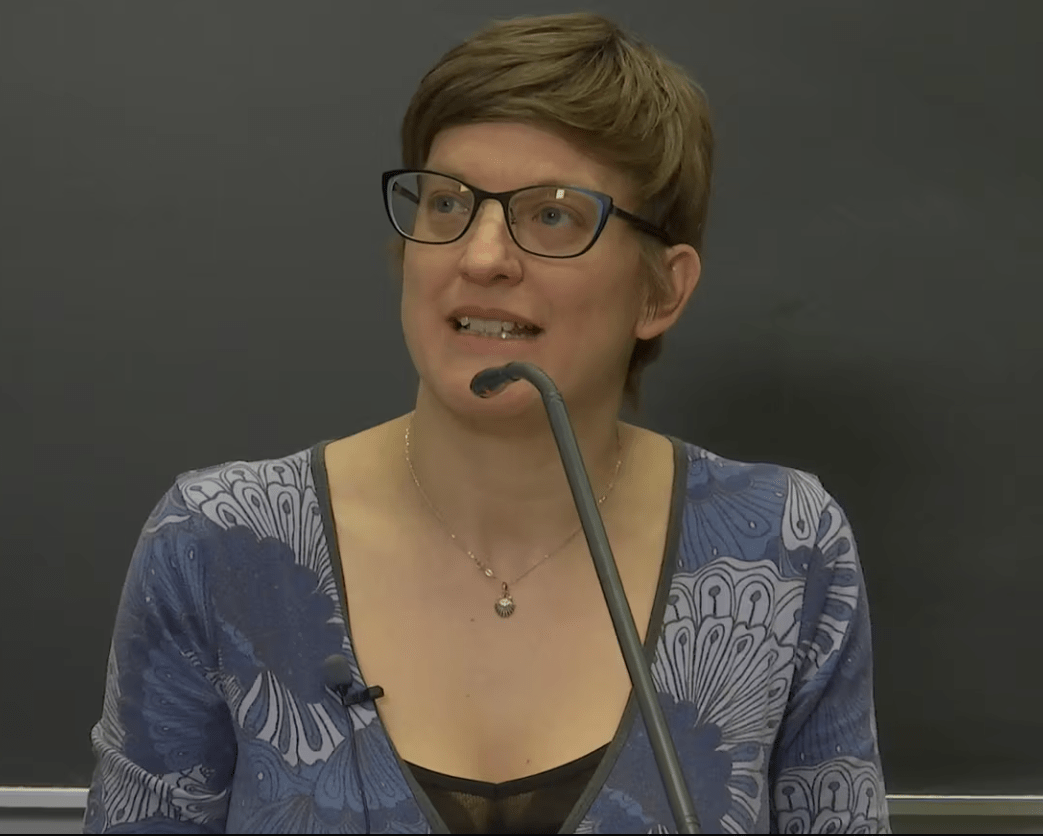
It’s been barely six months since I took over as president of the Samuel Beckett Society, but a rich and exciting time already. I want to start by thanking outgoing president Patrick Bixby for leaving the Society in such rude health, with a new sense of purpose and clarity of role, building on the expansion of remit and ethos of social engagement instituted by past presidents such as Daniella Caselli and Laura Salisbury. These are hard acts to follow. I want to thank too retiring Board member Nadia Louar, current members Julie Bates and Lucas Margarit, new member Katherine Weiss, vice-president (and president-elect) José Francisco Fernández, and of course the lynchpin of the Society and this publication, Feargal Whelan. Their work for and beyond the Society, translating and disseminating Beckett’s writing for diverse audiences and putting it to work for good, is genuinely exceptional.
An instrument of this work that I should jump to mention first is this beautiful publication itself. I am proud to introduce and be the first to appreciate this new form for the Society’s public face. Huge thanks to editor Feargal Whelan and Patrick Bixby, continuing to serve the Society by acting as sub-editor, for their brilliant work in producing it.
This first issue of the Beckett Review, replacing the venerable Beckett Circle, offers a vibrant set of articles reflecting the dynamic work of the Society as well as an interest in Beckett’s writing that continues unabated in the wider world. It also introduces a new feature, ‘From Our Own Correspondent’, highlighting non-Anglophone, Global Majority or neglected international contexts for response to Beckett’s work. In this issue, this comes from Saudi scholar and teacher Amjad AlShalan, exploring the significance of introducing a wider Beckett canon to her students and to an Arab audience, and the potential in that context of non-literal reading.
The longer form pieces also reflect a renewed visibility to Beckett’s work in the world of the arts. Patrick Bixby gives a nuanced exploration of a Los Angeles Godot (Geffen Theatre/Gare St Lazare Ireland) featuring US television star Rainn Wilson as well as Beckett stalwart Conor Lovett, a production exemplifying a year in which celebrated and often veteran actors of the screen ticked Beckett off their bucket list (see also Michael Coffey’s considered review here of F Murray Abraham in Krapp at the Irish Repertory Theatre, NY, or Ros Maprayil’s thoughtful response to the London Haymarket Godot with Ben Whishaw and Lucian Msamati).
The reception of this same production in starkly different circumstances is considered by Katherine Weiss, who accompanied it into the women’s wing of the Federal Correctional Facility two hours south of Los Angeles for a landmark performance yielding a distinctive response. This is–remarkably–the first staging of Beckett for incarcerated women, despite the long and prominent history of Beckett’s work in carceral environments–a fascinating and important new chapter in this story. The trenchant effect of these fresh eyes on Beckett is complemented by the fresh approach taken by director and actor Jeni Jones, interviewed by Weiss in another ‘longread’ here about her production of Not I (seen at this year’s Society conference in Edinburgh) and previous Beckett work. Her account of being warned off performing Beckett produces a clear-eyed reflection on both the fear of working with this material and the stance of fearlessness that must–and perhaps precisely can–be taken as a younger female artist.
This facing down of what Jones calls “taboo[s]” crystallizes something about the current moment in Beckett studies and Beckett theatre history. This year has seen the milestone publications of Pascale Sardin’s biography of translator, writer and companion to Beckett, Barbara Bray, and Emilie Morin’s work on writer and spouse Suzanne Dumesnil, building on the momentum created by Georgina Nugent-Folan’s 2023 Journal of Beckett Studies special issue on ‘Beckett’s Women Contemporaries’. This work of recovery and reconsideration of female writers and artists who have lived in the shadow of Beckett’s work and life (Feargal Whelan’s work on Mary Manning and Michael Coffey’s on Susan Howe are also notable here) has been striking both in its inherent interest and for the disciplinary and methodological innovations to which it has given rise. I am particularly excited by the superbly conceived Society panel (Julie Bates, Dúnlaith Bird and Georgina Nugent-Folan) on Dumesnil, Toklas and the modernist ‘wife’ that will take place at MLA in 2026. A final feature of this new and dynamic direction I will note is the publication of Not Beckett, an acclaimed collection of five plays by female and non-binary playwrights in response to Beckett’s work, reviewed in performance by Jonathan McAllister in this issue.
We also see in this issue accounts of a rich array of Beckett and Beckett-responding creative work, including the powerful memoir by Michael Coffey, Beckett’s Children (reviewed by Dan Gunn), and virtuosic performances of Quad and Morton Feldman’s musical piece For Beckett at the Southbank Centre in London (Catherine Laws). Works for the theatre, albeit in a range of intriguing venues and interpretations, include the Gare St Lazare Ireland devised piece Shades through a Shade at the Samuel Beckett Theatre, Dublin, reviewed by James Baxter, a transgressive production of Happy Days at the Arcola in London seen by Stiene Thillmann, Geoff Riddell’s consideration of a (productively) discordant set of Beckett shorts at the Oregon Shakespeare Festival, and a Godot (reviewed by Paul Shields) performed to a responsive audience in the Great Road Church in Acton, MA.
Amidst all this, the highlight of the year for many of us was the superb Society conference, Beckett’s Relationships, organized by Hannah Simpson and her team in Edinburgh on the 5th to 7th June. Cal State, LA was a hard act to follow, but Edinburgh offered bright skies, tasty haggis (or was that just me?) and a conference dinner where it could only have been–a convivial Scottish pub. The scholarship (probably worth a mention!) was quite astonishing in its quality, range and the sheer number of new directions and interventions. The conference will be covered in more detail in a subsequent issue of the Review, but suffice to say that ‘relationships’ was an exceptionally generative theme, standing for the warm connections as well as the nuanced work on display. We look forward already to building on this relational theme at next year’s conference, Beckett and Intertextuality, hosted by Dirk van Hulle in Antwerp, 21st-23rd May 2026.
‘Relationship’ could indeed be the watchword of the Society’s current activities, as evidenced, to give one example, by the continuing work by and for our early career members. Backed by the Society, Swati Joshi and Eleanor Green launched the innovative online seminar series but the clouds, exploring the ‘grey pluralities’ that resist normative or settled definitions and identities in Beckett’s work, in September 2024. Board member Katherine Weiss has continued to organize webinars tailored for the ECR community, and the Society will develop its initiative to support early career contributors through the composition and editing process (to publication in the Beckett Review). Plans are also taking shape for a more orchestrated mentorship scheme to come to fruition next year.
I am excited by the vibrant condition of the Society in this, its 48th year: its expanding membership, groundbreaking scholarship, flourishing relations with prominent artists, commitment to Global Majority and non-Anglophone Becketts, and most of all, open and supportive community–bucking so many trends in the wider academic and political world. Thank you for your valuable part in making the Society this way.
Liz Barry
President, The Samuel Beckett Society
 The Beckett Review