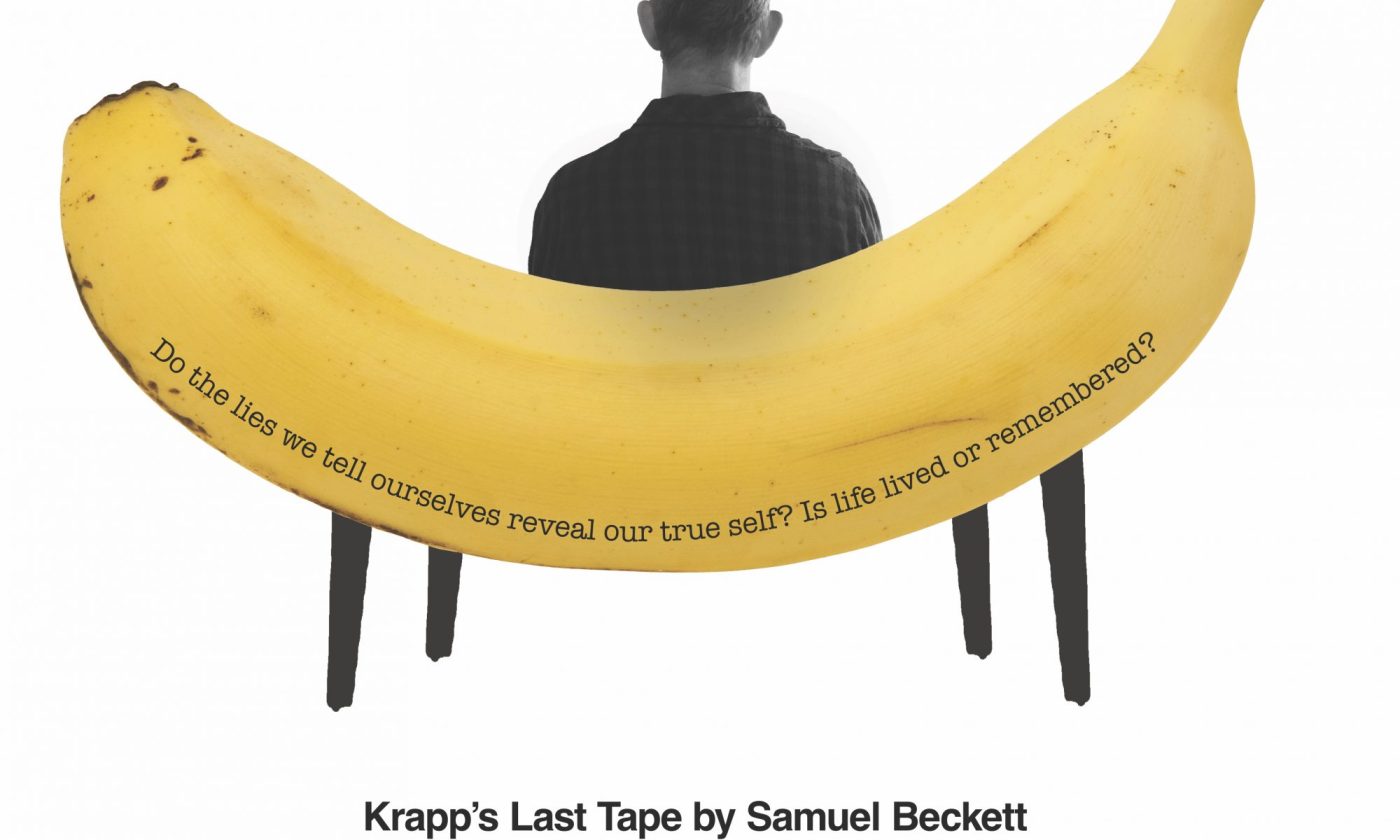
Interview by Annette Balaam
Philip Robinson is a versatile and seasoned actor, writer and the creative director of the Living Room Theatre company. Touring mainly in the Southwest of England, he devised and performed The Washing Machine of Destiny with Luca Saunders, a musical supported by Arts Council England that embraced neurodiversity through joy and play. He is currently touring The End is in the Beginning: The Beckett Omnibus with the Living Room Theatre company, a production which weaves together Beckett’s prose, poetry and plays into one performance. This two-hander is performed by Philip and Sarah White. The creative direction is by Philip, Sarah and the Director, Nikki Sved. In December 2023, he performed Krapp in Your Living Room, specially produced and filmed for the 8th Annual Samuel Beckett Society Conference: Beckett’s Environments.
Link to Philip Robinson’s Krapp in Your Living Room project version of Krapp’s Last Tape on YouTube
AB: When performing Krapp for Zoom, did it feel like a stage play/performance or a film performance?
PR: No, I’ve never done it on stage, I’ve always done it in people’s living rooms and village halls, so my experience of performing Krapp was always other than on a stage. The main difference was that I couldn’t see the audience, but I knew they were there just beyond the camera. I very much approached it as an intimate performance.
AB: Is physical proximity useful for an actor?
PR: It’s more detached in the theatre. I also thought Zoom was potentially immersive for the viewer because they would be watching it in their lounge or kitchen on their laptop or phone.
AB: What was the pre-production plan for the Zoom?
PR: [Video director and editor] Michael [Flexer] and [director] Polly [Whitfield] knew what we were moving towards. Because the script was the script, we didn’t change that, but we had to decide how to shoot it. I was already thinking of it as small scale in living rooms, so I had to be very meticulous about my movements because there’s a lot of close-ups and I’m always in shot – my movements tell the story as much as the words. It was scary to only have six hours. I’m sure the jeopardy and quick decision making informed the performance. When Beckett directed it in the 70s, he would also make intuitive, spontaneous decisions about the actor in front of him. Later, they became embedded in scripts, but at the time they were very much in-the-moment decisions based on what was working. We did that as well.
AB: Did you change the script?
PR: We made the same changes Beckett made when directing it, like changing the waistcoat to a dressing gown and the boots to leather slippers. Other things were to do with changes in the text. He [Krapp] went off camera less – he’d decide when to stand, make a decision, and sit down again. Any changes we made were all adaptations that Beckett had made when he directed various Krapps and changed the original script. Just as Krapp is about different iterations of himself, my performance is about the different iterations of Krapp in Beckett’s head.
AB: In that little insert screen, sometimes he was ahead of himself on the big screen, other times he was in the past. Did you film those separately?
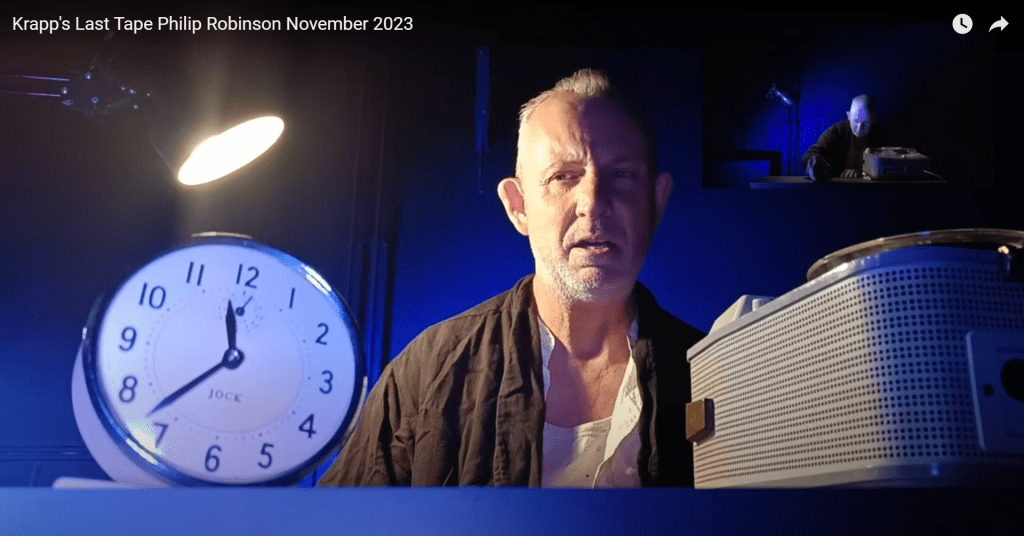
PR: Michael planned to have one camera focused on me sitting at the table and another from a different angle focused on the same action so that you would see the same action from a different angle on two screens. That didn’t work, so he filmed the same take with one camera. I’d do one take and then another take of the same shot, slightly differently.
AB: Two different performances?
PR: Of the same bit.
AB: Like stop-motion film?
PR: Yes. The viewer makes spontaneous decisions in real time: “Was this in the past or was it just before?”, “What’s real, what’s the past?”
AB: Did you also make spontaneous decisions in real time?
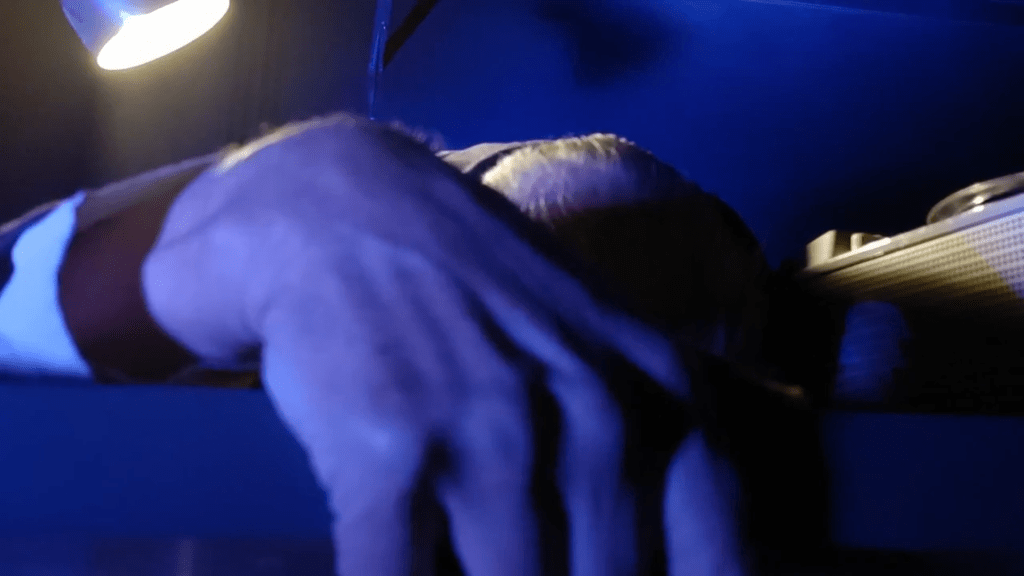
PR: I was aware the camera had moved so I may make different action decisions. There are quite a few close-ups in the production…
AB: …extreme close-ups.
PR: They create an awareness of: “He’s concentrating on my hands, so I’m going to put all my energies into acting with my hands” – being aware, present in-the-moment, making intuitive decisions.
AB: Is it that you’re inhabiting your body and face and aware of how they move, at the same time as disembodying yourself and looking back in a more analytical way thinking, “this is an extreme close-up”?
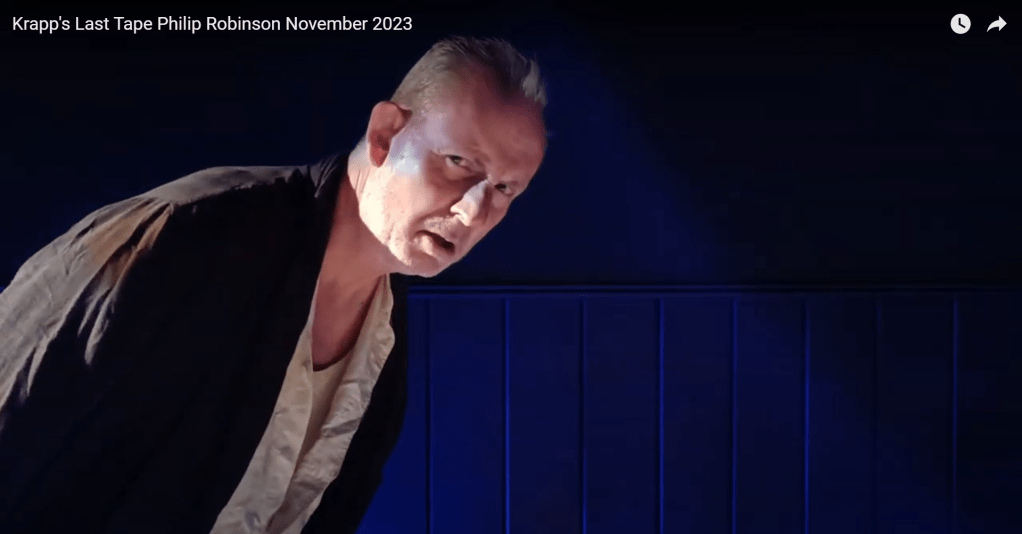
PR: Yes. Also, I was aware that the audience of possibly one person is going to be watching this on their laptop. I realised the whole thing is going to be edited together – it wasn’t a through-line from start to finish, we stopped and started, and I began to think more about the person watching. I said to Michael, “We’ve got to see the person, we’ve got to see the person watching it,” and he said, “What do you mean see them?” I said, “To create that link between what I’m doing and the person watching we’ve got to also make the link that I am watching them. I need to do that silent movie trick of suddenly stopping and looking at them.”
AB: Breaking the fourth wall? A metatheatrical moment?
PR: Yes.
AB: There’s a peacock blue corridor that Krapp crosses through when going to his cupboard for a drink and then coming back to his den. At one point, you go out of shot and then you suddenly bend half your body back in from the left-hand side of the screen. All we see is the top half of your body coming into shot and then you turn your head and look directly at the viewer. There was an immediate breaking of the fourth wall and a feeling of “Oh, he can see me! He can see me through the screen!” It was like being in a zoo where you can see each other.
PR: Just the once, enough to say, “I know you’re there”. It was an important moment to try and recreate those intimate moments of a small space. In a big space, the actor can’t usually see the audience, so it’s a different connectedness you sign up to and give your consent to; the play’s happening over there. In the smaller space, you’re drawn in, immersed in the whole experience. Even though you know it’s not real, you give your consent but then you’re aware of having given your consent and all that involves. It’s hyperreal, partly due to a continuous consciousness of consent.
AB: I was aware: “I’ve made these decisions,” “I’ve immersed myself in this.” Krapp’s looking at me saying, “You consented to this, you decided to come here,” and then asking, “Am I Philip or am I Krapp?”. Suddenly you’ve got different layers of reality simultaneously; there’s a real person, a character, different times and screens and then a permeable screen where Krapp/Philip comes out towards us. A proximity that creates a sense of, “I’m immersed in this world,” but also “I know I’m immersed in this world, so I’m not immersed in this world.” There’s a real discontinuity of space and time, “Am I in the screen, my office, or Krapp’s den?”.
PR: There’s a synchrony because Krapp also has difficulty trying to capture those past moments and doesn’t quite get them right. He has a relationship with the mechanical device, in this case the tape-recorder rather than the screen and the camera, that he’s trying to make decisions about; what he recaptures or captures again.
AB: There was an intense focus in the performance, where did that come from?
PR: There were two main reservoirs of intensity. An actor needs to be present in the moment and with that comes a vulnerability and an openness to opportunity, because we’re not just saying the lines and doing the moves. This is potentially quite intense because you’re like a coiled spring looking for opportunities, but within a confined space – in this case a screen – and knowing how far you can go one way or the other to stay in shot and within the script. But also knowing that the camera will spot every movement, so every tiny raise of the eyebrow will be caught on camera and tell the story. That kind of tension or focus of energy is one thing. The other is that in the six hours we had to do this Michael made a lot of spontaneous decisions. I had to react and do things in a less prepared way so that tension of getting it right because we needed to move on created a bit of jeopardy and that informed the tension in my body – not necessarily a bad thing.
AB: You were walking and then you’d suddenly, instantly, physically freeze and then start. There were no joining movements – like the old-fashioned stop-motion movies, a ‘stop-motion-man’. It was like watching a puppet or a marionette and just seeing the separate motions. Was this to do with focus, attention and jeopardy?
PR: Part of it was to do with that. I had to make quick decisions about movement, I realised that my stillness and movement would tell a story. Part of it came from the pause and pace of the elderly. I went into care homes over Lockdown to speak to them and saw that their movements were to stop and start. They would start something, forget what they were going to say and their whole body would stop. Or they would move and get up and have to take a pause. As I was doing Krapp, I was thinking about how my movements were mimicking the brief frenetic movements of the tape-recorder. The tape-recorder moves, it fast-forwards, it stops, it rewinds.
AB: It was noticeable that the stop-motion-man would physically freeze with a deep silence. I thought my laptop screen had frozen. These moments were stretched out for so long that I thought it was a technical failure and the streaming had stopped. This matched the extreme vocal silences and pauses. Was that a conscious decision?
PR: It was an in-the-moment decision. I was trying to adhere to Beckett’s three dots or two dots in terms of pauses and silences. And credit to Michael, he could have cut it, but he was also thinking of the pace and rhythm of the story.
AB: The rhythm in the silence?
PR: Yes. And the rhythm of watching it on a small screen is different to the rhythm of watching it live.
AB: There were very deep and complete silences.
PR: When I do live performances I try to stretch the pauses, silences and stillness as long as possible.
AB: Because again that breaks the fourth wall? It forces the audience to think, bringing us out of the performance. We’re not just watching or reacting, we’re proactively thinking, “Why is Krapp silent for so long? Is this Krapp or is this Philip forgetting his lines?.” This brings us out of the performance but we’re still in the performance because we’re questioning it.
PR: Exactly.
AB: Is there a complex relationship between audience and performer?
PR: In this case, you can just pause it or turn it off. It’s kind of disempowering without you realising it.
AB: Did it feel like a live performance?
PR: It became episodic.
AB: Your mouth was open all the time, it reminded me of Edvard Munch’s The Scream. Your jaw was frozen open and silently screaming. Where does the image of the slack jaw come from?
PR: The honest answer is, I have no idea. But when we got to the end of the first take Michael said, “I really like the jaw”, and I said, “What do you mean?” and he said, “That kind of slack jaw”, I said to myself, “Ah, I’ll stick with that”.
AB: There was also a tension within the slack jaw.
PR: There’s something about the fact that Krapp has his mouth open and then, at times, particularly at the end, he’s mouthing incomprehensible words that you can’t hear. The words are coming out of his open mouth but we’re hearing his words on the tape-recorder when he was a younger man. It’s going through the tape-recorder, through his hands.
AB: The voice in the tape is going through the machine into his hands and then though his open silent mouth – he becomes the machine.
PR: Indeed.
AB: There were times where you were rubbing your jaw where it joins the skull and I thought, his jaw is frozen open because he hasn’t spoken to a live human being for who knows how long. He wants to talk, he needs to talk, the mouth’s open ready to talk, but there’s no-one to talk to?
PR: Yes.
AB: What about the blue corridor?
PR: When we were filming it, we lit this area of the space and I would disappear over to the left-hand side of the screen. When I looked at it on film, I said, “It’s a blue corridor. Where does that go?”.
AB: It was a powerful image because it literally was the passage of his life, it wasn’t just a metaphor. He’s going from the present to the past to the future and back again – travelling through this passage that was/is his life. This uncertainty in time and space forces the viewer to engage. Again, we have the paradox of the rhythm and fluidity of the performance and film and the stop start motions. This juxtaposition of extremes creates a gap somewhere in between. The viewer imagines a solid, stable reality and narrative because the production is not giving us one.
PR: Yes. And then we pulled the rug from underneath all of that at the end, which we hadn’t planned to do.
AB: What happened at the end?
PR: We finished and Michael turned the lights on. I looked at the debris of his life and of filming all over the floor – bags, props, cassette tins, an endless supply of bananas. Then Mike moved the camera but didn’t realise that he’d left it filming. Suddenly, you see the room and me walking across collecting the slippers and for about 30 seconds you see the reality.
AB: In black and white?
PR: It’s in colour, but I suggested black and white to create a different reality, it’s the real reality.
AB: Like Beckett’s Quad?
PR: Yes. Then I suggested we put the credits there as real life comes back in.
AB: You bring us out of Krapp’s world?
PR: Into the real world. And Laura – [then Beckett Society President] Laura Salisbury – was really interested, she said, “That sounds like a really good idea, but you’ve got to allow enough time before you do that at the end of the performance, it can’t just jolt us in, it’s got to give us time to settle and then suddenly we’re in a different reality.” And that again was about pace and rhythm.
AB: It’s all theatre, even behind the stage is a stage and a performance.
PR: We’re not telling you anything that you don’t already know, but it’s important to tell you.
AB: It’s showing the reality behind the performance. A way of bringing you out of the immersion of the Zoom.
PR: Can I ask you a question?
AB: Yes.
PR: What do you think Samuel Beckett would have made of it?
AB: He’d have loved it. He was a huge fan of technology.
PR: Hence why he used the new tape-recorder for Krapp’s Last Tape.
AB: He used as much new technology as he could as and when it became available. The pace and rhythm of this production gives the play a tone of deep compassion, it understands Krapp and his life. Even though we had all this visual stop-starting motion and jerking, it was done with such a musical sense that it flowed, it was rhythmic and compassionate. You saw the process of his thinking coming through the screen. This production cared about Krapp, about an old man.
PR: It was made after Lockdown. People see the world differently now, they see it how we see theatre. We saw the vulnerability of older people then; it was a different kind of compassion articulated differently through the lens of Lockdown.
AB: Thank you. Would you like to add anything?
PR: Well only that it was me doing the acting, but it was Michael doing the directing and editing, Polly got me back into the zone of being Krapp, and all the behind camera people, a joint effort.
AB: A collaboration.
PR: Always a collaboration, the best way.
Annette Balaam holds a PhD in modern and contemporary theatre and performance and digital and virtual reality from the University of Bristol. She has a particular interest in the work of Samuel Beckett and how his work prefigures our experience in the digital world. She regularly presents her work at international conferences online and in-person. She has written widely on Beckett’s work and is published in journals including: TheTheatre Journal, PARtake, The Theatre Times, The Beckett Circle, Samuel Beckett Today, and LONGITŪDINĒS.
 The Beckett Review
Leave a comment