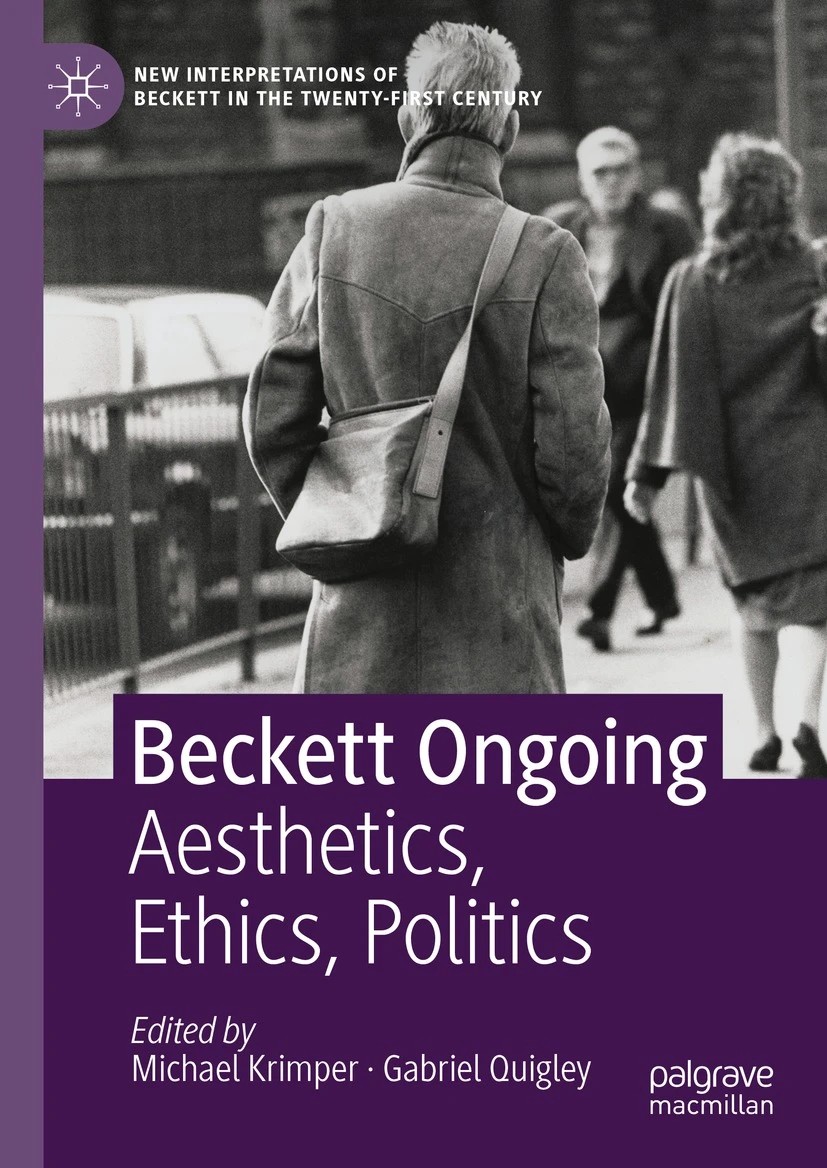
Reviewed by James Martell
As the chapters in this volume show, Beckett scholars are particularly adept at perceiving (listening and seeing, but also touching, smelling, and somewhat tasting) all the material metaphors and figures that build his oeuvre, from the primeval and infernal mud of How It Is to the scorching landscape in Happy Days and the fire of Krapp’s memories. In this sense, it is not surprising that a volume focused on the notion of ‘ongoing,’ and especially on the morpheme ‘on,’ a particle that denotes both temporal and spatial extension—and support—would display so many on- and sometimes no-going surfaces as they make and unmake place in Beckett. What is surprising and laudable in Beckett Ongoing is the way the contributing authors manage to show how such Beckettian topology opens radical perspectives on our modern understanding of the political, and particularly of its failures.
In the volume’s first chapter, ‘Beckett: On,’ David Lloyd shows how Beckett’s ‘proper’ thing is precisely an exposition of the ruptures or holes on the surface where subjects and objects are thrown (as sub-jet and ob-jet): ‘Emanating from a mouth that is a wound, or from a nameless placeless inner exterior, Beckett’s voices are the mark of a gap or tear in the fabric of subjecthood itself’ (32, emphasis mine). Further, Lloyd remarks how any consideration of the ethical or political possibilities of thought inherent in Beckett’s oeuvre lies neither in his biography nor in the content of his expression, but rather on the singular forms as places and things that his oeuvre makes—in the most figural and material-imagistic way—from where thought can arise: ‘In Beckett, both subject and voice (…) offer us the pitilessly negative image of the place and the thing from “which our condition is to be thought”—if at all—once again’ (32-33, emphasis mine).
The next chapter, Cosmin Toma’s ‘How to Become a Thing: Overcoming Mourning in Ill Seen Ill Said,‘ takes the work of mourning as its focus. Toma argues that Beckett is one of the best authors with whom to work through our own mournings, precisely because he makes us work. Insofar as we must work as readers of Beckett’s difficult text, we realize that we are part of our mourning textualities, semantic but also syntactic beings. Here, ‘the subject–object distinction becomes moot within the res literaria, which is a monstrous fusion between a human and a nonhuman, between a text and its reader—it is a thing in the uncanniest sense of the term’ (53-54).
Nadia Louar’s chapter, ‘Beckett’s Figural Language: A Reconfiguration of the Sensible’ reads Beckett’s figurality vis-à-vis Lyotard’s famous notion of the figural. Borrowing from Lyotard, she shows how Beckett’s literature, as an event, might not necessarily utilize existing surfaces of inscription, but rather invents them through its tracings: ‘if it occurs, it must touch some “surface” where it leaves its trace: a consciousness, an unconsciousness, individual or collective. Perhaps it even had to invent this surface in order to leave such a trace’ (Lyotard, qtd. in 69).1 For his part, Jean-Michel Rabaté, in ‘Rêve de transfert collective: Beckett’s Resurgent Unanimist Dream,’ shows how the French literary movement, Unanimism, was not merely an early influence on Beckett, but even perhaps a ‘dark mirror’ upon which we can read Beckett’s purportedly isolated and lonely characters. As Rabaté describes it, this unanimist background could be seen, quoting Beckett’s own ‘Les deux besoins,’ as the “enfer d’irraison d’où s’élève le cri à blanc, la série de questions pures, l’oeuvre.” [the hell of unreason from which the white-hot scream rises, the series of pure questions, the work.] Here is the minimal ontology chosen by Beckett'(93). In this dream or nightmare of collective transference, ‘no one is truly alone when writing, no writing subject can be assured of being alive or dead in that process’ (93). In this Unanimist ground, we are in that ground/abyss of indistinction not only between human subjects, but also between the human and the non-human as we saw in Toma’s chapter.
Gabriel Quigley and William Broadway’s chapters, ‘Beckett’s Unwarranted Miracles: Pascal, Geulincx, Kleist’ and ‘Philosophy in the Flesh: Feeling, Folly, and Animals in Beckett’ raise questions about two particular sides of Beckett’s on/no-going topology: miracles and animals. While the miracle, understood in the occasionalist tradition, can be seen as yet another affirmation of the lack of freedom in Beckett’s universe, Quigley sees it as an opportunity for wonderment, and thus for a more positive view of Beckett’s inherited occasionalism. For his part, Broadway sees Beckett’s animals as a significant facet of his topology, continuous with the human through sensation and empathy, notwithstanding what rationalism dictates or justifies.
Finally, Michael Krimper and Stefanie Heine gently problematize the volume’s emphasis on the surface, asking, in different ways, what is under the surface. The groundlessness that supports Beckett’s continuity is the focus of their chapters ‘”The Golden Moment”: Enclosure, Fugitivity, and Broken Immanence’ and ‘Sans Cesse: Beckett, Proust, Knausgård.’ In these final chapters the image of an immanent yet broken—pierced with innumerable holes or gaps—Beckettian universe appears, what Krimper describes, borrowing Jean-Luc Nancy’s notion of disenclosure (déclosion), as ‘the groundlessness on the basis of which the totalizing enclosure of the world is founded and maintained in late capitalist modernity, an undercurrent flowing elsewhere’ (145, my emphasis). While Krimper shows an underlying continuity between beings in Beckett, particularly in instances like Molloy’s ‘golden moment’ at the end of the first part of the novel, Heine traces a type of discontinuous continuity through Beckett, Proust, and Karl Ove Knausgård. She notes Beckett’s correction of the traditional translation of Proust’s ‘sans solution de continuité‘ from ‘without loss of continuity’ to ‘without solution of continuity’ in his essay on Proust. At the end, Heine goes on to expose the figure of Beckett’s superficial on/no surface as a continuously transpierced Moebius band. As a whole, Beckett Ongoing makes clear that it is only through the holes of such a trypophobic and/or trypophilic surface that new thoughts of ethical, aesthetic, political, and ontological subjectivities and objectivities have their chance to arise and develop.
James Martell is Associate Professor of French and Comparative Literature at Lyon College. He is the author of Modernism, Self-Creation, and the Maternal: The Mother’s Son (Routledge 2019), and of Beckett and Derrida (Cambridge UP, forthcoming), and the editor of the upcoming Understanding Sade, Understanding Modernism (Bloomsbury). He co-edited Samuel Beckett and the Encounter of Philosophy and Literature (Roman Books) with Arka Chattopadhyay in 2013, with Fernanda Negrete, in 2018, a special volume of Samuel Beckett Today/Aujourd’hui, titled ‘Beckett Beyond Words,’ and in 2021 Tattooed Bodies: Theorizing Body Inscription Across Disciplines and Cultures (Palgrave) with Erik Larsen. He is currently working on a book on surfaces of thought in European literature and philosophy.
1 Jean-François Lyotard, Textes dispersés. Miscellaneous Texts, ed. Herman Parret (Leuven: Leuven University, 2012), 201.
 The Beckett Review
Leave a comment