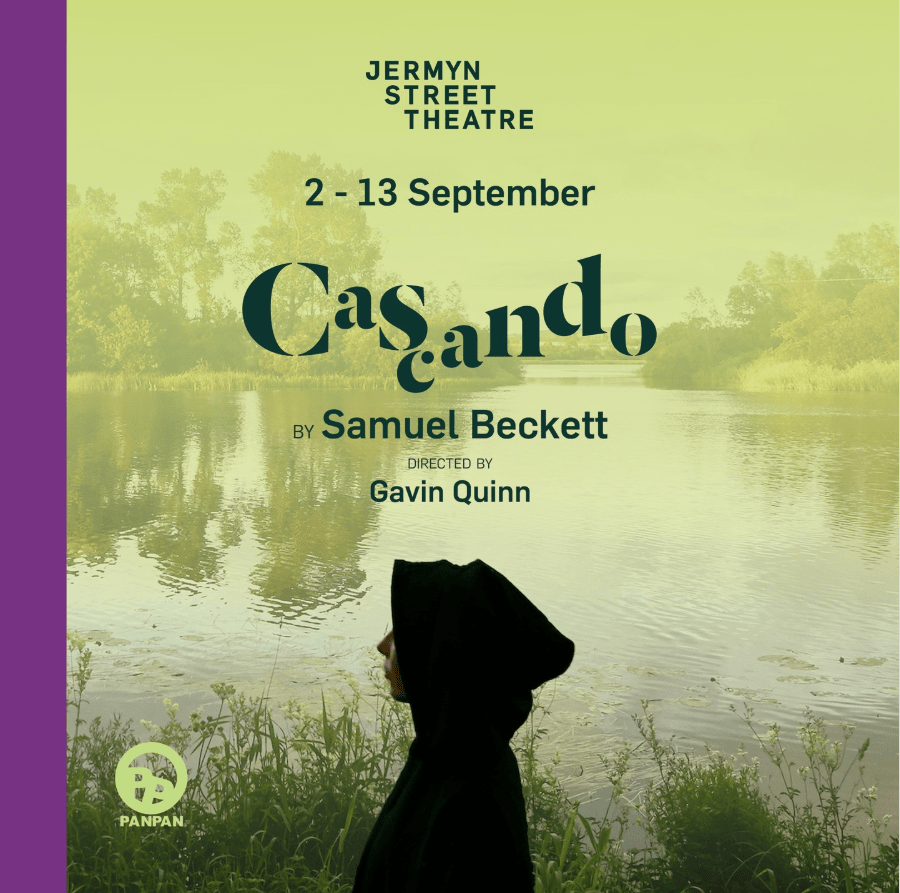
Directed by Gavin Quinn (Pan Pan Theatre)
Featuring Andrew Bennett (Voice), Daniel Reardon (Opener)
Music by Jimmy Eadie
Design by Aedín Cosgrove
Tuesday 2 September 2025
Review by James Baxter
‘It is the month of May … for me’. The first line of Beckett’s 1961 radio play Cascando stumbles at the outset, tripping on problems of time and perspective that leave the text adrift somewhere, ‘elsewhere.’ It is September when we arrive for the revival of Pan Pan’s renowned production at the Jermyn Street Theatre, at the tired end of a long hot summer. Described as a ‘rhythmic, immersive, group choreographical experience,’ the company intelligently translate the text for radio into a walking performance that proves very effective at implicating the audience within the denuded environments of Beckett world. Indeed, the most effective Beckett productions find a way to hold the spectator within the embodied instance of contradictory impulses. In this case, Beckett’s enigmatic tale unfolds as a haunted journey into the heart of [Transport for London’s] Zone 1, situated against the rarefied chill of the back streets of London’s West End, breathing strange new life into Beckett’s restless voices.
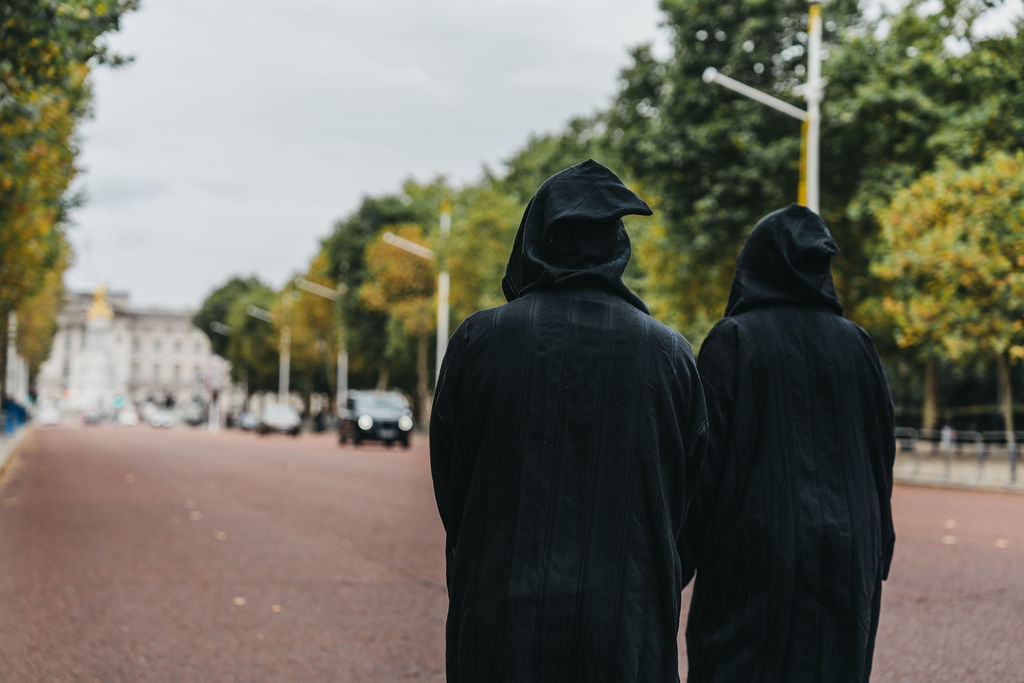
Shortly after arriving at Jermyn Street Theatre – a venue with its own sturdy history of notable Beckett productions – a robe and headphones (with attached iPod Nano) are handed to the audience who remain cloaked, listening to the pre-recorded play for the duration of the walk.1 Since 2016, the performance has itself roamed widely across locations in London, Dublin, Berlin, New York City, and as far as Xichang, China (the last time Cascando was performed in London in 2023 found Pan Pan’s walkers roaming the brutalist cloister of the Barbican Centre). Throughout, the company has acquired a reputation for multimedia and experimental approaches on the cutting edge. Just before setting out again, Pan Pan artistic director Gavin Quinn offers a few introductory remarks, commenting that the dark robes place the audience in a unique position of being both anonymous and observed. As the performance begins and the audience sets out in single file, truncated under-robe glimpses (you are encouraged to keep your head down) reveal Jermyn Street’s glassy facades, from high-end footwear to glossy bookstores. The total effect is somewhere between a live art installation and a silent disco from hell.
On the face of it, Cascando is an unlikely option for a high-concept Beckett revival. A relatively minor work for words and music, Beckett would remark that the text is ‘about the character Woburn who never appears.’2 We meet two speakers – Opener and Voice – who each hover around a third solitary figure, laying claim to his story. Through the metatheatrical layers of Beckett’s construction, we glimpse ‘Woburn’ as he heads out, wearing the ‘same old coat,’ to the coast in the hope of shelter or something else. The central monologue is impressively performed by Andrew Bennett, who substitutes the panting tenor of Beckett’s own English translation of the French script with a gravelly baritone: an absorbing voice that could be engaged equally in an act of seduction or sinister pursuit. Bennett’s delivery skilfully navigates the author’s tonal rotations, turning on his own search for a satisfyingly final story, a terminal difficulty which, as with so much of Beckett’s work, turns into a generative means to continue ‘on… getting on… finish… don’t give up… this time… it’s the right one…’. By contrast, Daniel Reardon’s ‘Opener’ speaks in a nakedly artificial register, barking orders to open and close, rummaging around the narrative’s various chambers. All the while, we are left with a central question floating around an unresolvable core: who is speaking to whom?
It is to Pan Pan’s credit that both the design (Aedín Cosgrove) and performance of Cascando provide enough to reconsider the abiding strengths of Beckett’s early 1960s audio experiment. Throughout, the tense dynamic between Opener and Voice is intercut with flashes of music (arranged by Jimmy Eadie) which both colour and confound the narrative situation. Like comparable works for radio, such as Words and Music, Cascando denaturalises the component pieces of a theatrical scene, exposing its emotional geometry. In this regard, characters appear inextricably linked to their audio emanation, reaching its full potential in the rising strings that accompany Voice’s roving monologue. The overlap of music and monologue create uncanny moments of melancholy that are difficult to resist – no less for our embodiment of Woburn’s journey during the walk itself. We can’t help but go along, the recording operating on the audience like a Skinner Box, prickling with emotional spikes that fire before being sharply withheld.
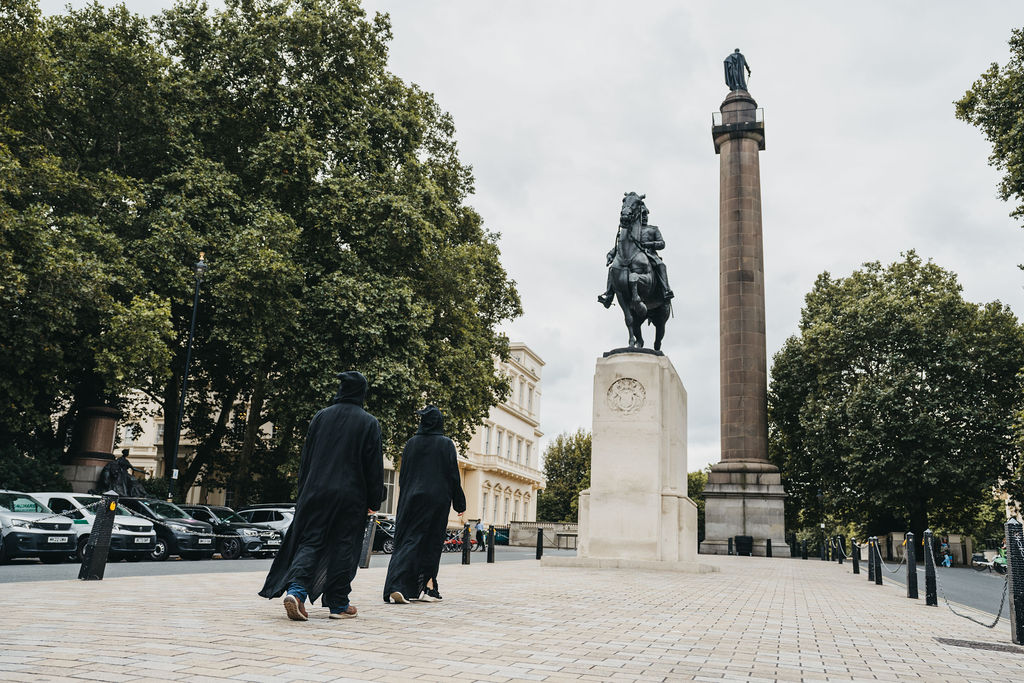
Likewise, the play necessarily invites altered consideration of the environment. At a certain point, the walkers cut away from Jermyn Street and begin the passage down to St. James’s, where we participate in a turn about the garden square, amid the flush Georgian townhouses of private members clubs and high-end marketing agencies. Here, the clamour of Leicester Square and the flashing screens of Piccadilly are replaced by Chatham House and the stately yet oddly attenuated entrance to 1 St. James’s Square: the London headquarters for BP. In this context, the funereal procession takes on a strange new meaning. Making our way back up, we pass a few shrilly lit office buildings: mostly empty, except for a lone security guard or a few Londoners working overtime, hunched over a laptop screen. All the while, dimly underneath the cushion of headphones, the ominous growl of the city adds a further transformative detail to the play’s sonic power.
Beyond a few stray glances there isn’t much in the way of public reaction (for better and for worse). A glance from a nearby restaurant, a tourist stopping to take a photo before moving on. Passing up Duke of York Street on the way back to the theatre, a few drinkers from the after-work crowd threaten to approach, all Cheshire Cat grins and plummy accents. Rather, the most enduring impact of the performance is local, meditative, tuned into the rhythmic movement of fellow walkers. While from the outside we are indistinguishable, each member of the procession is simultaneously cut-off from the person in front and the person behind. Much like Beckett’s marooned audio figures, the individual is both shut-off and connected to the push and pull of others (with a few seconds between each participant’s iPod being switched on, one also acclimates to the silent collective experience as a kind of prolonged echo of Beckett’s play). You become keenly aware of your fellow participants upon considering the difficulty in knowing whether what you are hearing matches up exactly with what others are listening to. To find a ‘new way’ of ‘being we’ Beckett writes in ‘The Capital of the Ruins’.3 Similar difficulties haunt Cascando, with Reardon’s Opener offering the refrain that Woburn’s story is simply ‘in his head,’ only to later add, ‘There is nothing in my head.’
By the final leg, we find Woburn, previously fallen into sand and mud, as he is sailing out into open water. As Bennett’s Voice preys closer to its target, in time with the crescendo of strings, the performance ultimately amplifies a sense of bathos, the monologue unable to achieve any lasting succour. The most that Beckett’s ghosts can hope for, it seems, are moments of fleeting unity between words and music, ‘as if linking arms’. Despite challenging material, Pan Pan allows these moments to shine through, affording enough room for the enjoyment of chance encounter and wandering observation. In other words, (and perhaps the best that can be said) is that, now, it is quite difficult to imagine Cascando being performed as anything other than a robed promenade. And yet, it is surprising how quickly you feel at home in the hum of the city, despite the Beckettian garb, no longer out of place exactly, just another component of an obscure crowd. With the performance over, you hand your robe and headphones back and set about making plans to travel home. Another day in the ghost town.
James Baxter is a researcher, editor, and ghostwriter, based in London. He holds a PhD in English Literature from the University of Reading and is the author of Samuel Beckett’s Legacies in American Fiction: Problems in Postmodernism (Palgrave, 2021). He is currently working on a study of the mid-century ‘big little magazine’ titled Literary Hospitality: Little Magazines, the Mass Market, and the Mid-Century United States, which is under contract with University of Massachusetts Press.
1 Recent Beckett performances at Jermyn Street Theatre include: 2021’s Footfalls and Rockaby (Dir. Richard Beecham), 2020’s Beckett Triple Bill: Krapp’s Last Tape, Eh Joe, The Old Tune (Dir. Trevor Nunn), 2012’s All That Fall (Trevor Nunn); also noteworthy is 2024’s Not Beckett, a showcase of 5 short plays in conversation with Beckett by Jennifer Barclay, Olwen Fouéré, Felispeaks, Hannah Khalil and Nicola McCartney.
2 Deidre Bair, Samuel Beckett: A Biography (London: Vintage, 1990), p. 574.
3 Samuel Beckett, ‘The Capital of the Ruins,’ in The Complete Short Prose of Samuel Beckett: 1929-1989, (New York: Grove Press, 1997), p. 277.
 The Beckett Review
Leave a comment