
Directed by Vicky Featherstone
Featuring Stephen Rea
Sunday 4 May 2025
Review by Andy Wimbush
For a play about an obsession with the retrospective, putting on a truly authentic production of Krapp’s Last Tape requires a surprising amount of forethought. In February this year, Samuel West announced that he had recorded the taped section of the play back in 2006 – Beckett’s centenary year, no less – when the actor was 39, the same age as Krapp was when he created Spool Three (Box 5). For a brief six-day window, starting on Beckett’s birthday, 13 April, it was possible to book extremely early-bird tickets for West’s performance, which will take place in Dublin in 2036, when West himself will be 69: the age of the Krapp on stage.
Luckily, we don’t have to wait that long for a Krapp with some distance from his mechanical reproduction. Stephen Rea – who plays Krapp under the direction of Vicky Featherstone at the Barbican – also elected to tape his lines in advance. ‘I had no certainty that one day I might play Krapp,’ Rea said, ‘but I thought it a good idea to pre-record the early tapes so that the voice quality would differ significantly from that of the older character, should the opportunity ever arise to use it.’1 This is the kind of forward planning required for a play set, as the stage directions stipulate, on a ‘late evening in the future.’
It’s a risky move, however. The recorded voice of yesteryear is unchangeable. Its performance cannot be given notes. It cannot be revised. John Hurt, who played Krapp on and off for over a decade, always used the same recording for each performance and became increasingly dissatisfied with his early work. ‘The more I come to dislike what I did on the tape,’ Hurt reflected, ‘the more it plays into the hands of the present Krapp.’2
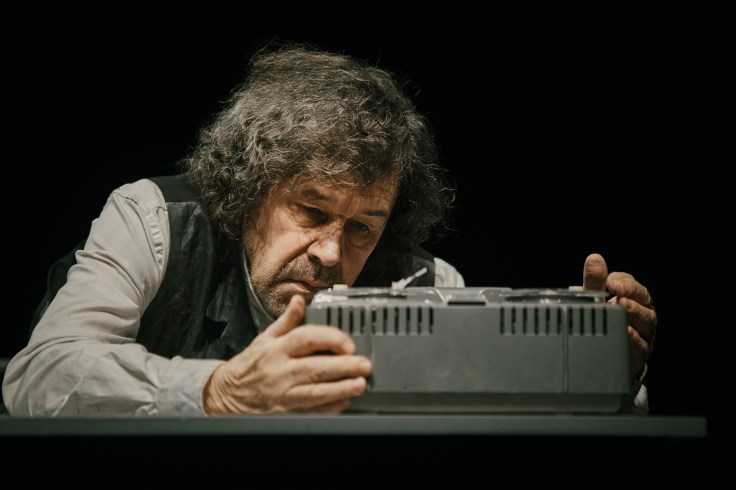
Hurt recognised his physical resemblance to Beckett and leant into it whenever he played Krapp: pomading his silver hair into the erratic spikes familiar from John Haynes’s photographic portraits of the playwright. Rea’s Krapp, however, has a cloud of charcoal curls and faint beard. Against the gloom of a darkened stage, they seemed to evoke two of Beckett’s great influences. On the one hand, he looked like Rembrandt – another obsessive autographer – in his later self-portraits: the ones from 1659 onwards, in which he looks out at the viewer with a kind of desultory sigh as if to say ‘Well, what did you expect?’. Rea gave a similar kind of shrug and sad half-smile to the audience more than once during the performance. On the other hand, I could almost see Rea’s Krapp as a washed-out version of Descartes, as if that most famous portrait of him had been sent to clown school, kicked out for falling asleep in class, and then drowned in a bottle of whiskey ever since. Krapp, of course, has none of the comforting epistemological bravura of Descartes’ chief realisation, which so confidently proclaims the supposedly indubitable truth ‘I am, I exist.’ The further Krapp’s meditations go, the further he seems from anything resembling a clear and distinct Cartesian ego since he is perpetually at odds with earlier versions of himself. Twice in the play, Krapp mentions that there is ‘not a soul’ around. Stanley Cavell once pointed out that Beckett is fond of literalizing idioms and unfixing clichés: taking an ossified phrase and forcing it to mean precisely what it says.3 Krapp’s is one of these: there is truly not a soul, no ideal core of the onion, no discernible Cartesian self that holds his tapes together. Indeed, when the stage directions instruct Krapp to wrench off the tape he has just recorded and throw it away, Rea launches it with gusto, stage right, into the same darkness that swallowed the two banana skins from earlier. This is self as detritus.
One of Rembrandt’s most striking self-portraits from his younger years was, for many years, referred to as Democritus Laughing, on account of an anonymous inscription on the back: ‘Democrite Philosophe [?] /son [?] profonde meditation / des (de?) [?] faiblesses [?] / tous ensemble. Nous concevons mille différ? / nous formons mille projets que nous ne [?] / pouvons executer. / C’est une espece de folie r[?] ce Philosophe / Je [se?] ris.’4 In describing his tragicomic vision, Beckett often evoked the pairing of Heraclitus weeping over the incessant flux of the world and Democritus, instead, laughing at it. ‘I might do worse than find myself as it were polarised between Democritus and Heraclitus for eternity,’ he told Nuala Costello in 1934, ‘I would be familiar with that position.’5 This balance between tears and laughter is difficult to get right in staging Beckett. I was decidedly unimpressed by the last Krapp I saw at the Barbican: Robert Wilson playing the role ten years ago with a shrill and clownish abandon that robbed Beckett’s most poignant play of its pathos. Rea and Featherstone get it just right, however. There are plenty of moments that borrow from the vaudeville and silent comedies that Beckett so loved. Krapp’s drawer, at the right of his desk, is preposterously long and the bananas are always at the very far end of it. Rea hastens his way off stage to get boxes and knock back a drink with a hunched and comical shuffle. He even has clownish stripy socks protruding between his white boots and black trousers. And there are plenty of laughs to be had in this performance, most notably with the bathetic tonal pratfall when Krapp-the-elder starts recording: ‘Just been listening to that stupid bastard I took myself for thirty years ago.’ But this is still very much the ‘wearish old man’ mentioned in the stage directions – the Democritus Jr of Robert Burton’s Anatomy of Melancholy. I found Rea’s Krapp perhaps the saddest, loneliest, and most abject version of the character I’ve seen yet. In the early stages of listening to his 39 year-old self, he seemed to lean in towards the machine, yearning for its youthful company. Then, as the tape starts to wax romantically about the ‘miracle’, the ‘fire’ and the ‘great granite rocks’ at the end of the pier, Rea became not quite exasperated, but anxious, panicky even: mopping his brow, fidgeting, cringing, and wringing his hands, as if he just found it just too unbearable to hear – whether from alienation or embarrassment or both. And then, at the passage he wanted all along, the bit about the punt and the sunshine and the lying down across her, Rea put both his arms around the tape machine, cradling it. Like the younger Krapp, he so desperately wants to be let in. Rea even glances over his shoulder before he replays this faintly steamy section, self-conscious about the voyeurism with which he revisits an intimate moment that is, strictly speaking, no longer his. All in all, Rea cuts a far more convincingly defeated, deluded, and dejected character than previous Krapps.
In his 1930 essay Proust, Beckett set out a rather glum theory of personal identity that anticipated what he does in Krapp’s Last Tape: ‘the individual is the seat of a constant process of decantation, decantation from the vessel containing the fluid of future time, sluggish, pale and monochrome, to the vessel containing the fluid of past time.’ Subtle choices with light and set make this very much a monochrome production: lit and designed with a coldness and sterility appropriate to a ‘future’ of mechanical self-storage. The flat greys of the furniture. The sharp edges of the spotlighting. The sound helps too. There’s an unsettling low electronic hum that seems to get louder as the play progresses. Krapp’s lonely steps echo metallically as he hurries from desk to drink and back again. It all serves to reinforce the hollowness of Krapp’s life, the loneliness that is particularly apparent in Rea’s performance, and the absurdity of trying to hold on to one’s best moments through an indifferent machine. At the very end of the play, the fade to black is briefly arrested by an unexpected flash of light that signifies neither death nor epiphany, but rather the mere snapshot of this life that we have just witnessed.
Molloy advises that ‘the most you can hope is to be a little less, in the end, the creature you were in the beginning, and the middle.’ Krapp’s Last Tape – perhaps particularly in this production – shows us that we needn’t bother hoping for even this: the diminution is inevitable.
Dr Andy Wimbush teaches courses on Beckett, Melville, and other things at the Institute of Continuing Education at the University of Cambridge. His book Still: Samuel Beckett’s Quietism was published in 2020 by Ibidem.
1 ‘Krapp’s Last Tape: Digital Programme.’ Available at: https://www.barbican.org.uk/digital-programmes/digital-programme-krapps-last-tape [accessed 4 May 2025].
2 John Hurt, ‘Krapp’s Last Tape: John Hurt on Samuel Beckett’s loner hero’, The Guardian, 23 July 2014. Available at: https://www.theguardian.com/stage/2014/jul/23/john-hurt-samuel-beckett-krapps-last-tape [accessed 4 May 2025].
3 Stanley Cavell, Must We Mean What We Say? (Cambridge: Cambridge University Press, 1976), p.111.
4 ‘Rembrandt Laughing (Getty Museum).’ Available at: https://www.getty.edu/art/collection/object/103QTM#full-artwork-details [Accessed 4 May 2025]
5 The Letters of Samuel Beckett: Volume 1, 1929–1940, ed. by Martha Dow Fehsenfeld, Lois More Overbeck, Dan Gunn, and George Craig (Cambridge: Cambridge University Press, 2009), p. 185.
 The Beckett Review
Leave a comment