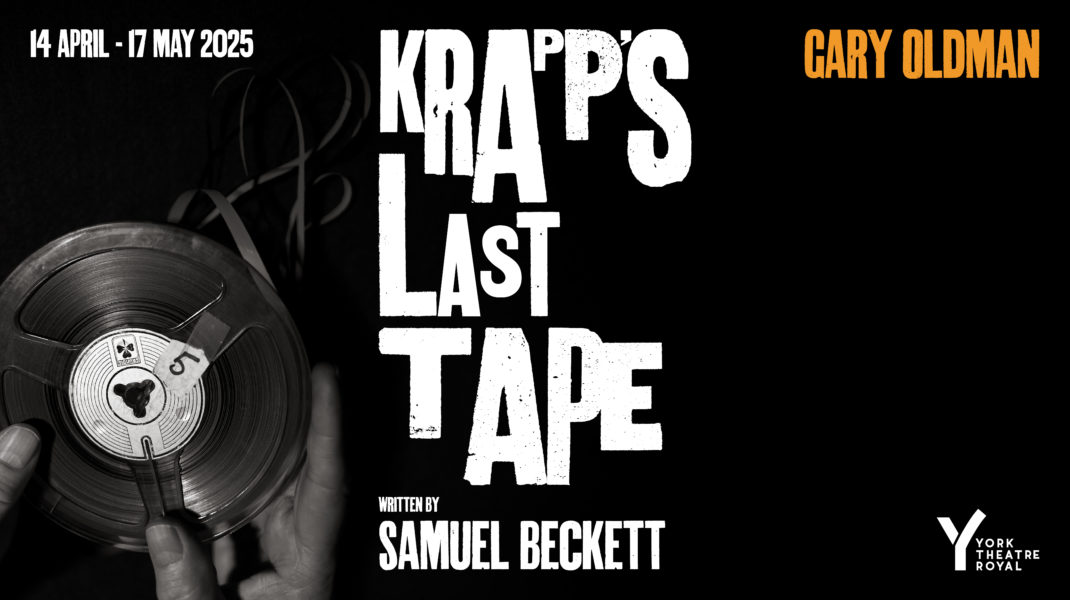
Directed and designed by Gary Oldman, by arrangement with Doug Urbanski
Featuring Gary Oldman (Krapp)
Wednesday 23 April 2025
Review by Emilie Morin
Will April 2025 be remembered as Krapp month? In fact, have we ever seen as many high-profile productions of the same Beckett play competing for attention in a single month?
On 14 April, Gary Oldman’s much-awaited production of Krapp’s Last Tape opened at York Theatre Royal. On 30 April, a short run of performances starring Stephen Rea as Krapp, directed by Vicky Featherstone, opened at London’s Barbican, using tapes that Rea prerecorded fourteen years ago. Rea’s performance as Krapp is central to the BBC Northern Ireland documentary focused on his acting career, The Fire in Me Now, first aired on 24 April. And, on 13 April, in honour of Beckett’s birthday, ‘Extremely Early Bird’ tickets went on sale for two other productions, firmly set in an evening in the future this time. The agenda involves maximum situational exactitude: these future productions will feature the British actor Samuel West and the Irish actor Richard Dormer, who recorded their tapes in different BBC studios when they were thirty-nine years old and will perform the play when they reach sixty-nine, for Art Over Borders’ new Beckett Biennale, in 2036 and 2038 respectively.

Krapp’s Last Tape is, of course, ill-suited to so much hype. This is such a humble, pared-down play, which does so much with so little. But we should greet this major revival with gratitude: perhaps these are the last chances for this play to get an extended public airing in its original form. Indeed the specific apparatus this play requires means that it will soon be a museum piece – unless permission is given to perform it very differently. Well-functioning reel-to-reel tape recorders are rare, but they can be sourced – what is harder to find is someone with the technical expertise to fix them. Spare parts are as rare as hen’s teeth. Reel-to-reel tape recorders were common in radio studios as late as the 1990s, especially in France, but they never took off with fans of obsolete technology (how will a reel-to-reel tape recorder come across to audiences in the late 2030s?). Tellingly, the tape recorder used by Oldman ought to be a museum piece and probably will be one day: it is the device that John Hurt and Michael Gambon used before Oldman when performing the play and it is a temporary loan from Dublin’s Gate Theatre to York Theatre Royal.
Oldman’s is certainly a maximalist production and that approach has its charms. The stage is busy, with many books discernible in the background, upturned chairs at the front, boxes of all sizes and types, piles of unidentifiable clutter, and plywood furniture coated in that characteristic 1950s and 1960s brown varnish (York, like any affluent British city, is packed full of charity shops selling vintage tat and treasures, many within a stone’s throw of the theatre itself). We are in the late 1950s, the set declares loudly. Visually, the only element that situates the performance in the present is the white plastic bag into which Krapp throws banana skins. There is brown gaffer tape just about visible on a cardboard box – but that, too, is an invention dating from 1959. The desk is at the centre of organised chaos. Around it, a small circumference of empty space allowing movement, with the rest remaining unnavigable, densely filled with unidentified things presumably pushed or thrown away by Krapp during his frequent bursts of anger. We seem to be on the top floor of a house – Oldman enters via a suggested staircase at the centre – and this is a room that Krapp doesn’t enter often: his ledger is covered in thick dust.
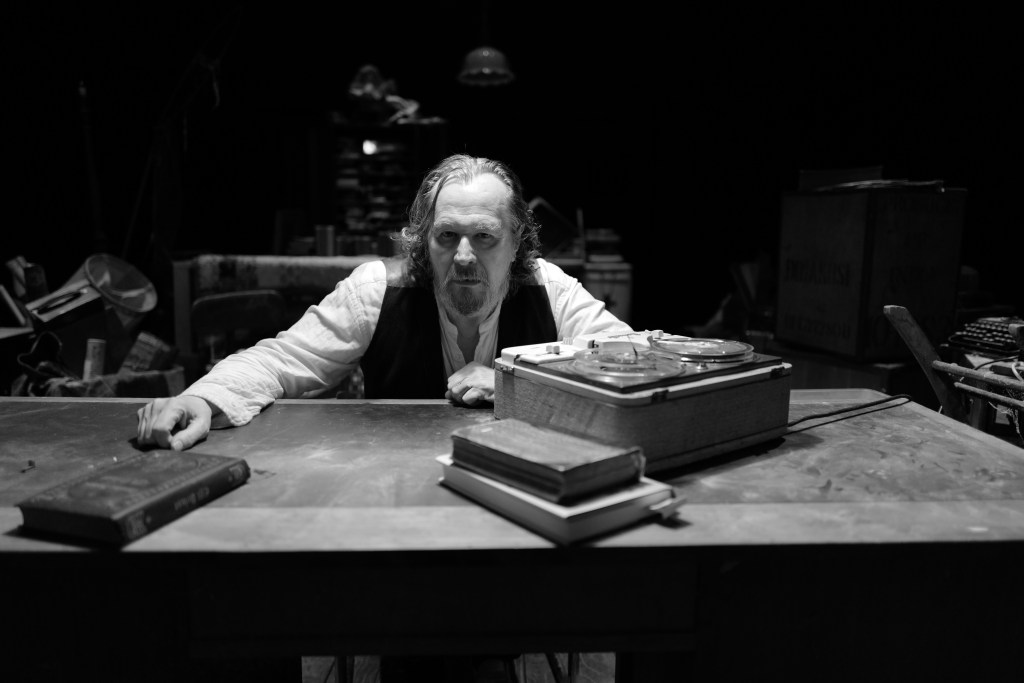
This, then, is a physical space with a history and there is nothing symbolic about it. It is excessively functional, excessively compartmentalised, excessively laden with heirlooms. What this does is allow a whole sonic world to arise. In the first part (shall we say the first movement?), the production is orchestrated by means of incidental sounds: Oldman’s wheezing and coughing, the shuffling of his feet on the stage floor, the rustling of the plastic bag, the plastic reels rubbing on the tape recorder. He moves around the back of the desk, towards a bookcase, to check his ledger, then his dictionary. There is no space within which to retreat offstage. A quarter bottle of whisky is stashed in a desk drawer. He drinks straight from the bottle. He peels his bananas the proper way, from the bottom and not from the stem – a small gesture which reinforces Krapp’s sense of himself as a connoisseur. He keeps his reels of tape in old biscuit tins. In short, there is a great deal of subtlety to the physical comedy.
The second and third movements revolve around the contrast between Oldman’s recorded and spoken voices. The voice on tape is mellow, seductive, naturally eloquent, comfortable with itself; it is a voice with the right habitus to get ahead in life. The spoken voice is broken – too broken to sing. It emerges from much wheezing and coughing, and only once a good amount of whisky has been had. Krapp evolves from idiotic to haunted as the play shuffles along from comedy to tragedy – a boundary probably crossed when the revelation on the jetty is evoked. The final movement – Oldman recording himself – is hypnotic. Suddenly, the character gains all the depth, poignancy and acidity that the rest of the performance had denied him. The fire is in him now.
As the programme explains, the production is a homecoming for Oldman, a return to the theatre in which he learned his trade in the late 1970s, and it is dedicated to the memory of John Hurt and Michael Gambon. What an odd journey this is, from the heat of LA and Palm Springs to the touristy, cramped, quaint delights of rainy, historic York. Oldman’s next commitment is Series 5 of Slow Horses for Apple TV+; sometime after that, his Krapp’s Last Tape will be revived for the Royal Court Theatre’s 2026 season. Iconic Beckett performances are like that, always in close proximity with other worlds that seem, on the surface, incompatible but are not so in practice. Much fun can be had thinking about the continuities between A Clockwork Orange and Patrick Magee’s Krapp, between The Omen and Whitelaw in Footfalls and Rockaby, between Jeanne Dielman, 23 quai du Commerce, 1080 Bruxelles and Delphine Seyrig’s Pas, between Bloodlands and Blackshore and Lisa Dwan’s Beckett dramas, between The Crying Game and Rea in Krapp’s Last Tape… Such dissonance between the world of the stage and the wider television and film industry was always part and parcel of the Beckett style; even the most Beckettianally single-minded of Beckett actors doesn’t work in a vacuum – how could they? It is, of course, profoundly odd to see a Hollywood star like Oldman on the stage of a local theatre, in a small city, in a country where theatres are routinely struggling to stay open because arts budgets have been gutted for so long. There is no doubt that the audience on the evening of 23 April was enjoying its brush with stardom. The reverence for Oldman was palpable. Some spectators came in thinking that they would have a good laugh and greeted every bit of physical comedy in that spirit. A few, however, didn’t feel that staying put was worth the bother. Yours truly, hypnotised by the performance, did not have the heart to turn back and check whether the people who made a noisy exit after fifteen minutes wanted out because nothing had happened yet or were trying to get to the toilet downstairs. It is hoped that this was a walkout. The play remains radical in its form, its intensity, its brevity. It was a good night.
Emilie Morin is Professor of Modern Literature at the University of York, UK. She has published widely on Beckett over the past twenty years. Her most recent contributions to Beckett studies are an essay on Beckett in Tangiers in Interventions and a Cambridge University Press Element entitled Suzanne Dumesnil, Suzanne Beckett, published in July 2025.
 The Beckett Review
Leave a comment