
Translated, performed and directed by Pablo Finamore
Lighting design by Leandra Rodríguez
Sound design by Nicolás Diab
Sunday 11 May 2025
Review by Alicia Nudler
In Argentina, where almost all of Beckett’s plays and several of his non-dramatic texts have already been performed, it is the first time this novella has been adapted for the stage. The performance took place in the Teatro-Escuela Moscú, a drama school and independent off-Corrientes theatre in the Villa Crespo district of Buenos Aires.
Clearly distinguishable from the stalls, two white diagonals cross the small, black, bare stage on which the actor moves about, avoiding the centre, covered by a black square. The difficult, abstract Worstward Ho text was set to the space Beckett designed for Quad, a TV play with no words at all and thus the seemingly endless, repetitive flow of words, the meaning of which often escapes readers and audiences, is bestowed with a physical spatial pattern. In an interview, Pablo Finamore jokingly described his production as ‘un poco de quick, un poco de quad‘ (a bit of quick, a bit of quad).
Finamore, an experienced theatre actor and director based in Buenos Aires, has had this text in mind for the stage for years, ever since he received Alan Badiou’s book Pequeño Tratado de Inestética [Handbook of Inaesthetics] as a birthday present, one chapter of which analyses Worstward Ho. Fascinated and intrigued by it, Finamore – dictionary in hand – translated Beckett’s novella himself, despite of the existence of a Spanish-published translation.1
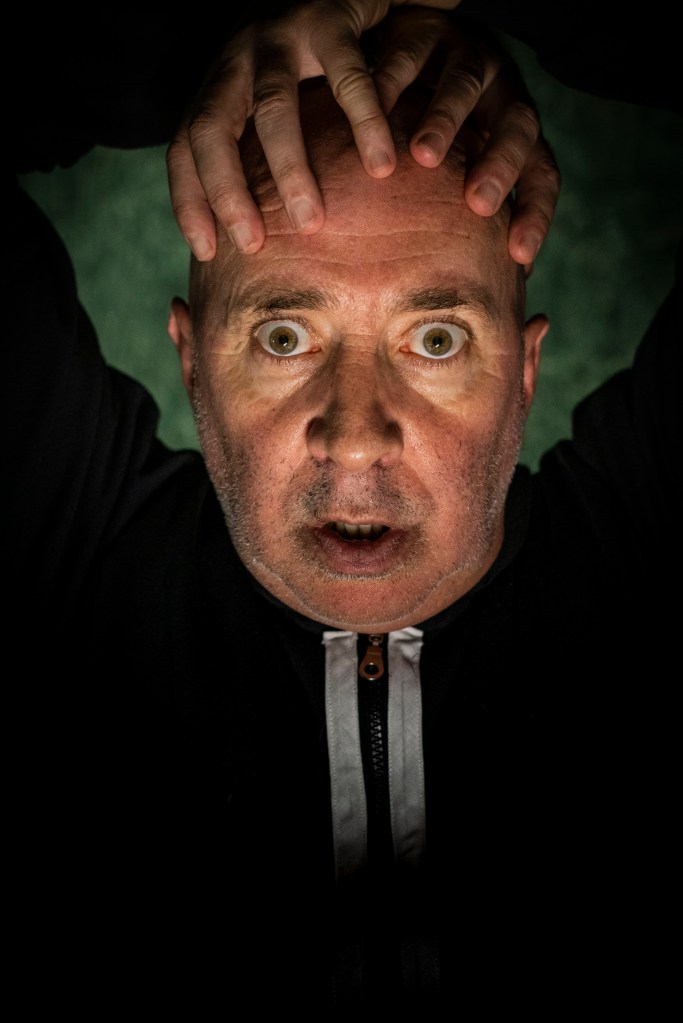
At the beginning of the performance, when the stage is lit up, Finamore appears from a dark corner. At first only his head is illuminated, then his torso, then his whole body. During the unfolding of the text, performed with rhythmic flow and an expressive body, Finamore directs his speech in one direction when evoking ‘the one’ – the woman – and in another direction when evoking ‘the two’ – the old man and boy. This structures the repetitions and provides a certain rhythm and soothing effect.
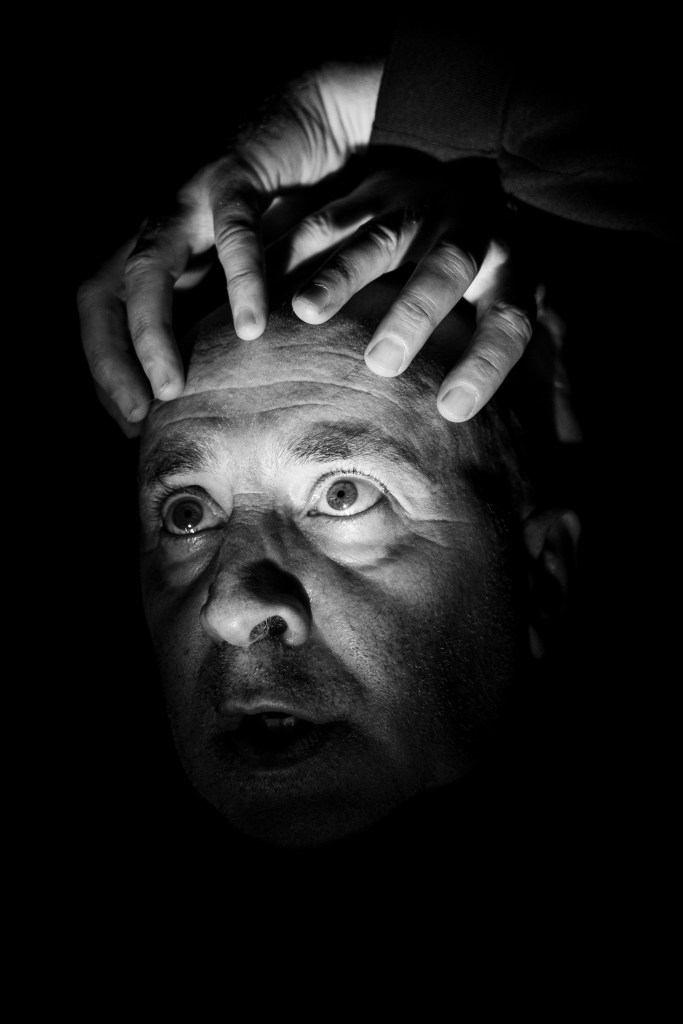
The introduction of a recording machine to the performance has Beckettian resonances. Finamore carries this device and on several occasions records short parts of the text and plays them back, especially around the paragraphs that mention ‘mejor peor‘ (better worse). Organising the space according to Quad and using a recording device are two of this performance’s real finds. Another is a gesture that Finamore repeats, where his hands claw at his forehead from behind, so that it appears as if someone else is doing it. This framing of the skull emphasises a key theme, if there is such a thing, in this relatively unfathomable Beckettian piece: thinking.
As Worstward Ho was not written for the theatre, lighting is not indicated by Beckett. However, the word ‘dim’ appears more than a hundred times in the text, sometimes along with ‘light,’ sometimes along with ‘void,’ sometimes by itself, as a noun. Leandra Rodríguez, a self-confessed Beckettian who has directed several Beckett texts in different performance settings, contributed various directorial aspects and created the lighting design, a fundamental aspect of this performance. The projection of a circle of light on the back wall underscores the idea of the skull, an image that persists in Worstward Ho. Nicolás Diab, who has worked with Rodríguez on several productions of Beckett’s plays before, contributes subtle sounds that emerge at certain moments from the floor of the stage.
Beckett struggled with this text for several months during the winter of 1981-2, until he finally sent it to his publisher and the book came out in 1983, its title parodying Charles Kingsley’s 1855 novel Westward Ho! It is in Worstward Ho, of course, where Beckett’s oft quoted sentence, ‘Ever tried. Ever failed. No matter. Try again. Fail again. Fail better’, appears. Beckett considered it impossible to translate this novella into French, although he made some attempts. The text was finally published in French after Beckett´s death, translated by his friend Édith Fournier, under the title Cap au pire, chosen by Beckett himself among options Fournier suggested.2
When, after attending the show, I read Worstward Ho and compared it to Finamore’s Spanish translation, I was slightly baffled by three of his choices. The first was his use of infinitives instead of imperatives. Beckett’s text is full of, what I understand, are imperatives, beginning with the incipit: ‘On. Say On.’ Regardless of the problem of how to translate the English word ‘on,’ which Beckett considered impossible, Finamore translates ‘Say on’ as ‘Decir aún‘ which we could also translate back as ‘To say on.’ Likewise, ‘Say for be said’ becomes ‘Decir para ser dicho, ‘Say a body’ is ‘Decir un cuerpo,’ and the famous ‘Try again. Fail again. Fail better’ becomes ‘Intentar de nuevo. Fracasar de nuevo. Fracasar mejor.‘ I understand those as imperatives in Beckett’s text, but it seems they could be considered either way. For instance, Dirk Van Hulle states: ‘the closure of the English version effectuated by means of the opening infinitive (or imperative) “Say”…’ (my emphasis).3 Independently of Beckett’s intentions, I think the imperative form grants those sentences a more powerful ‘urgent’ quality, while the use of infinitives dilutes them into more philosophical reflections on the human condition in general. Imperatives are used in the Spanish published version, which made me wonder whether Finamore’s choice was a result of the dilemma that Argentinian theatre often faces when it comes to imperatives or the second person voice. Argentinian Spanish conjugates these differently from Spain or other Latin American countries, but if the imperative is said in the Argentinian way it can sound too familiar or local and if it is said in the more ‘neutral’ way it sounds artificial.
The ambiguous presence of imperative/infinitive or command/description is somehow present in the title itself; Worstward Ho can be the description of a state of things (I/you/someone is going towards a worse outcome), but it can also be an invitation, an exhortation, especially if we consider its origin in Westward Ho! with the exclamation mark. Is there not an irony about West being swapped for Worst?
The other word I would translate differently is ‘dim,’ especially when it is used in combination with ‘light’. In Finamore’s translation, it is ‘penumbra‘, and again he is not alone in this choice, as Fournier translates ‘penombre‘. I think that ‘luz tenue‘ (a light that is not strong) might be an interesting alternative, as it keeps the word ‘light’ and therefore works as a reference to theatre. Finally, also relating to light, darkness and seeing, the fascinating oxymoron ‘Clenched staring eyes’ presents another challenge. Finamore uses ‘Ojos desorbitados cerrados‘, which amounts to a great image (something like bulging closed eyes), but this loses the deliberate action of staring. The longer ‘Ojos cerrados que miran fijamente‘ would work as another possibility.
This text is astonishingly difficult to memorise, as it is mostly composed of loose words or very short sentences, the majority of which are either a predicate-less subject or a subject-less predicate. Finamore surprises with a very fluid and rapid word-stream, halfway between performing and reciting. His body is also very expressive; sometimes it is difficult to know what it expresses exactly, but there is a human quality to it, especially when his postures evoke the shades: old woman, old man and child. ‘The twain,’ Beckett admitted to James Knowlson, was an obsessional childhood memory he had: an old man walking hand in hand with a child. For me, this was one of the most touching moments in Finamore’s performance, together with the image of the child raised to reach the holding hand, which has also stayed with me. In the end, Finamore manages to conquer a very arid text and, even with the added obstacle of language migration, successfully stages what Knowlson has called ‘a hard, spare, yet still moving poetic prose,’ resurrecting words, ‘particularly powerful when read out loud.’4
As is always the case with Beckett texts that were not designed for the stage, every production has its own understanding and approach and this is even more apparent with this enigmatic and open piece of writing. Worstward Ho is not one of Beckett’s most staged works, but there have been some productions worth mentioning. Mabou Mines staged it in New York in 1986, directed by Frederick Neumann. Beckett granted the rights and had several exchanges about this production with Neumann, who by that time had become his friend. According to descriptions, this staging was very different from the one I am reviewing here. Apart from Neumann, who uttered the text, it featured three other actors who silently impersonated the woman, the old man and the child. Neumann was kneeling inside a grave, with a skeleton to his side, emphasizing the aspects of the work related to death.
In 2005, Gare St Lazare Ireland staged Worstward Ho in Cork’s Public Museum, which was performed by the North-American actor Lee DeLong and directed by Judy Hegarty Lovett. According to Fintan O’Toole, DeLong ‘goes for a warm, almost chatty tone, creating a cadence that is close to conversational. She also disrupts the minimalism of the piece. She gestures with her eyes and hands, moves about the playing area with considerable freedom, and occasionally smiles at us as if this evocation of the waning of life were actually a rather jolly game.’5
Back in Buenos Aires, critics unanimously praised Finamore’s performance. And on Alternativa Teatral, the city’s main online theatrical listings guide, many spectators left their impressions which for the most part celebrated this staging of an extremely difficult text. In other words, Finamore did not fail at all, nor did he fail better. In the teeming and highly competitive world of Buenos Aires theatre, this production stood out.
Alicia Nudler is based in Bariloche, Argentina, where she teaches psychology and group dynamics to drama students at the University of Río Negro. Her research focuses on theatre spectatorship from an embodied cognitive perspective. She is also working on the history of performances of Beckett´s plays in Argentina from the 1956 premiere of Waiting for Godot to date.
1 In my research of staged Beckett’s texts in Argentina, I have found that theatre practitioners often prefer to do their own translations.
2 James Knowlson, Damned to Fame, (London: Bloomsbury, 1996), 685.
3 Dirk Van Hulle, ‘Translation and genetic criticism: Genetic and editorial approaches to the ‘untranslatable’ in Joyce and Beckett, Linguistica Antverpiensia, New Series: Themes in Translation Studies, 14 (2016), 51.
4 James Knowlson, op.cit., 675.
5 Fintan O’Toole, The Irish Times, 8 April 2005, https://www.irishtimes.com/culture/reviews-1.430301, [accessed July 21, 2025].
 The Beckett Review
Leave a comment