The Beckett Society has initiated a programme of publishing peer-reviewed essays by early career researchers as a means of broadening access to publication for all scholars. We are delighted to publish this work, the first in the series, by Alicia Nudler. Alicia is based in Bariloche, Argentina, where she teaches psychology and group dynamics to drama students at the University of Río Negro. She completed her PhD in History and Theory of Art in 2024 at the University of Buenos Aires. Her research focuses on theatre spectatorship from an embodied cognitive perspective. She is also working on the history of performances of Beckett´s plays in Argentina from the 1956 premiere of Waiting for Godot to the present. She has published in Samuel Beckett Today/Aujourd´hui, Journal of Beckett Studies and Beckettiana.
Three Versions of Krapp´s Last Tape through Daniel Stern´s Vitality Forms
Theatre semiotics has often understood meaning as eminently propositional, an intellectual activity linked to language, thus failing to account for bodily impact and the sensorial/convivial aspects of theatre, which often resist verbalization. Critics like De Marinis (1997) and Pavis (2003) have stressed this limitation and proposed new concepts to broaden theatre theory. However, the moment-to-moment unfolding of the experience of play-watching has remained insufficiently explored. My research focuses on the ways in which meaning and perception/body impact braid together in theatre spectatorship. With that aim, I have studied Beckett´s 1958 play Krapp´s Last Tape through embodiment and the concept of forms of vitality (Stern, 2010).1
Specifically, I look at how movement, perception and the experience of time affect the construction of meaning in spectatorship, creating certain ‘understandings’, experiences, and emotional results. I selected Krapp´s Last Tape as my case study for several reasons. I saw it for the first time in Buenos Aires in 2016, and I was deeply moved and intrigued. What was so touching about this old man listening to his own past voice? I sensed there was some mystery in the pauses, in the detentions and accelerations of the tape, encapsulating more meaning than I could grasp. As I repeatedly read and watched the play, I found some answers, and new questions arose (and still do). Immersing myself in the play, a universe of meaning, well beyond my initial intuitions, emerged. Why does Krapp stop the tape when he does? What prompts him to sometimes rewind and sometimes fast forward? Why does he skip only the scene of the jetty? What is so extraordinary about this jetty to become the scenery for such a vision?2 Why does he listen more than once to the punt scene? Some of these questions found answers through iterative watching, in a back and forth process consulting Beckett´s text. The written play has some latent meanings, only realized by repeatedly watching it, when the actions are seen and heard, unfolding over time.
I also selected this play for the consistency of the changes Beckett introduced, which seem to enhance the audience´s embodied experience; for its reflections on time and memory; for the brilliant dialogic situation created by the tape-recorder. The scholarship usually identifies as its main topics identity (and split identity), memory, time, failure. Cohn, almost in passing – but famously – called it a ‘memory play’ (1975, 194). For Gontarski (1977), its central theme is the self´s inability to perceive itself accurately: ‘Krapp-69 sneers at Krapp-39 who in turn laughs at young Krapp. At each stage Krapp sees the fool he was, not the fool he is’ (64). Knowlson (2021) stresses the thematic elements of the play specifically mentioned by Beckett: solitude, light and darkness, woman.
My research develops within embodiment, the interdisciplinary field that considers the whole body – not just the brain – as involved in every aspect of cognition and having a key role in the ontogenesis and functioning of psychological experience. Within this perspective, the aesthetic model of human development sees psychic development and meaning-making as generated in movement experiences. In the 1970s, psychiatrist Daniel Stern, a pioneer in this field, studied pre-linguistic intersubjectivity by filming and playing back in slow motion spontaneous mother-infant interactions and identified a portion of experience grasped by babies from birth involving energetic profiles of movements and sounds, which he named ‘vitality affects’ (1985). He defined movement experience as the original source of psychological life, therefore placing dance at the centre (Español et al, 2022).
Renaming this experience ‘dynamic forms of vitality’, Stern later defined them as perceptual gestalts of movement, space, time, direction/intentionality and force, a subjective integration of movement in various sense modalities (2010). Forms of vitality (from now on, FOV) concern the energetic profile of movement displayed over time; they accompany subjective experiences: emotions, perception of body movements in oneself and others, actions, thoughts, and sound. FOVs are ways of doing things, the how – not the what or why – of movements, gestures and actions. For instance, one can bite an apple vigorously and voraciously or in a gentle and delicate way; one can hand someone a cup with an energetic sudden impulse or in a slow, careful way. Stern provides a non-exhaustive list of words that name FOVs like ‘exploding’, ‘fading’, ‘swelling’ (2010, 7). Key here is the assumption that movement perceived in ourselves and others is at the base of our capacity to assign meaning throughout life. For the person perceiving it, movement is also present when something – e.g. a light, a sound – changes in intensity or direction over short periods of time and is thus infused with some kind of vitality. In 2010, Stern explored FOVs in cinema, dance, theatre and music.
Based on these ideas, I carried out a comparative study of three versions of Krapp’s Last Tape: Robert Wilson’s directed by himself, Héctor Bidonde´s directed by Augusto Pérez, and Patrick Magee´s directed by Donald McWhinnie (BBC Television version). Wilson´s production premiered in the Spoleto Festival (2009), and has had several re-stagings, among them one at the Happy Days Festival (Enniskillen, 2012). I selected it because it works well for a study of perceptual and narrative elements. Augusto Pérez´s version with Héctor Bidonde as Krapp premiered in Buenos Aires in 2016; I selected it because an Argentinian version would enable me to closely understand gestures and other subtleties. I chose Magee´s because it is the version closest to the original: Beckett wrote this play inspired by Magee´s voice, and to be performed by this Irish actor (Beckett even referred to it as the ‘Magee Monologue’ for some time) (Knowlson, 2021, xiii). In 1972, fourteen years after its premiere, Magee performed it for television, also directed by McWhinnie. This version incorporated most of the changes Beckett introduced when he directed Martin Held in 1969 at the Schiller Theater . My analysis is based on the videos of the three versions. I also saw two of them live: Wilson´s performance in Santiago de Chile in 2018, in the Teatro Municipal, the country’s main theatre and cultural centre; and Bidonde´s version in Buenos Aires in 2016 in El Camarín de las Musas, an independent theatre venue.
My method combined microanalysis, used by Stern and other early development researchers, with the constant comparative method. The materials were the three videotapes, Beckett´s text (1958) and Talens´ Spanish translation (Beckett, 2006). I also consulted Knowlson (2021), which contains a revised version of the original text and a facsimile copy of Beckett´s handwritten Schiller Theater notebook.
There are a few antecedents of work on vitality forms and theatre. Wilson in collaboration with Stern and Nadia Bruschweiller-Stern (2019) created a dance-theatre piece consisting of ‘cycles of contraction and relaxation, crisis and resolution, tension and release, and shifts in vitality forms’ (Stern, 2010, 92), which evolved from a detailed interview Stern conducted with Wilson about his thoughts and emotions a few hours before at breakfast. The piece aims at translating inner musings to theatrical enactment, threaded together by vitality forms . Wojciehowski (2014), inspired by Stern´s theory, coined the term ‘vitality effects’: deliberate stagings of vitality forms, intended to produce feelings and sensations in the viewer. She provides as an example Shakespeare’s The Winter´s Tale´s final scene, contending that when the statue of Hermione unexpectedly moves, her vitality provokes a thrill in the audience that reinforces whichever meaning each spectator assigns to the movement. My research extends this work by looking at the unfolding of different vitality forms – not just vitality in general – and how they can scaffold specific meanings.
I divided Beckett´s text into fourteen fragments and segmented the video files accordingly, ending up with three sets of excerpts starting and ending with the same word and/or action. The duration of the excerpts varies in each version. I subsequently found Beckett´s segmentation of the play into six sections to stress the separation of listening and non-listening, and I used that division as a reference as well.3 As I viewed the fragments, I wrote a phenomenological description of each, occasionally going back to the unsegmented videos to look at transitions. I detected the significant perceptual events, mainly displayed by FOVs, in four dimensions: body movement, light, voice and sounds other than voice, and created analytical categories of what I labelled events offered to spectatorship. By events I mean short perceptual episodes with a beginning and an end. For instance, Wilson, after putting the banana in his mouth, drops his arms with an accentuated swinging, while at the same time a loud thunder sounds; with a sudden movement Magee searches for his watch and looks closely at it while the camera also suddenly changes its angle; Bidonde, after finding the number of the tape he wants, while saying ‘bobiiii’ enthusiastically faces the boxes on the desk, raises his arms and after a brief pause synchronic with the prolonged ‘i’, falls on the box heavily as if catching prey, at the same time as he shouts ‘ná!’ (from bobina, spoooool…). Utilizing the constant comparative method, I watched back as new categories appeared, arriving at a total of thirteen categories, which name elements of sensorial perception bearing various relations with construed meanings.

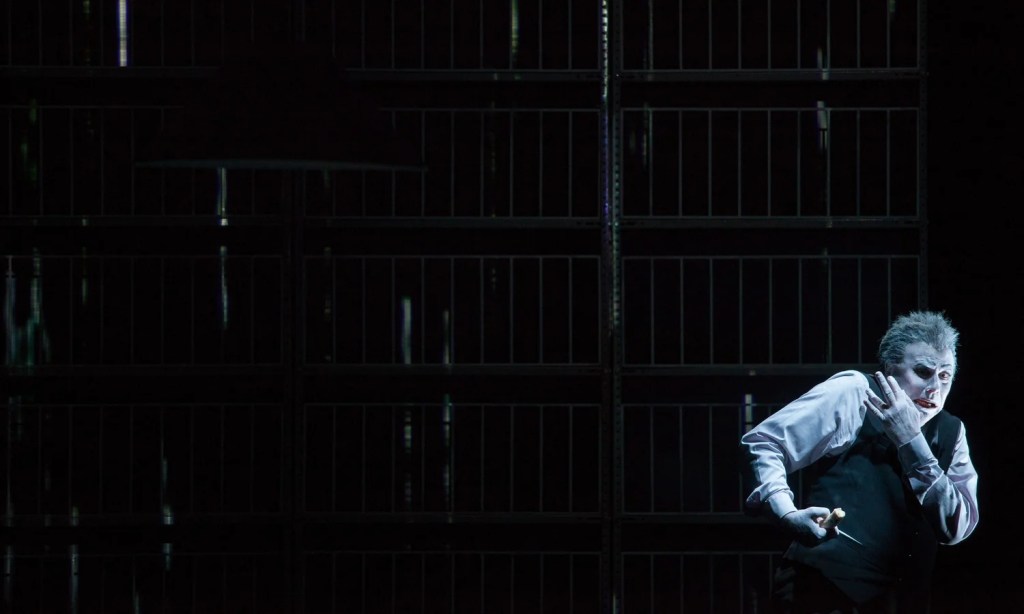
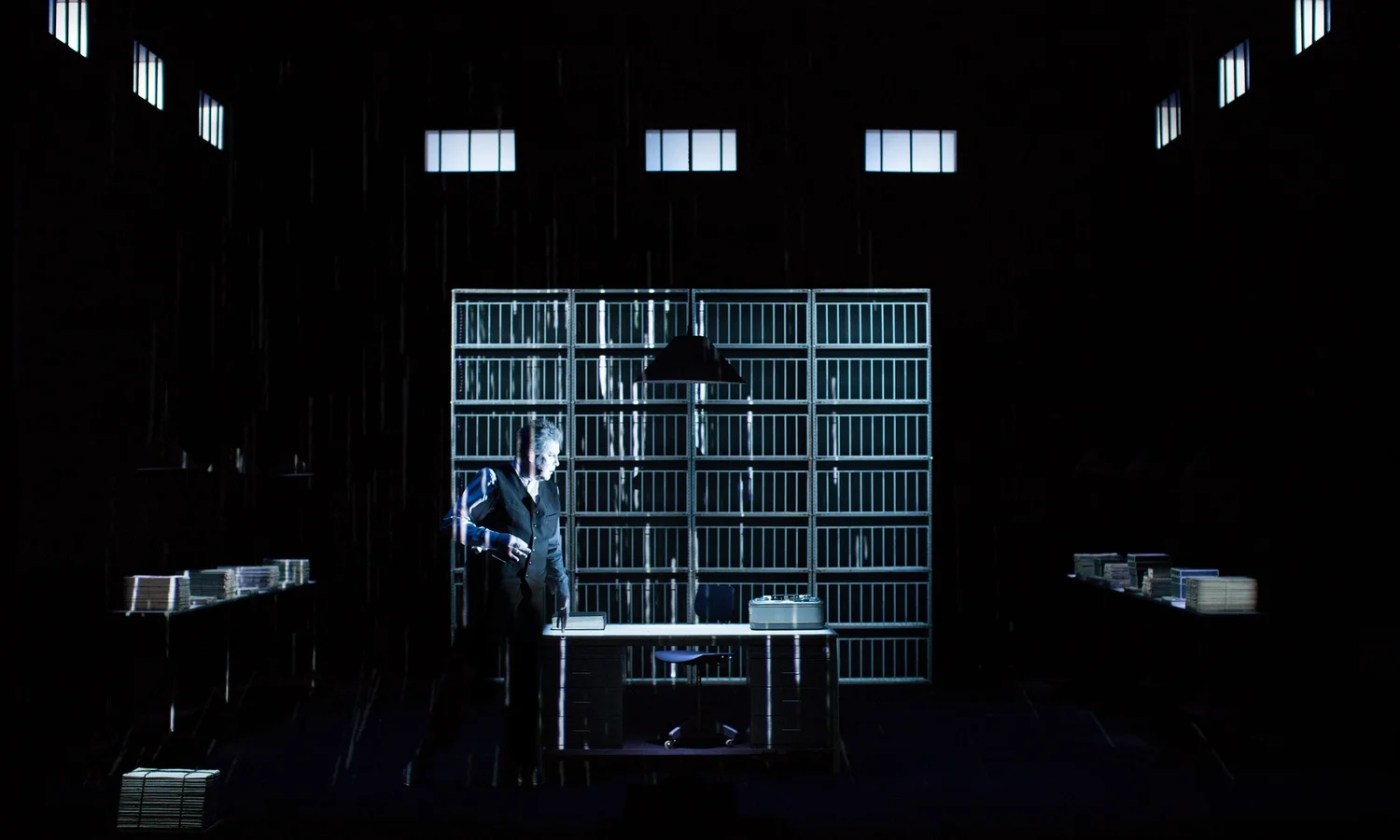
Wilson´s acting style is non-naturalistic, anti-Stanislavskian, based on formalism, minimalism and a stylised theatricality, also influenced by dance and the Noh theatre. He uses slow-motion, repetitions and fixed positions. This version respects Beckett´s dialogues but also exaggerates features and adds elements. Numerous sound and lighting effects, a hallmark of Wilson´s theatre, are used. One added element is the long opening scene with an intense sound- and light-created rain effect. Upper ‘bars’ created with lighting and tidy shelves at both sides are also added. Wilson´s face remains inexpressive or so flooded with light as to be indiscernible. Analysis revealed a large amount of accentuated modulation of FOV instances, where the FOV in movement, light or sound is aesthetically modulated, emphasised confluence of FOVs in more than one dimension, where the FOVs in two or more dimensions emphatically coincide (e.g. Wilson abruptly drops the ledger on the desk in synchrony with a sudden change of light and loud sound), and stylized segment of a goal-directed action, when part of an action is stylized – usually slowed down — for aesthetic effect.
Some of Wilson´s events offered to spectatorship highlight aspects latent in Beckett´s text. For the last ledger entry Krapp reads, Beckett specifies ‘Farewell to – [he turns page]—love’ (1986, 217). After reading ‘Farewell to’, Wilson moves the page very slowly to its vertical position, then lets it go synchronically with ‘love’. This expanded way of doing what would otherwise be an everyday action underscores the poetry of the moment, creating that suspense only achievable in performance that Beckett probably wanted (farewell to what, we wonder for a second), but also highlighting the metaphor: Krapp was turning a page of his life. Another example is how Krapp discards the tape, towards the end of the play. Beckett specifies that Krapp ‘wrenches off tape, throws it away‘ (223). Facing front in a standing straight position, Wilson holds the tape for a while with extended arm, then emphatically opens his hand and drops it, synchronously with a loud prolonged non-realistic sound reminiscent of an echo in a catacomb. This resonates with the tape going deep and far, with the intensity of Krapp´s ambivalent wish to get rid of it, with the burial of the past. Another example of highlighting happens when Krapp-on-tape talks about the new light above his head as ‘a great improvement’ (217). Wilson emphatically looks at the lamp, making spectators aware that it is the same as thirty years ago. While Krapp-on-tape says ‘I love to get up and move about in it’, Wilson gently moves arms upward, floating in the light. With the words ‘then back here to me… Krapp’ he drops his arms on his lap with a quick downward movement, the disillusion of going back to himself conveyed in an embodied way.
Wilson´s Krapp does not elicit empathy or identification, but, in the absence of facial clues, some of his mental states are conveyed through the FOVs of body movements. One example is the prolonged pause of his index finger toward the tape-recorder when he is about to resume listening, denoting hesitation. He exaggerates gestures, stylizes movements and adds elements, whose meanings often remain unclear but contribute an atmosphere of mystery and intrigue. It is mostly a non-realistic version, close to post-dramatic theatre, by which Lehmann (2006) refers to spectacles that break the idea of drama, do not offer a totalizing fictional whole, and whose main focus is not linguistic. Wilson´s Krapp’s Last Tape combines the development of Krapp´s fable with some of Lehmann´s procedures: musicalization, visual dramaturgy, physicality, and a non-hierarchical use of signs aiming at synaesthetic perception. It is a good example of FOV´s multimodality, at the same time following written dialogues and a story line. According to Lehmann, in Wilson´s theatre the figures seem to be at the mercy of a ‘mysterious magic’ (58). This appears in some of Wilson´s unmotivated actions, like a repeated movement of his arm towards shoulder with an interjection of pain, or the moment when he violently sweeps boxes and ledger to the ground. Beckett´s written action has a reason, ‘settling himself more comfortably he knocks one of the boxes off the table‘ (217) and this irritates him. Wilson does not do this unintentional knocking off, which deprives the violent sweeping of any apparent reason, both showing a character in control (unlike Beckett´s), and presenting us with actions that come from nowhere, against any psychological profile.
However, an emotionally charged moment does occur when Krapp listens to the scene in the punt, with the sweet and gentle modulation of Krapp´s taped voice and Wilson´s almost complete stillness. Thus, one of the meanings ‘hidden’ in the text, that the sixty-nine-year-old Krapp wants to listen to this scene because it was then he made a life-changing decision, is highlighted. Whether audiences fully grasp this or not, the moment´s significance is felt. The voice of Krapp-on-stage is full of pitch changes, while Krapp-on-tape speaks in an everyday manner, which creates contrast and reinforces self-aware theatricality, as if clownish Krapp-on-stage was histrionically showing his past realistic self. While Krapp’s Last Tape might well be Beckett´s most realistic play, Wilson´s version bestows it with a sort of ‘this is theatre’ effect.
The scenery is also sparse and minimal, in Bidonde´s version, but the acting is realistic and the tone of the character markedly different from Wilson´s. Bidonde displays sudden impulses (to peel a banana, switch-on the tape-recorder, etc), followed by brief movement arrests, resumption and completion. This reveals an impulsive character, who then doubts and regrets; it also shows him as energetic, sometimes clumsy. He comes across as more at peace with himself than other Krapps. His bodily reactions do not show extreme self-rejection or irritation. For instance, when the boxes fall from the desk, instead of sweeping everything down, he just switches off the machine with an interjection of annoyance, rewinds, and resumes listening. Bidonde constructs a less irascible Krapp almost from the start.
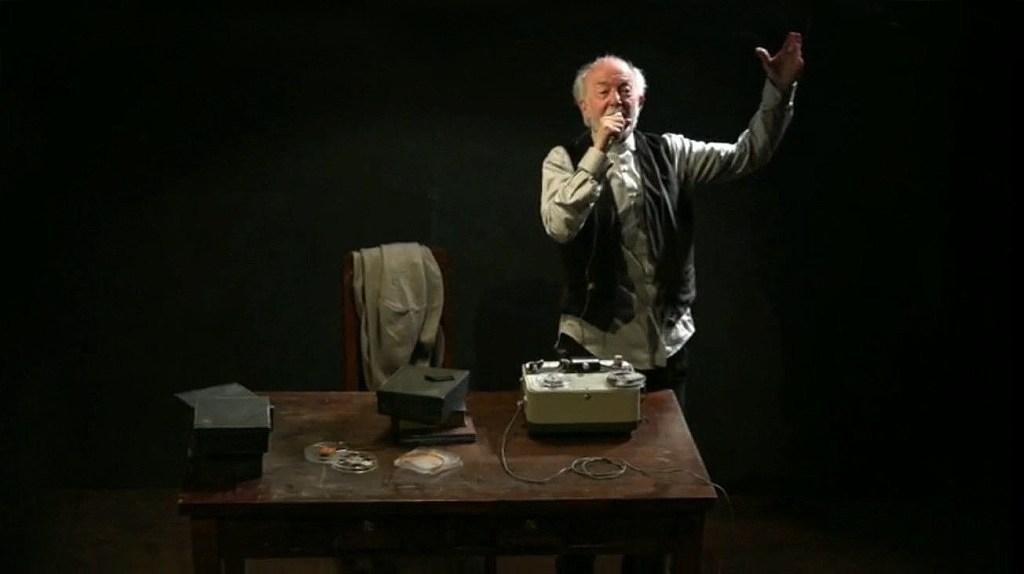
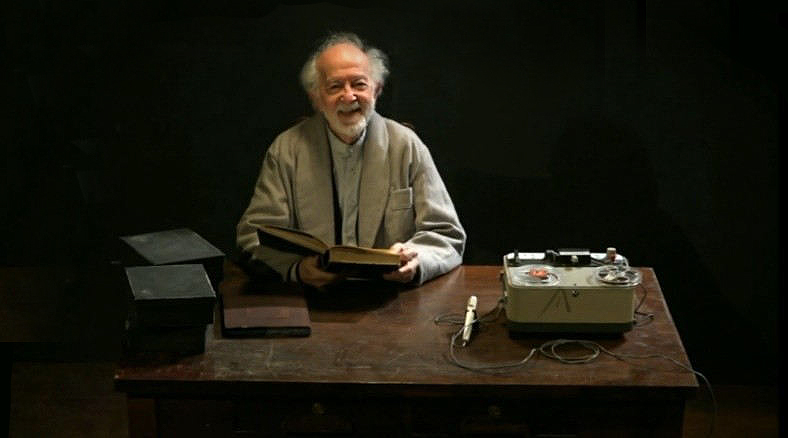
Bidonde´s character is also more hopeful. Krapp´s self-order towards the end, ‘Be again, be again’ (223), is an invitation to dream of visiting Croghan again, but also to exist again, to live life all over. Bidonde says ‘Volver a estar en el valle…’ [to be again in the valley] along with an encouraging gesture, as if to believe he will actually return there one day.4 Identification is not difficult with this psychologically quite transparent character. There are many FOVs revealing inner states, when the quality of body movements reveals intentions, wishes, and emotions. Although at times complemented by facial expression, often movements are telling in themselves. The sheer number of gestures Bidonde displays made it necessary to include that category. I define ‘gesture’ as movements of hands, arms or head or general body posture distinguishable from the continuous movement flow, with a beginning and an end, a particular configuration and well delineated shape, not including facial expression. I divided gesture into two categories: idiosyncratic cultural are gestures that convey a particular meaning and only make sense within a given culture; being more or less conventional, they depend on a shared code. For instance, Bidonde scratches his head meaning brooding, brings his shoulders up implying resignation, sweeps the air with his hands meaning ‘nothing’, describes fast circles with his finger meaning over and over again. By contrast, personal idiosyncratic gestures are movements or body postures repeated often but not intended to communicate. They are characteristic features of the character; for instance, Bidonde´s Krapp has a personal way of walking, slightly leaning forward, with his hands behind his back. The gestural quality renders here a Krapp quite porteño (from Buenos Aires), but not due to language use, since there is no local slang and the only markedly linguistic characteristic is, for the few imperatives, the use of Argentinian second-person voice, voseo. The porteño quality is conveyed instead by Bidonde´s gestures and movements, something probably not intended by the production, as director Pérez kept reminding Bidonde ‘this play is not a tango’ (Pérez 2017). It is of note here how FOVs can render such different characters. A more hopeful Krapp is in some ways possible, not completely at odds with Beckett´s story. If Krapp still wants to record a tape – something for the future- some hope must exist.
In Magee´s version, camera movements interplaying with Krapp´s FOVs are key. Magee´s immobility is outstanding in the ‘listening sections’, where inner states are conveyed through subtle movements of eyes, lips and head by a camera so close as to make skin surface distinguishable. Beckett´s desired contrast between silence/immobility and noise/agitation is noticeable throughout. When Krapp is still and listening, a communion with the audience arises with both in the same attentive witnessing position.
Magee´s personal idiosyncratic gestures bestow the character with much consistency. Whenever he visits the cubicle, instead of diagonally – the most direct path – he walks with extended arm towards the lateral wall, then turning 90 degrees continues next to wall, backstage. This route appears at first odd, a bit comical, but one soon realizes it responds to physical instability; in this simple way, vulnerability is conveyed. Another personal idiosyncratic gesture consists of raising his head every time he tries to understand references from ledger/tape; when trying to remember, his eyes move quickly. He has an idiosyncratic way of listening, indicated by Beckett (‘leaning forward, elbows on table, hand cupping ear’, 217), of switching-off the tape-recorder with both hands and weight, and of standing up, hands on desk.
Some interesting scaffolding – movements that support meanings – features in this version. When Krapp-on-tape mentions that ‘the blind went down’ (indicating the window of the room where his mother was dying) Magee slowly closes his eyes, highlighting the power and embodiment of the metaphor: blinds go down, like eyelids in death. Another significant moment is when Magee stops the recording because he ‘realizes he is recording silence‘ (222).5 Here again the power of the metaphor – albeit in this case only a stage direction – is stressed: if Krapp died now – one of the possibilities of ‘last tape’- the tape would go on, recording silence. In another poignant moment accomplished through FOVs, Magee, recording with a decisive voice, is interrupted by involuntary recollections, which burst out with a distinctive mellow tone: ‘the eyes she had!’ (222).
In order to draw comparisons in specific scenes, when Krapp listens to ‘that memorable night in March, at the end of the jetty, in the howling wind, never to be forgotten, when suddenly I saw the whole thing’ (220), Wilson displays a frenetic whirling on the chair along with a crescendo of screams (emphasised confluence of FOVs), aesthetically conveying the rising irritation indicated in the text: ‘switches off impatiently‘, ‘curses‘, ‘curses louder‘ (220). The scene also irritates Bidonde´s Krapp, in a much milder tone, in accordance with his more accepting character. Magee´s Krapp shows irritation through a subtle trembling of lips, also in line with his stillness and self-containment in the listening sections. He stops the tape three times in a similar way, but growing impatience is revealed by interjections in the second and third.
The punt episode is what Krapp wanted to listen to on this birthday. He presses play and we hear the voice saying ‘my face in her breasts and my hand on her’ (220), then describing the stillness and silence of the moment. But when, after a brief interruption and pause, he rewinds the tape and resumes the scene from a previous point, we realize this was not just a moment of intimacy and erotism, it was also when the couple separated: ‘I said again it was hopeless and no good going on and she agreed, without opening her eyes’ (221). Later, Krapp listens to parts of this scene again. The punt episode is probably the central scene evoked by Krapp and it is significant that it is here that the versions I studied are most alike. On the three occasions that this scene comes up, Wilson´s recorded voice is soft, low and intimate and his body on stage is still, while his hands delicately touch the machine. Bidonde is also quite still, compared to the way his character behaves the rest of the time; as he is a restless Krapp, he nevertheless makes some movements here too, for instance changing position on the chair, and displays some hand gestures and facial expressions, like one of resignation. Magee remains completely still, and the camera is so close to his face and upper body that we can perceive his slightly agitated breathing. Here again he interrupts the recording with his idiosyncratic movement of both hands and listens with his ear-cupping hand gesture.

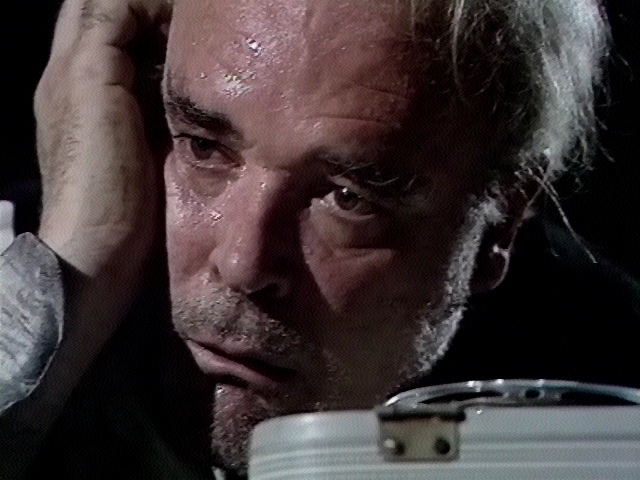
Towards the end of the second time he listens to the scene, Magee starts bringing his torso down, as indicated by Beckett, when Krapp-on-tape recounts saying: ‘I said again I thought it was hopeless and no good going on’. Magee´s movement starts with his eyes, helped by the proximity of the camera, then progressively head and torso. Beckett indicated the movement end in ‘We drifted in among the flags and stuck’. A scaffolding is accomplished when, simultaneously with the word ‘stuck’, Magee´s head, at the lowest point, remains fixed behind tape-recorder and hand. As Beckett remarked, the tape-recorder as the sole companion of Krapp’s solitude is identified with whatever the tape is relating (Knowlson, 1976, 56). In this scene the machine becomes, by virtue of Krapp´s close proximity, the woman herself: ‘Anger and tenderness of Krapp towards the object which through language becomes […] the girl on the lake’ (Knowlson, 2021, 67).
My conclusions concern both meaning-construction and theatre spectatorship in general, and Krapp´s Last Tape and its three considered versions in particular. Analysis showed that not all meaning is ‘decoded’ in a linguistic sense; some things are perceived and become meaningful in a direct way, because of how our body/minds resonate with others. For instance, when Krapp listens to his recorded description of the moment in the punt, no linguistic shared code is necessary for the intimacy of the moment to reach us, conveyed by Krapp´s torso approaching the machine. It is not that as spectators we think: ‘oh, I see, the tape-recorder has become the girl’; we just feel the intimacy, along with a general understanding of what is going on, provided by the words.
This conclusion needs to be contextualized within the broader subject of social cognition and its intersection with theatre studies. There are basically three perspectives to understand how people make of sense of others´ inner states: first, second and third person. First-person perspective understands social cognition as a projection of one´s own states; third-person perspective sees it as a specific capacity – ‘mind theory’ – a cognitive module that, like one for the physical world or other aspects of reality, allows people to understand other people. These perspectives both see a basic opacity in people´s minds that needs to be overcome. The second-person perspective, instead, sees a basic communion between people and considers that most behaviour in person-to-person close interactions makes sense in a direct, almost transparent way. There have been attempts to defend second-person perspective as the right approach for theatre spectatorship (Gomila, 2013), but without sufficient explanation as to how it is possible that a mechanism that basically works for person-to-person interactions can also apply to theatre, which usually does not involve such reciprocal exchange. As result of my work, by applying micro-analysis to moment-to-moment scenes, I now think that when we watch theatre, the close interpersonal interactions of everyday life, implicit in our experience, are triggered, put to work, allowing us to directly make sense of what we see. What enables us to make sense, be moved, identify with intentions, emotional and mental states of characters on stage are the same psychological interactions that conform the substratum of our subjective and intersubjective configurations. If, as Stern pointed out, grasping vitality forms provides fundamental clues for the mental attributions and the body adjustments we do when interacting with others, something similar happens when we watch theatre, even if those adjustments do not occur in an open way.
Microanalysis has revealed a great deal of details and a multiplicity of events – most of them thread together by vitality forms – that cannot be processed in the ephemeral moment of watching a play; that is why we often leave the theatre room ‘despalabrados‘ (unworded) (Dubatti, 2021). However, all those micro-events ‘thicken’ the experience, load it with meaning, even if it is not possible to know exactly what those meanings are. For instance, in the course of my analysis, when Wilson suspends the page right before the word ‘love’, the metaphor of turning a page in a life became apparent. Although I did not have that thought when I watched him live, the suspension must have created an expectation that made the moment thicker, more significant, more charged, to then receive the word ‘love’. Ultimately, I think this type of analysis illuminates aspects of the activity of theatre spectatorship that other analyses do not account for, thereby advancing knowledge on meaning-construction and social cognition.
In relation to Krapp’s Last Tape, analysis showed that the three versions, even following Beckett´s text and stage directions, offer quite different experiences and personae. Wilson´s version displays a methodical, self-contained, in-control character who does not elicit identification, except when he listens to the punt episode. Bidonde´s Krapp is energetic, expressive, and, in comparison with the others, hopeful. He is not so much at odds with himself although full of nostalgia and some regret, and comes across as quite endearing. Magee´s Krapp is physically fragile, clumsy, and at the same time very irascible, introverted, nostalgic, and in deep conflict with his past self.
This research has shown the extent to which the meaning and impact of a play is created through perceptual events, in combination with the textual tapestry. In everyday life as well as in theatre, subjective and intersubjective worlds are shaped by the modulation of vitality, a direct corporal resonance between people. And in Krapp´s Last Tape, a play so compact and personal, layers of meaning certainly multiply and resonate.
References
Beckett, Samuel (1986), Krapp’s Last Tape [1958], The Complete Dramatic Works, London: Faber and Faber.
Beckett, Samuel (2006), La última cinta de Krapp, Teatro Reunido, Barcelona: Tusquets.
Cohn, Ruby (1975), ‘The Laughter of Sad Sam Beckett’, in Samuel Beckett Now, ed. Melvin J. Friedman, Chicago: University of Chicago Press, 185-197.
De Marinis, Marco (1997), Comprender el teatro. Lineamientos de una nueva teatrología, Buenos Aires: Galerna.
Dubatti, Jorge (2021) ‘Espectadoras/es, sujetos de derechos: el vínculo existencial con el teatro’, Círculo Escénico, 1, 7-14.
Español, Silvia, Martínez, Mauricio y Rodríguez Fernanado (2022), Moving and Interacting in Infancy and Early Childhood, Cham: Springer.
Gomila, Antoni (2013) ‘Emociones en el teatro: ¿Por qué nos involucramos emocionalmente con una representación?’, in La representación de las pasiones: Perspectivas artísticas, filosóficas y científicas, ed. Tomás Soria, Barcelona: Dykinson, 57-8.
Gontarski, Stanley E. (1977), ‘Crapp’s First Tapes: Beckett’s Manuscript Revisions of Krapp’s Last Tape’, Journal of Modern Literature, 6:1, 61-8.
Knowlson, James (1976), ‘Krapp’s Last Tape’: The evolution of a Play, 1958-75, Journal of Beckett Studies, 1: Winter, 50-65.
Knowlson, James, ed. (2021) The Theatrical Notebooks of Samuel Beckett, vol. 3: Krapp’s Last Tape [1992], London: Faber and Faber.
Lehmann, Hans-Thies (2006), Postdramatic Theatre, London: Routledge.
Pavis, Patrice (2003), Analyzing Performance: Theater, Dance, and Film, Ann Arbor: University of Michigan Press.
Pérez, Augusto, Interviewed by Alicia Nudler, Buenos Aires, 2017.
Stern, Daniel (1985), The Interpersonal World of the Infant. A View from Psychoanalysis and Developmental Psychology, New York: Basic Books.
Stern, Daniel (2010), Forms of Vitality: Exploring Dynamic Experience in Psychology, the Arts, Psychotherapy and Development, Oxford: Oxford University Press.
Wilson, Robert, Stern, Daniel & Nadia Bruschweiler-Stern (2009), Bob´s Breakfast: From in the Mind to on the Stage. Unpublished.
Wojciehowski, Hanna (2014), ‘Statues that move: Vitality Effects in the Winter’s Tale’, Literature & Theology, 28: 3, 1–17.
- Here I share a summary of my doctoral thesis Experiencia teatral y corporización: las formas dinámicas de la vitalidad en la escena (Theatre experience and embodiment: Dynamic forms of vitality on stage), submitted to University of Buenos Aires for PhD fulfilment in 2024. Director Silvia Español, co-director Mauricio Tossi. Unpublished. ↩︎
- I realized that in my readings of the play I had pictured a small dock, like those of my city. When I visited Dún Laoghaire, it struck me as a powerful experience, with all its ‘howling wind’, ‘great granite rocks’, ‘foam flying up’ and ‘wind-gauge spinning like a propeller’ (Beckett, 1986, 220). ↩︎
- ‘Time divided about equally between listening (silence, immobility) and non-listening (noise, agitation)’ (Annotated copy for the 1973 Anthony Page production, Beckett Collection, MS 1479/1). ↩︎
- The ambiguity of the expression ‘be again’ cannot be conveyed in Spanish as the verb ‘to be’ has two separate forms. Bidonde opts for ‘estar’– and not ‘ser’- thus referring to location, not to existence. ↩︎
- This is the only stage direction explaining Krapp´s reason for switching off, one of the few text´s references to Krapp´s mental states. ↩︎
 The Beckett Review
Leave a comment