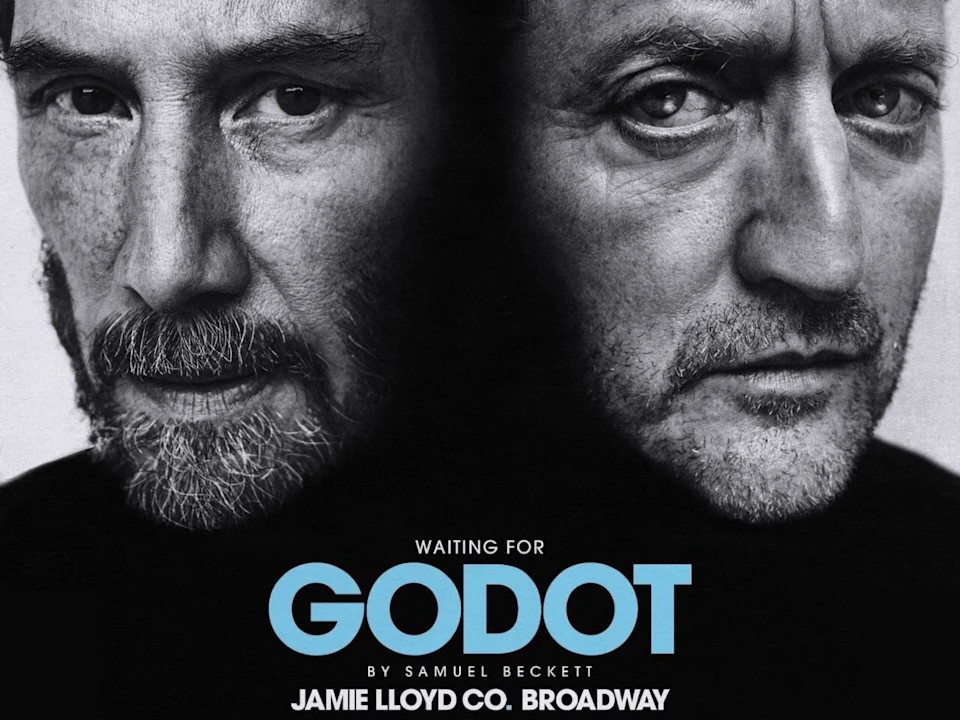
Directed by Jamie Lloyd
Featuring Keanu Reeves (Estragon), Alex Winter (Vladimir), Michael Patrick Thornton (Lucky), Brandon J. Dirden (Pozzo), Eric Williams/Zaynn Arora (Boy)
Friday 26 September 2025
Endgame, Irish Arts Center, New York
Directed by Garry Hynes
Featuring Bosco Hogan (Nagg), Aaron Monaghan (Clov), Marie Mullen (Nell), Rory Nolan (Hamm)
Saturday 24 October 2025
Reviews by Michael Coffey
As I write this review, the future, unknown and frightening, is pouring into the past, subject to inevitable disfigurations by a slew of political narratives. Democracies are in retrograde, environmental degradation rampant and somehow disputed, with appalling wars that will not stop, nationalisms afoot across the West, and yet here we are, right now – autumn in New York, where Samuel Beckett is as relevant as ever.
Three major works were on the boards here – a starry Waiting for Godot on Broadway in a large house; a highly wrought production of Endgame by Garry Hynes’s Druid Theatre (in its 50th year) at the Irish Arts Center; and, at NYU’s Skirball Theater, a handsome and perfect Krapp’s Last Tape featuring legendary Irish actor and Field Day co-founder Stephen Rea (the production was reviewed here in its Dublin run and is reviewed in its iteration at London’s Barbican in this issue)
The iron solidity of the Beckett texts seems to always deliver, or be delivered, regardless of the casts, direction, or production: you can’t kill Didi in his ditch, you can’t sever Pozzo from Lucky or Hamm from Clov or Krapp from his memories, ably aided by his helpmeet, the tape recorder (Rea includes the machine when taking his bows).
Emilie Morin says it is ‘largely through the performance history of Waiting for Godot and Endgame in situations of political hardship and oppression’ that has led to Beckett’s work being central to debates about ‘the nature of political writing,’ 1 and there’s no reason to argue with that. The two plays under review are inherently political. Each takes place in some aftermath of violence or famine – disaster of some kind, any kind. And each has at its core at least two power relations. Most noteworthy about these Beckett masterpieces at this time and place are the very different depictions of those power relations by two very different ideas of theatre.

The Waiting for Godot, featuring Keanu Reeves and Alex Winter, playing to sold-out audiences at the oldest extant theater on Broadway, The Hudson, is a star vehicle writ large.2 Jamie Lloyd, an accomplished and very busy director from the British stage and Broadway, who has done everything from Pinter to Chekhov to Genet to Shakespeare to Evita and Sunset Boulevard, copping Tonys and Olivier awards along the way, presented an extremely bizarre (though crowd pleasing) Godot at the 1000-seat venue. It was a complete resetting that suggested German expressionist theatre, with a stark yet exaggerated visual design (by Soutra Gilmour) fending off any suggestion of realism. Set in a kind of runoff tunnel with a narrow ramp running to the back of the stage as if the Rockettes were about to file in, the play was badly disfigured. Once you accept Didi and Gogo standing or sitting on the bottom edge of the set which dwarfs them you are soon treated to the idea that all props are imaginary, from the tree to the country road, to the carrot and later to Pozzo’s basket, his pocket watch, his pipe and so on. And no moon. Are they all hiding in the flies? Perhaps Act Without Words had been grafted on? But no. We are left to imagine the interactions with these objects and sights, denying us material glimpses into the impoverishment of these characters. But there are losses everywhere – even a most crucial power relation between Pozzo and Lucky, so effectively reversed in most sensible productions in the second Act, here is defused or rather refused.

In the first Act, Pozzo enters pushing Lucky in a wheelchair (no rope, no whip, no Lucky in the lead), and it is the same relation in the second Act, Pozzo again serving Lucky, though one is now blind and the other ‘dumb’ (have Hamm and Clov wandered into the play from the Irish Arts Center a few blocks away?). There is no explaining any of these choices. Nor a defense heard from the director or dissent from the audience of star-struck people who cheered wildly when the lights went up on their movie darlings. The crowd would eventually perform a clap-along when Lucky sang his song and laugh when Lucky flips the finger to Gogo. There were probably no patrons older than my wife and I in the place. We were among the few that have not seen any of the three instalments of Bill and Ted’s Excellent Adventure in which Reeves and Winter star as time-traveling stoners, or The Matrix or Reeves in the John Wick films; hence, a moment of ‘air guitar’ from the dudes was lost on us, but what a roar! So the crowd – mind you, tickets range from $245 for the poor seats we had in the ‘dress circle’ to $600 in the orchestra – was in rapture.
Despite the middling (at best) reviews, the Beckett Estate and Borchardt agency might well be pleased with this Broadway hit, as another generation is being wildly entertained by Beckett, arguably a good thing, making the dour Irishman a comic genius with maximum gravitas and top-shelf entertainment to boot (matters turned a bit maudlin at the end, and I think some of these youngins might have wondered, What’s a charnel house? Where’s the Mâcon?). That said, Reeves and Winter were winning and game; some lines they nailed, though Reeves was wooden throughout, declaiming his lines without intonation, as if reciting in a foreign language (perhaps Beckett is that to him).3 Pozzo, played by Brandon J. Dirden, was excellent and strange, like a deranged overseer on a southern plantation who hasn’t realized he is no longer overseeing much. Lucky, played by Michael Patrick Thornton, in that mask, in a wheelchair, was a shell of the usual character, disabled here both by stage craft and direction. Lucky’s famously elusive and confounding speech was slowed to a crawl, enhancing understanding, perhaps, for the uninitiated… perhaps? In any event, and inappropriately, Lucky just seemed bored throughout, ready for removal.
Finally, what I have always thought was a great and hilarious line – ‘We should have thought of it a million years ago, in the nineties’ got a huge laugh. Why? I suspect the house was full of millennials born then, in the 1990s, as was the Bill and Ted franchise. But one thing this young crowd paying steep prices for their Broadway treat did not have to face was the traditional and essential owner-slave relationship between Pozzo and Lucky, which in all manifestations I have seen, is uncomfortable to watch, the more so today when disparities of wherewithal are growing.
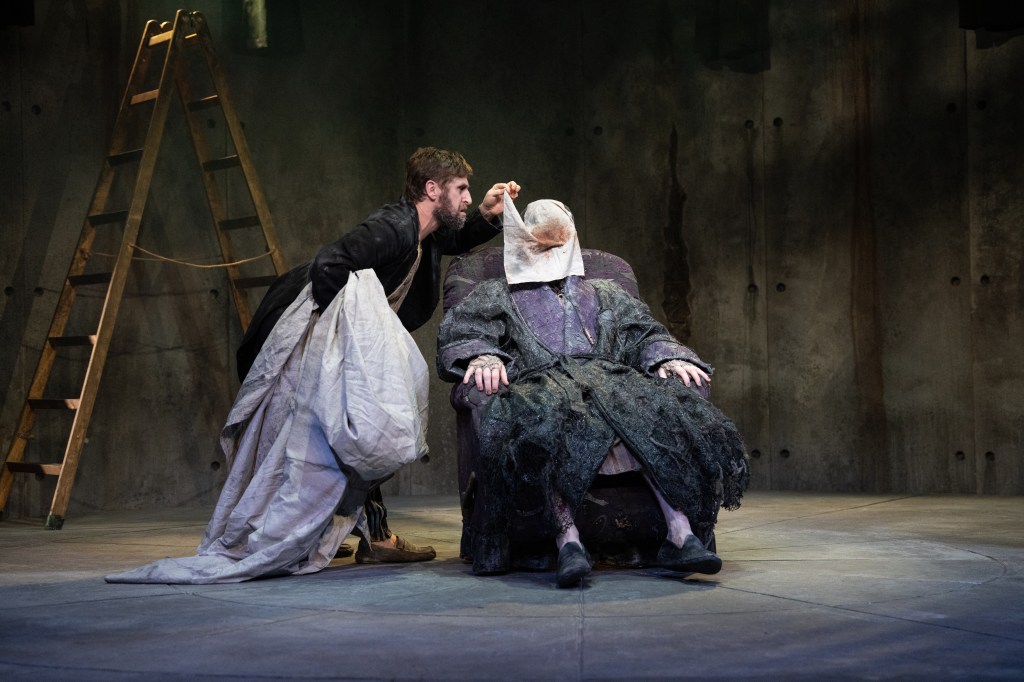
Garry Hynes’s Druid production was another thing altogether with respect to the master-slave relation at its center and the design. What stood out was Clov’s furious and militant posture from the start until the very end, heatedly objecting to his servitude to Hamm. There is none of the bemused exasperation one might see from Bill Irwin’s Clov, for example. And, as is typical of a Hynes Beckett production, what lasts are the musical rhythms of the speech, the geometric precision and the sounds of the choreography: Clov’s six steps up and down his high ladder impeccably syncopated – good leg, bad leg, his embittered but precise pirouettes moving the ladder from window to window. Clov’s pique shows when he shoves Hamm into the wall, hard. The audience at the Irish Arts Center was not spared this stalemate, nor the misery of Nell and Nagg, played very movingly by Marie Mullen, a co-founder of the Druid, and the earnest and tender Bosco Hogan. Both bring a tragic pathos to their dark fates, starving for pap or biscuit or human touch, none of which they are to receive. Aaron Monaghan is the unhappy Clov in an earthy, angry performance cutting the very figure of another rather dispirited Beckett character, Gogo, who he played in the Druid’s 2018 Godot, a much-admired Irish Arts Center production, also directed by Hynes. Opposite him as Hamm here is Druid member Rory Nolan in a faded but elegant robe (Nolan played Didi to Gogo in the 2018 show). These two actors have all the moves mapped perfectly, delivering the production’s clockwork elegance and economy. This production really does feel like it is finished, at the end, as Clov hoped. Or nearly finished. One feels it is Beckett as Beckett would want.

The set by Francis O’Connor suggested a high cylinder, like that described in The Lost Ones, except with windows (round, like portholes, here). Clov’s kitchen is to the left, unusual but allowed by Beckett in remarks to Michael Haerdter in 19814, with the bin-ridden Nagg and Nell to the right. The depth of the cavern, its window hovering so high, lends another menace – that the sea might inundate the space through one window or the earth bury it through the other. It is all suggestive of a future grave site. Nonetheless, Beckett’s beloved tableau at the finish – and the old stancher – remain.
Given the extravagant excesses of the Broadway Godot as opposed to the refined austerity of the Druid Endgame, perhaps it is through these two masterpieces together that the obligation to express a sorry truth of our time is fulfilled.
Michael Coffey’s Beckett’s Children: A Literary Memoir will be published in paperback, with a new Afterword, in April 2026.
- Emilie Morin, Beckett’s Political Imagination (Cambridge: Cambridge University Press, 2017), p. 8. ↩︎
- The Broadway weekly grosses show that Godot is taking in more than $1.8, and seating nearly 8000 customers a week. https://www.broadwayworld.com/grosses.cfm—- [accessed 4 November 2025]. ↩︎
- Reeves’s performance was reviewed as stiff, “standing at a distance” from his character, “intimidated,” wrote the New York Times in its otherwise positive review. Laura Collins-Hughes, ‘Waiting for Godot; Review: Cue the Air Guitar,’ New York Times, 29 October, 2025, C1. One day later, perhaps a Hollywood publicist kicked into gear: the Times’s Jesse McKinley, whose beat is not theatre, interviewed a ‘devoted Keanuphile’ who once taught a class on Reeves – 32 years ago – and who claims that Reeve’s ‘Brechtian’ strategies are not ‘bad acting…. [but] a choice.’ Jesse McKinley, ‘Complexity Under a Dude’s Surface,’ New York Times, 30 October 2025, CT1. ↩︎
- S.E. Gontarksi, ed.,The Theatrical Notebooks of Samuel Beckett, Vol. 2: Endgame (New York: Grove Press, 1992), p xviii. ↩︎
 The Beckett Review
Leave a comment