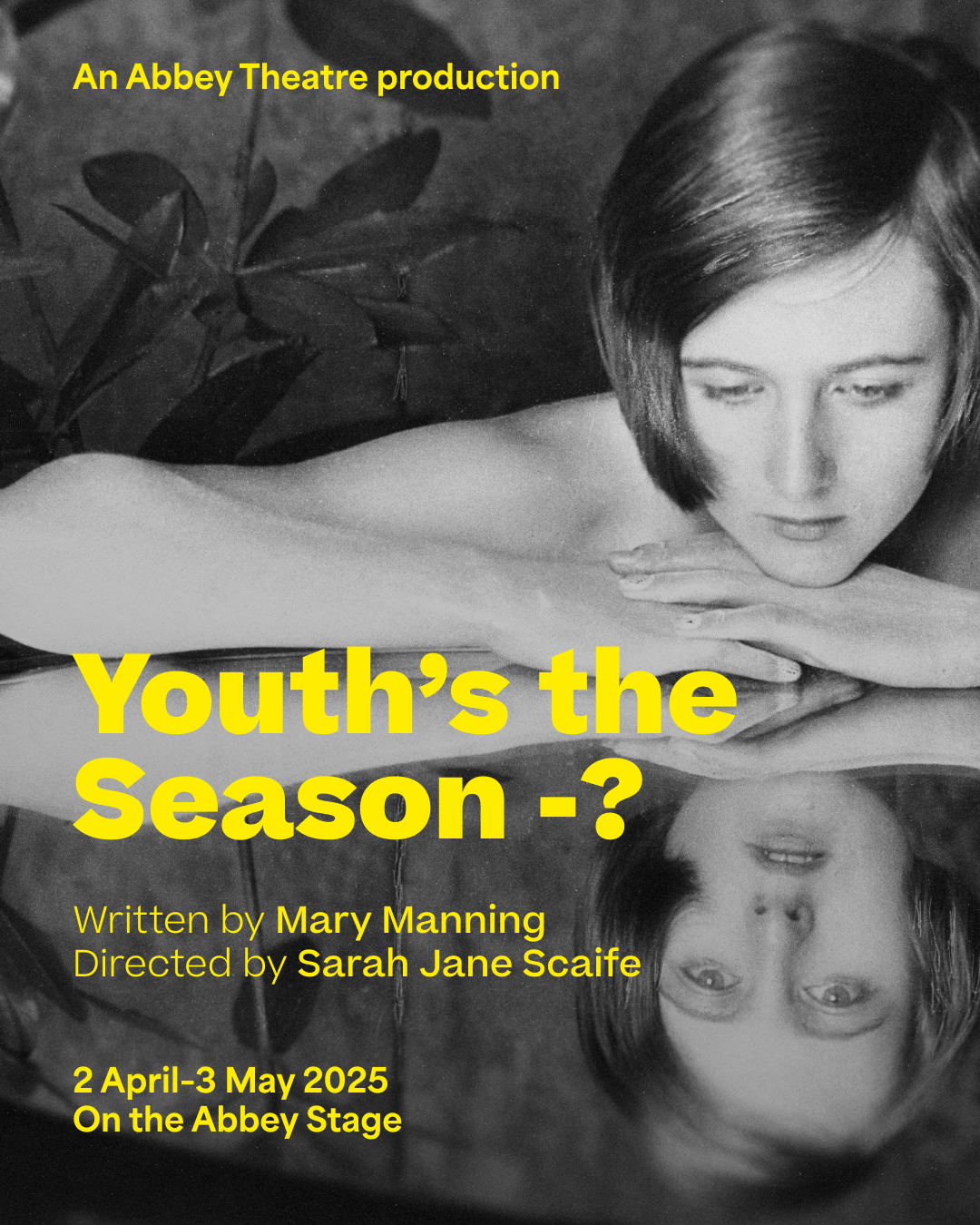
Directed by Sarah Jane Scaife
Featuring: David Rawle (Desmond), Sadhbh Malin (Deirdre), Ciara Berkeley (Toots), Kerill Kelly (Terence Killigrew), Lórcan Strain (Egosmith), Molly Hanly (Connie), Jack Meade (Gerald), Youssef Quinn (Harry), Valerie O’Connor (Mrs Millington), Mazzy Ronaldson (Pearl/Mary), Eoin Fullston (Willie)
Tuesday 8 April 2025
Review by Feargal Whelan
I was delighted and strangely relieved when I heard that the Abbey Theatre was mounting a production of Mary Manning’sYouth’s the Season –? Like so many initially successful plays by Irish women, it was so easily excluded from the canon and has remained largely neglected, along with Manning’s other works. Even following the increased interest in Irish women authors in the aftermath of the 2015 ‘Waking the Feminists’ movement, a revival seemed unlikely. The play remained slightly better known among Beckett scholars because he played some part in its composition, as mentioned by James Knowlson in Damned to Fame. However, this knowledge tended to give the play the status of an ‘interesting footnote’ rather than to promote any proper examination of its own broader qualities, or indeed any analysis of the impact that Manning, Beckett’s childhood friend, might have had on his development. So, the weight of personal expectation made me worried that it might turn out to be a disappointment. After all, it is the debut play of a twenty-six-year-old playwright from 1931.
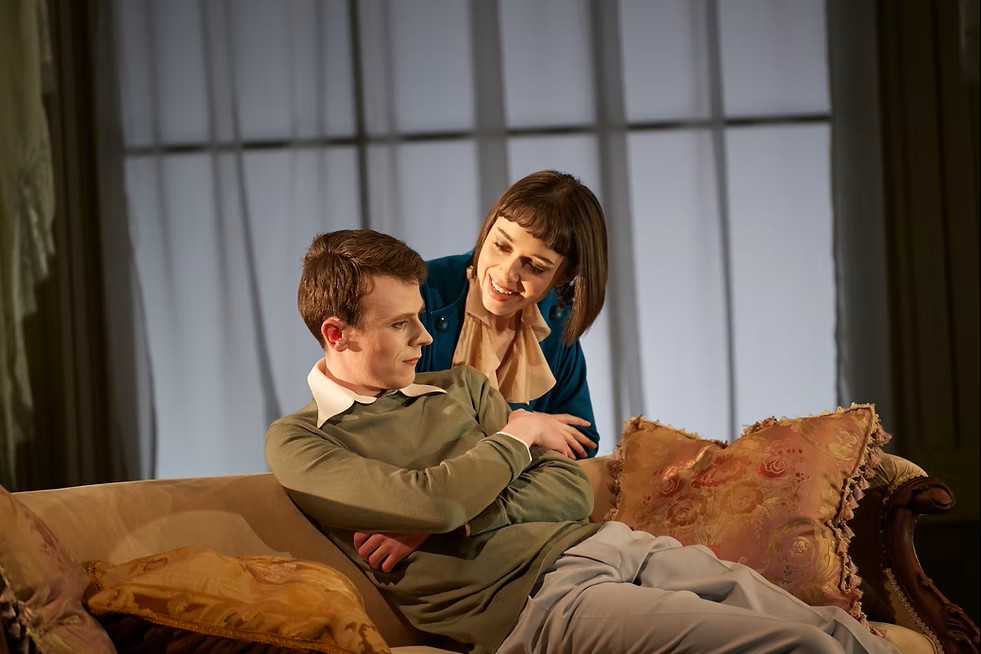
Set in 1930s Dublin, Youth’s the Season –? is superficially a conventional three-act drawing room drama which takes place in the home of the bourgeois Protestant Millington family. Desmond (David Rawle), the obviously gay only son is being primed to take his place in the family business though he yearns to move to London to live an artistic life with his apparent lover. One sister, Deirdre (Sadhbh Malin), is a tweed-wearing, unemotional science student described as ‘offensively competent’ and is engaged to a solid medical doctor, while the other sister Connie (Molly Hanly), we are told, ‘hovers between third rate musical comedy and bohemianism.’ She is in love with a feckless, self-obsessed writer Terence Killigrew (Kerill Kelly) but keeps her marriage options open by encouraging a strait-laced civil servant suitor who is based in Kenya. The dynamic, animating force of the whole is the smart, sharp-tongued Toots Ellerslie (Ciara Berkeley), who bears a strong resemblance to what we know of Manning’s own character. She is best-friend and ally to Desmond, providing commentary and wit with amused detachment. The louche Killigrew, arrogant and self-loathing in equal measure, appears in the first two acts accompanied by the silent and sinister Horace Egosmith, more doppelganger than friend. Independently, each of the bored and unhappy group is trapped by stifling social norms of an increasingly inert Dublin.
The mundane but waspish interactions of the drawing room are disrupted in Act II by an increasingly hedonistic party thrown in Desmond’s attic studio, in which all relationships deteriorate dramatically. The party’s aftermath, the following day, sees the sisters succumb to convention by abandoning their own interests in favour of conventional marriages and Desmond accepting the fate of the family firm. The predictability of it all, however, is punctured by the appearance of an unhinged Killigrew who breaks down dramatically, taking his life with a pistol following an unsuccessful attempt at drowning himself the previous night.
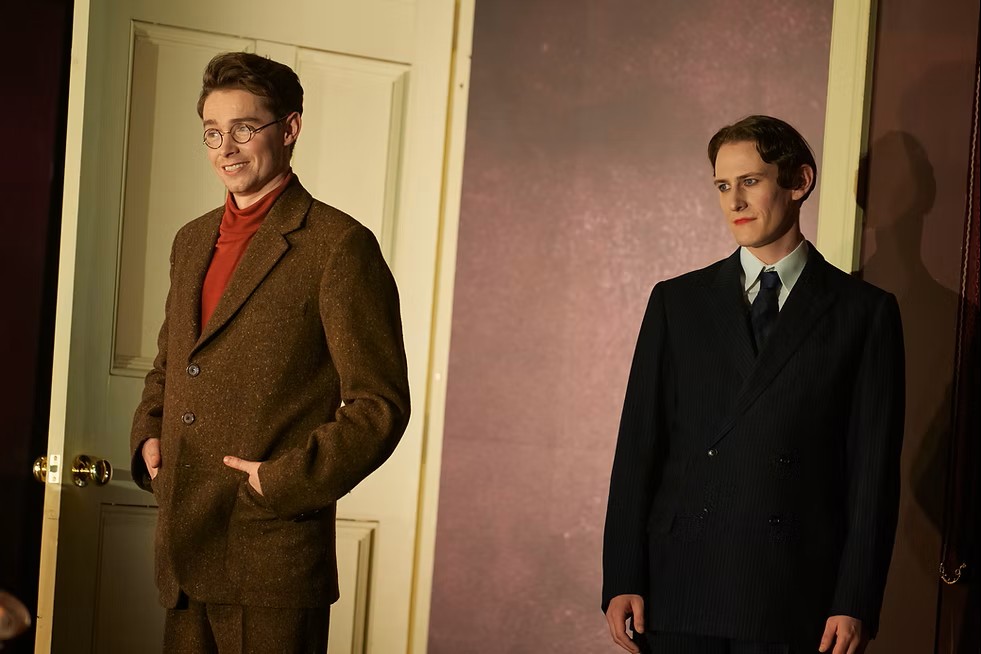
According to Manning, Beckett was the source of the silent character Egosmith, as all good Beckettians know. In the role, Lórcan Strain is a sinister but hugely powerful silent presence who manages to dominate the space even when not directly involved in the conversation. It is startling how much of a resemblance the figure of Terence Killigrew bears to Beckett himself. He is ‘constipated with too much Proust and Joyce’, we are told, and described in the stage directions as a young man ‘who has cultivated his personality at the expense of his intelligence’, who ‘started off as a “blood” and has suffered a sea-change into a shambling literary loafer, untidy, dissipated and frowsy’. Like Beckett, he wears ‘a crumpled brown suit and an orange polo jumper’. Kerill Kelly’s Terence was, for me, an unsettling reminder of the Beckett of volume I of the Letters, with an admixture of brilliance and arrogance, torpor, and fear.
Sabine Dargent’s design, augmented by Stephen Dodd’s lighting and Rob Moloney’s insistent score, accentuated the profound anxiety hidden by the surface frivolity. The ostensibly realistic opulence of the drawing room transformed imperceptibly over the course of the evening until it revealed a house crumbling at the seams, an enormous mirror hanging from the ceiling, re-emphasising and crowding the actors’ movements. Sinéad Cuthbert’s costumes were silky and luxurious, based on samples and patterns from the specific year of 1931 in which the play was set. This moment of transition in fashion, from the hedonism of the 1920s to the greater sobriety of the 1930s visually reinforced the sense of apprehension bubbling under the surface.
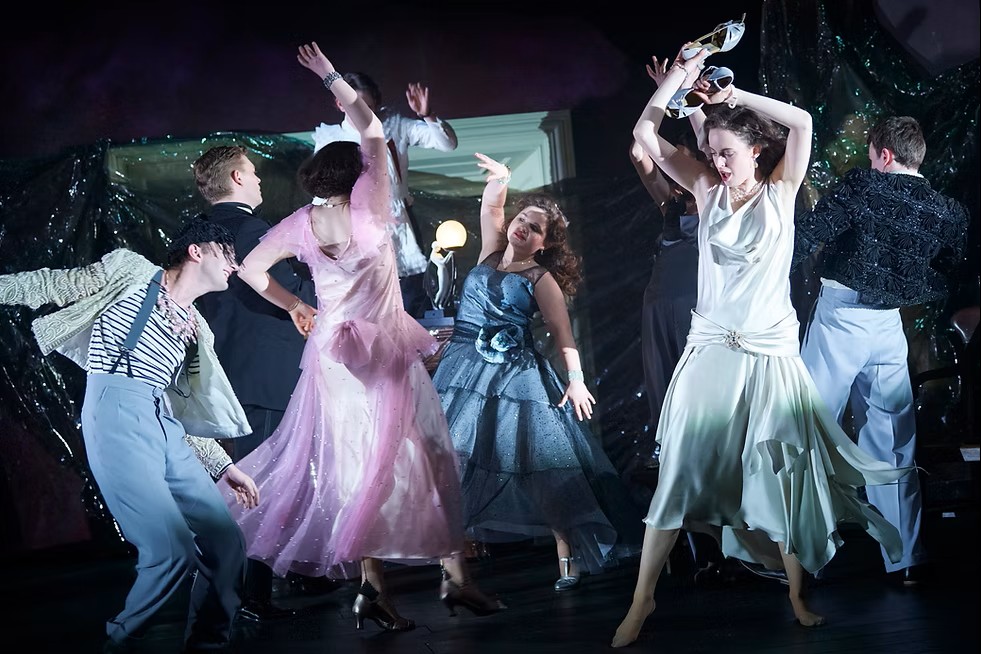
Director Sarah Jane Scaife, renowned for her many innovative productions of Beckett, emphasises the progressive darkening of the tone within the play. The sharp-tongued fecklessness of the first act descends to a gloomy anxiety by the end. She also insists on the importance of the ‘youth’ in the play’s title by casting as close to age-appropriate as possible (the twenty-one-year-old Desmond is played by the twenty-five-year-old Rawle) which produces a heightened nervous energy sustained throughout the night. To huge effect, the second act party becomes a highly stylised and increasingly choreographed affair, accompanied by an unsettling score which gives the whole a feeling of danse macabre with Egosmith pulling the strings at its centre. Scaife also elevates the themes of political decay, loss, ennui, dissipation, colonialism, female stasis, and queerness which punctuate the complicated text. As a result, the play fizzes with the anxiety and gauche bravura of a distinctly edgy group of youngsters horribly aware of the constrained hands they have been dealt but without the wherewithal to escape. Terence’s suicide is deemed a heroic act of courage by Desmond who, in turn, submits to ‘the bowler hat and the umbrella’ of a job in the family firm.
Far from a disappointment, this highly erudite play identifies in real time both the intellectual brightness and the creative potential of the milieu, particularly the women, while also demonstrating the deep sense of inertia which threatens to thwart it. What this production does is ignite the energy in the play which elevates it from an academically interesting museum piece to a stimulating, thoughtful and complex work of social commentary. And a hugely entertaining one at that. It also insistently asks us to review how we approach the young Beckett in this environment.
Feargal Whelan is a Visiting Research Fellow and occasional lecturer at Trinity College Dublin. He has published and presented widely on the works of Samuel Beckett and on twentieth century Irish drama. He edits The Beckett Review.
 The Beckett Review
Leave a comment