An Interview with Josh Gross and Alyssa Marie Mathews
Puppeteers for Fears (PFF), now in its tenth year, is an Ashland, Oregon-based travelling theatre company dedicated to creating and performing original musicals that blend sci-fi, horror, and comedy. The troupe performed Beckett’s What Where at the Ashland Beckett Shorts Festival in October 2024, a darkly sinister and comedic production that captured the absurdity of our current existential crisis. Josh Gross originated the troupe and writes and performs music for PFF’s shows, including for What Where. Alyssa Marie Mathews is one of PFF’s original members and was the director of What Where.
Interview by Katherine Weiss
Katherine Weiss (KW): I was first introduced to your work at the Ashland Beckett Shorts Festival in 2024. The playwright Octavio Solis commissioned Puppeteers for Fears to do Beckett’s What Where. While he chose the play, I’d venture to say that What Where was not your first introduction to Beckett’s work. Would you share your first introduction with Beckett and how you responded to his work.
Josh Gross (JG): This will sound like a weird thing to say considering the context of the interview, but I’m not a particularly big Beckett fan. Two things that are very valuable to me in a piece of writing are telling a story and making a point. Beckett doesn’t seem much interested in either. And that’s fine, just not to my taste. When I was assigned to read Waiting for Godot in college, I threw the book across the room and said, ‘What the fuck is this bullshit?’ and then I hadn’t really gone back since. But over the course of doing What Where I came to appreciate Beckett more. There is this playfulness with language, which is something I do like. I understand it more from a theatrical perspective. I can see what actors really like about Beckett in that he doesn’t channel them in too much. He allows them to build a character and do something with it. At least that is my understanding.
Alyssa Marie Mathews (AMM): We were connected with Octavio because he was my playwriting professor at Southern Oregon University (SOU), and he had recently seen our show Cthulhu: The Musical in 2023.
JG: The Ashland Beckett Shorts Festival was this weird, crazy idea Octavio cooked up during the pandemic. I did a bit of consultancy with him on trying to figure out how the structure of the festival might work. And he gave me What Where and said he thought it would work well with puppets.
Octavio described the piece as beat poetry. I saw what he meant when I read the script – the rhythm of the language. There’s a lot of repeated phrases and circularity in the sort of narrative. The concept that we took into the production was to treat it as one big slam poem. Alyssa brought the whole thing to the stage, other than the sound design, which I did.
AMM: I directed What Where. We knew we wanted to use drums, to keep up that rhythm and beat. As we kept approaching it, I realized I wanted a show that was simplistic but complicated. I wanted to create something deeply layered but still accessible – quick and fun at face value. That’s kind of how Beckett reads to me, personally. I have a theater background, so I have been around a lot of Beckett, but I actually never dove into his work intensely until participating in the festival. I’m not a big play reader, honestly. I’m a much more visual person, so I like to see a play more than I like to read a play. And there wasn’t a lot of Beckett going on [in Ashland]. But I always knew that his work intrigued me. I gravitate towards strange works that bend perception in reality. I feel like he does that very well.
JG: Puppets do something very similar, which is part of why What Where works so well with puppets. They exist between reality and simulation, so it already breaks that perception a lot.
AMM: You’re totally right. When I read What Where, I instantly knew that it was going to work well with puppets. I was also really excited to veer off from what we usually do as PFF.
KW: Why did you agree to take on the commission of What Where?
JG: I ask a lot of people to do a lot of weird things. And I feel like you can’t just be the person who asks everyone else to be involved in your weird projects and then not reciprocate. I wanted to help Octavio because, one, I can tell that this mattered to him a great deal and I think that that’s an important personal development that I wanted to aid in. And two, coming out of COVID we all needed to relight our fires by making those passion projects happen. Three, I knew that it would make good art. Four (to be a little shitty) when you live in Ashland, you’re kind of under the thumb of the Shakespeare industrial complex. When we started doing PFF, people would come up to us after the show and say, ‘thank you for doing anything different, anything’. They were so desperate for anything that wasn’t Shakespeare and the classics. And while Beckett is an important classical writer and all, the idea of a walking festival of shorts was something totally different. I’d never seen a theater festival like that, and I’d especially never seen something like that locally, so that pulled me in.
KW: There are a handful of Beckett plays that are now part of the canon, but most of them aren’t. Many of the short plays are rarely done. Alyssa, what particularly appealed to you about doing What Where?
AMM: I love what we, as PFF, do. I think we’re really successful at the way we do it, but this was so far removed from anything we’d ever done. We’d never worked with a published script that wasn’t written by Josh. We’d never done a festival like this. It was a unique opportunity that allowed us to stretch different muscles of our artistic practices. I’m always craving to stretch my own a little more. When reading the script, I loved its fast-paced repetitive nature. Puppets are heavily based in movement, so they work great with that. I also thought there was lots of opportunity for blending horror and comedy just like we do with PFF in our original scripts.
At first, me and Josh had conversations about whether we wanted to put the PFF name to this. It was so different from our norm. We finally decided, yeah, it’s different, but it’s still us. It’s still very much the kind of theater we do. The themes resonated well with our company. It was really exciting to take on something new, and we kind of just punched this one out. It was a quick process for us. We usually spend months preparing for a tour and then we’re on the road for two months. It can be exhausting. For this production, we only had a short series of quick and intense rehearsals before putting it up. That was a refreshing change of pace.
KW: It was an incredible production. It was the best What Where I had ever seen. The puppets resolved one of Beckett’s own conundrums. This is his last play which he finished in 1985. What Where is staged, but he’s not satisfied. Then it gets produced as a television play, which he prefers but is still not satisfied. One of the struggles for him was that he wanted these characters to look and sound as alike as possible. But trying to do that in the theater and doing that on screen made it, dare I say, dull. One of the things he was trying to do was to slow it down.
Interestingly, Beckett also was interested in marionettes, but he had never worked with them. I think that the puppets achieved what Beckett intended. They looked and moved alike, but they were still textured. Simple and complex. It seems to me that the speed achieved that.
Could you talk more about your choices?
AMM: The very top of the script says something like, ‘all four characters are hooded and exactly the same’. I wanted to honor that. These puppets were going to be all exactly the same. And then reading more about the play itself, learning that it was his last work, added a lot of context for me. Because these characters are all the same, I interpreted it as a play about turmoil within yourself. It has themes of death and dying, and the torture aspect is another fascinating addition. Beckett was nearing the end of his life and probably had past shame and worry that he had to face. The cycle of torture could have been just within his own mind.
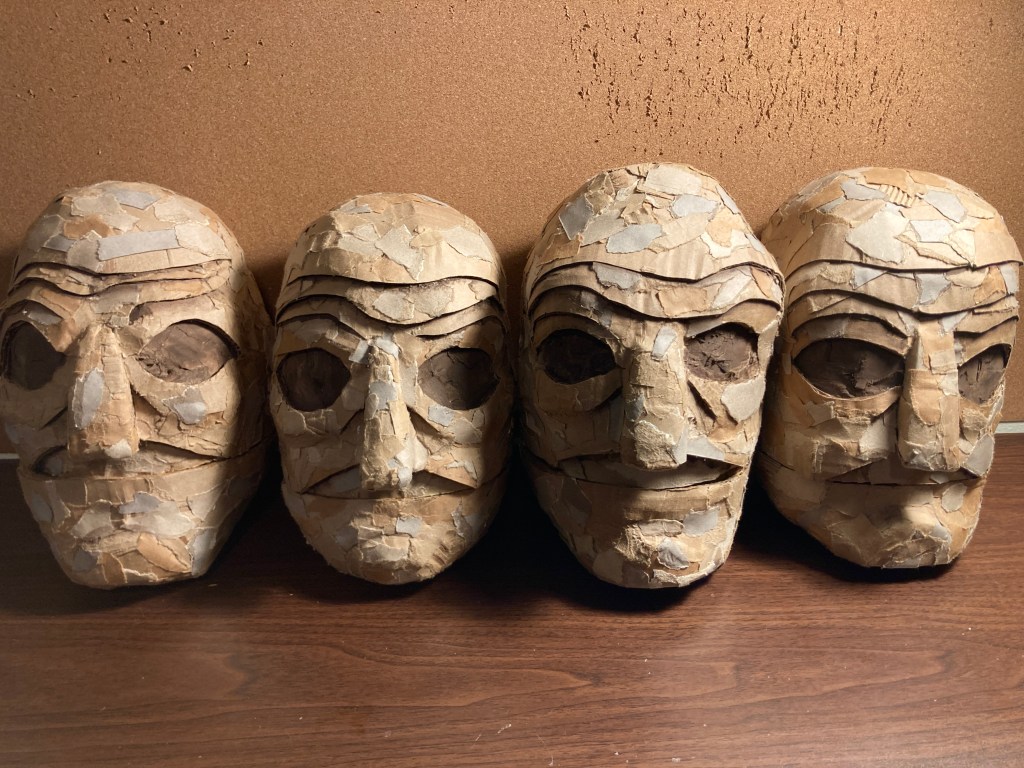
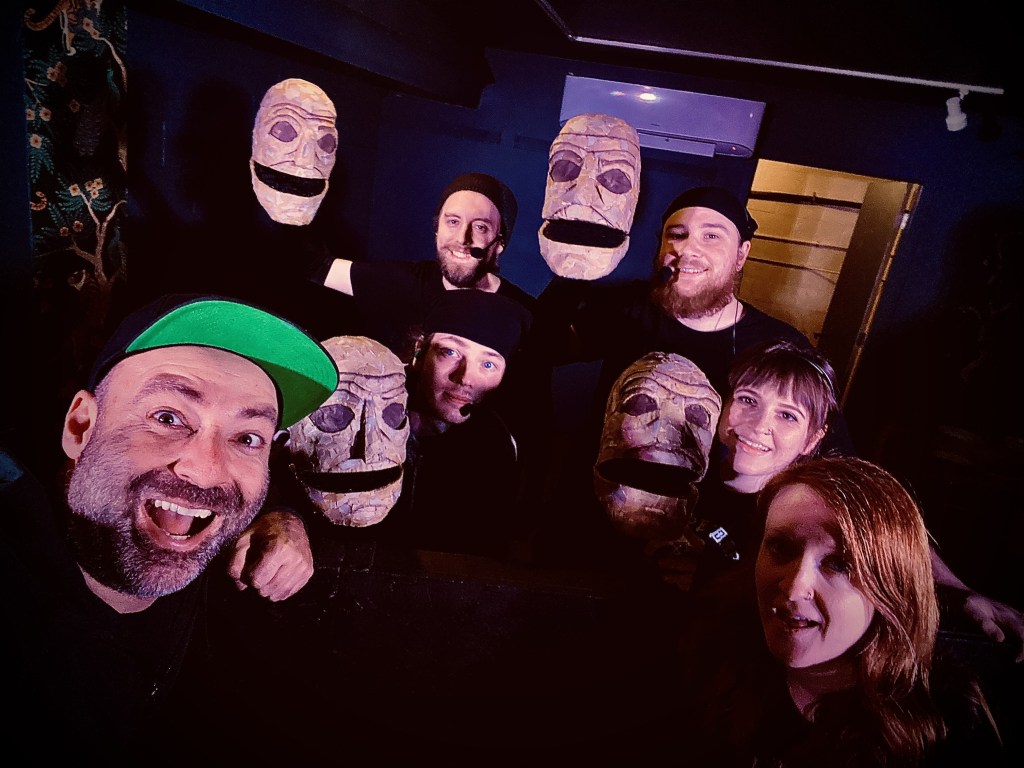
It definitely reads like a last work and keeping that in mind, I thought of Beckett’s own face in his later years. I kept staring at pictures of him and thought about how he’s so unique looking. I felt like I could base a puppet on his aging face, with the large nose, heavy wrinkles, and sunken eyes. I started sketching ideas for that. At first, I was thinking of putting the puppets in hoods, like Beckett says at the beginning, and then I scrapped that as I got further along in the fabrication process. The puppets turned out to have so much unique texture with the many overlapping layers of different types of cardboard, and I didn’t want to hide that. At one point I thought maybe they were going to be very large puppets. At another, I thought that maybe they were going to have necks and shoulders. But I chose to keep it as simple as possible to focus on what an old and dying face looks like.
They’re completely made out of cardboard. When I first told Octavio that I was making them out of cardboard, he was a little apprehensive, but once he saw them, he understood what I was going for.
JG: My favorite part of that was he gave us a materials budget of $1,000. When he saw the receipts, which were for like $8 or something, he thought we were joking, or panicked a bit that it was really going to suck, which was pretty funny…
AMM: I love using recycled matter in any puppet I make. I am big on sustainability, and puppets can unfortunately take a lot of material. So being able to reuse boxes I got on my front porch was great. The cardboard layers were a little spooky too, especially when adding the flashlights pointed underneath them. They had a texture that read as aging skin.
KW: The texture of the puppets reminds me of Jocelyn Herbert’s costume design for the production of Footfalls that Beckett directed. The dress appears to be torn to shreds. There’s a line in Footfalls that sums it up, ‘a tangle of tatters’. Beckett’s work has that quality. It’s worn, it’s deteriorating, it’s aging.
The percussion and the human screams incorporated in PFF’s What Where reminded me of Beckett’s 1981 play, Quad. Josh, could you talk about the sound design?
JG: Alyssa annotated the script with what the particular vibe, tone, moments, and stops were. We treated it like a beat poem where I was playing drums with jazz brushes – basically doing jazz rhythms, playing along and accentuating certain words. I also hung a microphone above the drum set that picked up little bits of sound from the various beats which I was running through a series of guitar effects pedals to turn them into strange noises. And I had a microphone that I could talk into. The idea was that drums on their own can be a little grating, but the microphones were picking up just enough of the drums that they were turning them into surrealistic sonic textures that sat underneath it. The premise of the play is ostensibly about torture, where they’re sending someone off to be tortured, and you’re basically hearing their screams coming from down the hall. The idea was that the sounds were like howls in the distance, things that go bump in the darkness kind of sounds, and that you were getting a lot of those from the echoes, the reverbs, and the sort of weird noises that were coming from the guitar pedals. I was accentuating some of that with the microphone where I was occasionally doubling things that the actors were saying to give them a little more emotional intensity. And as the play ends, we had a slow fade out and I played a heartbeat on the drums. At the same time, I was doing screams and sounds of torture in the distance because he’s by himself, but everyone else has been sent off to be tortured. He’s alone with the heartbeat.
What was interesting is the audience was supposed to get up and leave in the middle of that. We never really ended the show. I was told by one of the other actors that Beckett has a piece where the play doesn’t have an ending. We thought that was interesting. Rather than trying to stop, take a bow and the whole thing is over, we thought of it as in medias res. The play is surreal and uncomfortable. Let it be surreal and uncomfortable the whole way.
What was really funny is that one night a guy didn’t get that the audience was supposed to leave, and he came over to the drum set and he kept trying to talk to me. I think he was trying to say he liked the show or something like that, but anytime he would try to say something, I would just scream and whimper more. And it went on for a really long time. Because the rest of the crew was busy closing things out, they didn’t notice what was going on. It took a long time to get this guy to leave, three or four minutes.
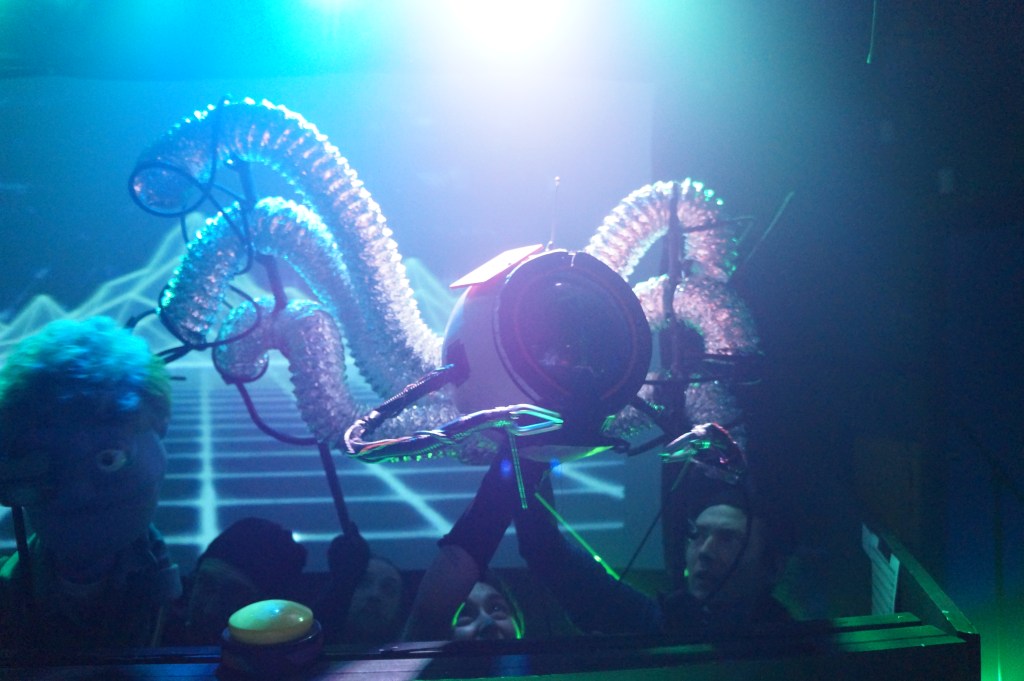
KW: That’s interesting because almost every time Beckett gets performed, there’s a curtain call. However, Beckett removed the curtain call from his productions. And many of the plays loop giving the impression that the play will go on even after the audience has left. I loved that PFF didn’t do a curtain call.
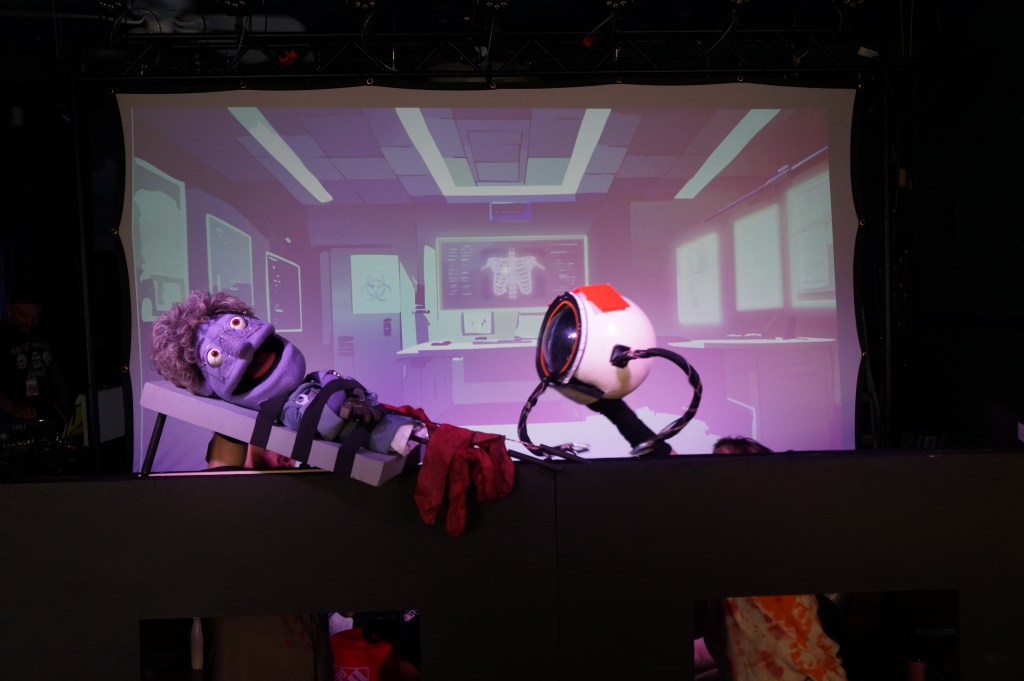
Your What Where was terrifying but also really funny. When I went to see your recent work, Robopocalypse: The Musical!, I was impressed by how well you weaved together terror, angst, horror and humor. Could talk about how you use humor?
JG: Horror and comedy are two sides of the same coin in that they’re about making and breaking tension and they’re about the strategic revealing of pieces of information to set something up. A lot of it’s about the timing, and you find that a lot of people who are big in horror came from comedy or a lot of people who are in comedy come from horror. These two things kind of go together. It’s like they say the recipe for comedy is tragedy plus time. Horror is just hyper tragedy. They’re closely interlinked.
I also read What Where as remarkably similar to what is generally considered the most iconic classic comedy routine of all time, which is Who’s on First? Both are playing with language and going around in circles. It’s just that the subject matter of What Where is obviously a lot darker. But I think that part of what makes it funny is that the circuitous logic was still just as absurd when looking at such dark subject matter. In fact, the people executing torture aren’t really thinking through the implications. They’re just playing with words. It’s not torture, just enhanced interrogation. They’re just moving things around. He didn’t tell you a thing? Well, go do it again. There’s a sort of nihilism underneath which makes that work. To me, they’re two sides of the same coin. A lot of horror is comedy taken out of context. A lot of comedy is actually terrifying. Like, oh God, why are we laughing? That person fell in a manhole cover and died, as Mel Brooks put it.
AMM: Josh is absolutely right; the two genres are so similar. I knew that I wanted to incorporate comedy in the show. I knew I wanted to incorporate horror too. The PFF code is comedy-horror, after all. And Beckett’s works really lend themselves to having both happen. But if you approach anything too far in one direction, it can fall flat easily. I was very aware of that. Having the mixture of both, having times where the audience doesn’t know whether to laugh or cry, is intriguing and it makes them think about the show for a long time afterwards. The absurdity comes in the repetition of What Where. What does he want? You don’t know. It doesn’t make sense in a lot of regards. It makes you question. The ambiguity forces you to think about what it meant for you, personally. And that’s what great art does, in my eyes.
KW: There seems to be so much Beckett in Robopocalypse: The Musical! The existential crisis of the characters, the nihilistic vision, but also the comedy, the humor, the terror. How do you think Beckett or, more generally, absurdism has made its way into your writing, or maybe it hasn’t, maybe your writing made its way into your production of What Where?
JG: Interestingly, I feel that Robopocalypse: The Musical! is a tremendously optimistic piece. It’s just that to find the light, you have to dive deep into the dark. But that is the nature of the hero’s journey. The entire repeating musical refrain of the show is ‘Brave New World’. The idea that this thing is happening, and we have to face it with our hearts fully open. The big conclusion of the show is that our hero, who has sacrificed herself to save the world, says, ‘I’m still going to win this one day’. And she triumphed by defeating the villain who represents a nihilistic, ‘nothing really matters other than me coming out on top’ vision. To me, it’s a repudiation of nihilism. That’s part of what I don’t particularly enjoy about Beckett as a writer. I don’t think he wants to take a stand on anything, and doesn’t want to have a narrative conclusion, which I consider a bit lazy, even contemptuous of the audience.
In Robopocalypse, all of the characters who were sort of trapped in that doom loop where nothing means anything, they’re all very excited that they’re not doing that anymore, that they’ve been liberated and can choose their own destiny.
AMM: I think Robopocalypse is the most fucked up PFF show. What is happening in it is so depressing and dark and crazy. We’re talking about a parent dying and a girl making her dead mom out of spare parts to connect with her again and then having this evil AI thing come into the mix. There are themes of self-actualization and questions of what it actually means to be alive and ‘human’. It’s probably my favorite PFF script. It’s the most complicated plot and it has the most multifaceted relationships that change drastically as the show goes on. It’s interesting to hear you say it’s optimistic, Josh. In some sense, I see it as optimistic, and then it’s also very, very, very dark.
JG: Darkness doesn’t necessarily mean not optimistic. Darkness is the fire you go through, not the compass reading. The question is do the characters give up or keep trying. When Hag’s mother dies in the show she doesn’t go, ‘well, that’s it. There’s no point to anything’. She says, ‘I’m going to rebuild her’. That’s classic Frankenstein horror, but it’s also optimism that she can fix her life and the world she inhabits rather than be resigned to it.
AMM: So true, and that blend is what makes it absurd, in a way. These characters do not give up. They refuse to give up even if they want to and even if the whole universe is succumbing to the darkness around them. It’s so dark, yet so funny. There’s some sort of absurdist thread in that.
KW: Beckett’s characters go on. There’s this resilience in them; they don’t give up. In Beckett’s Catastrophe, for example, the character Director (who is also a dictator) hasn’t crushed the spirit of the character Protagonist. It’s very clear when P defies D’s orders.
Many of Beckett’s works deal with this idea of technology, too. All That Fall features a woman who is going to meet her husband at the train station. Each person she meets along the way is using a different form of technology, and each breaks down in some way. And, in Krapp’s Last Tape, the old man tries to become a better writer but just ends up stifling him because he is wedded to his machine. I think there’s a lot of interesting parallels between these works and yours.
JG: I came to really like What Where and appreciate Beckett a lot more through doing the festival. It’s almost a shame that we did it four times for four days and now it’s over. It was such a fun experience and would be great to have in the old back pocket to pull out here and there, but I don’t know if that’s a thing we can do. I mean, part of the problem, one of the reasons we’ve always done our own shows, is that licensing for theater is such a mess.
AMM: Doing this piece really reaffirmed my strong held belief that puppetry can belong in a lot of very well-known playwrights’ work, and still keep the themes of the story, and still have respect for what’s happening. Puppetry can amplify the story and the themes in ways that breathe new life into them without being a gimmick, without falling into a ‘I’m just going to do puppetry for the sake of puppetry’.
It opened up my eyes to thinking what other playwright’s works puppetry would blend well with. I just saw a production of Glass Menagerie, and I was thinking it’d be so cool if there were shadow puppetry on the ceiling the whole time. It’s a memory play that’s supposed to bend the perceptions of reality already. Plus, Tennessee Williams constantly talks about light in that play, and there’s even a shadow work aspect written in, where one of the characters exclaims how big his shadow looks in the candlelight. To be able to expand my own creative ideas like that is exciting.
I would love to do more classic texts and add this element that I think is so magical and allows telling the story in a way that pulls the audience in even more. Puppetry does that.
Katherine Weiss is the Associate Dean of the College of Arts and Letters at California State University, Los Angeles. Her scholarly publications include Samuel Beckett: History, Memory, Archive (co-edited with Seán Kennedy, Palgrave/Macmillan, 2009), The Plays of Samuel Beckett (Methuen/Bloomsbury, 2013), A Student Handbook to the Plays of Tennessee Williams (Bloomsbury, 2014), Samuel Beckett and Contemporary Art (co-edited with Robert Reginio and David Houston Jones, ibidem, 2017), and Simply Beckett (Simply Charly Press, 2020). She has published book chapters in Samuel Beckett and Ecology (Bloomsbury, 2025) and Beckett’s Afterlives: Adaptation, Remediation, Appropriation (Manchester UP, 2023) as well as articles in the Journal of Beckett Studies and Samuel Beckett Aujourd’hui. She has given numerous invited talks at conferences and for theatre productions and festivals, including the Ashland Beckett Shorts Festival (2024) where she served as the Scholar-in-Residence.


Leave a Reply