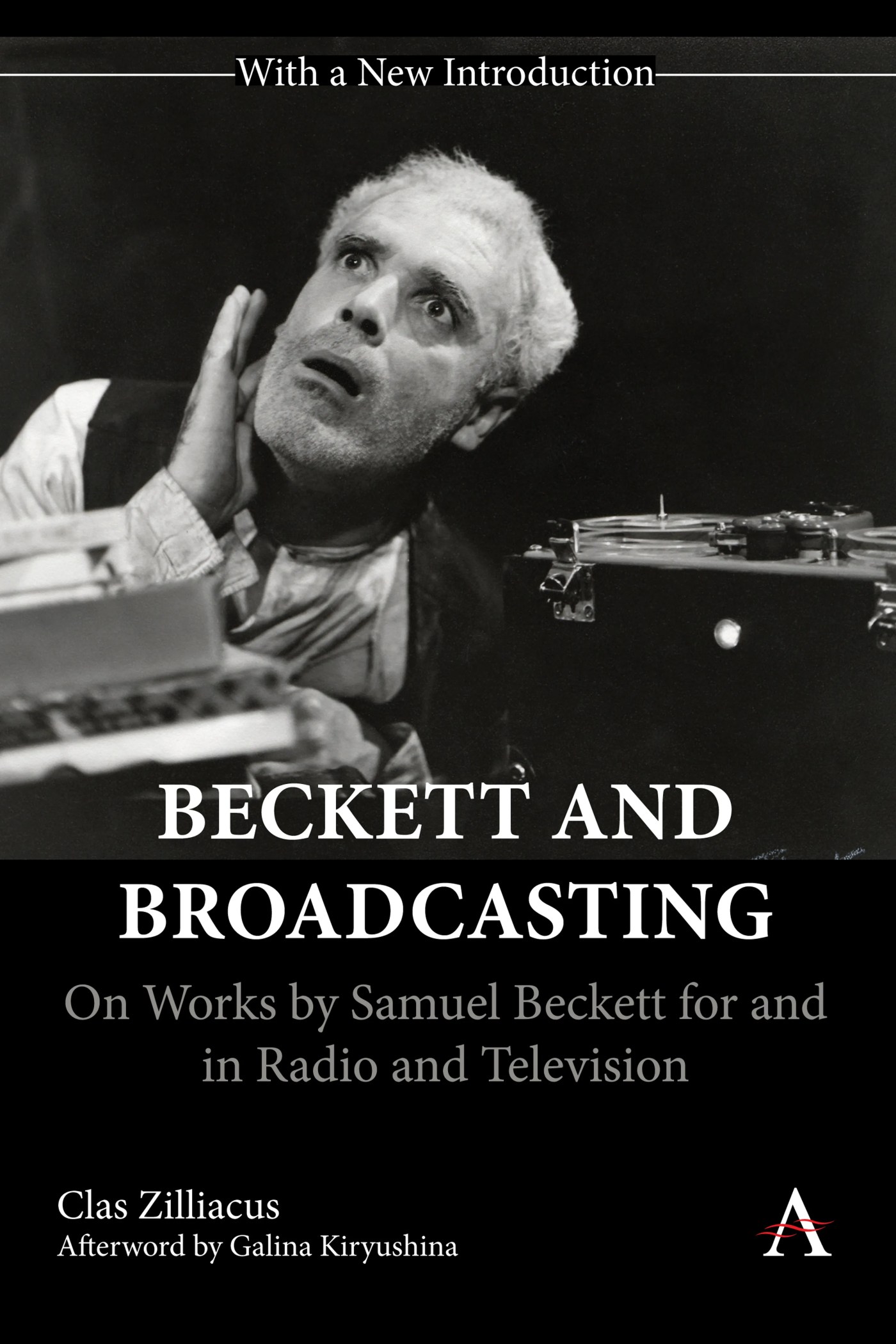
Review by Pim Verhulst
Clas Zilliacus, who passed away in May of this year, was just able to witness his monumental Beckett and Broadcasting reappear in print for its 50th anniversary. Still the undisputed work of reference on Beckett’s radio plays, it has long been a coveted and hard-to-find book, due to its publication by a small university press (Åbo Akademi) and low print run. Many of us ‘own’ it as a battered university library photocopy riddled with all kinds of annotations, which testify to the huge significance and impact this book has had for subsequent generations of students and scholars. What strikes one upon revisiting B&B is not just the thoroughness with which it pursues critical sources (in multiple languages) and its sharpness of insight, but also the quality of Zilliacus’s writing, the elegance of his prose and his playful use of language, which make this book such a delight to re-read.
One of the defining features of B&B is that it looks at the available drafts of Beckett’s radio plays as well as Eh Joe. Paving the way for studies like S. E. Gontarski’s The Intent of Undoing (1985) and Rosemary Pountney’s Theatre of Shadows (1988), Zilliacus’s genetic account is in no way supplanted by them. Instead, it offers a welcome corrective to the notion of ‘vaguening’ which has come to dominate studies of Beckett’s writing process, showing that details were not only taken away but also added, especially in the drafts of All That Fall. Additionally, B&B demonstrates the vital importance of oral history for understanding the collaborative nature of dramatic production – another burgeoning area in Beckett Studies – by means of interviews or exchanges with an impressive array of correspondents, from Donald McWhinnie, Desmond Briscoe and Michael Bakewell (BBC) to Reinhart Müller-Freienfels (SDR) and the German translator Elmar Tophoven – even Beckett himself, including letters from others in his private possession. Zilliacus situates the texts against the background of other radio plays broadcast in the 1950s-1970s, not just in the UK and France, but also in Germany and Scandinavia. Perhaps the greatest merit of B&B was its media-conscious approach to Beckett’s radiophonic and televisual work, at a time when textual or theatrical methods were forced upon broadcasting and the scripts were often lumped together with Film as ‘media plays’.
In 1976, when B&B first appeared, Beckett’s career had thirteen more years to go. During this time, he published another radio play (Pochade radiophonique / Rough for Radio II), four television plays (Ghost Trio, …but the clouds…, Quad, Nacht und Träume), and became involved in two screen adaptations (Not I and Was Wo, the German version of Quoi où / What Where). The Old Tune, Beckett’s free translation/adaptation of Robert Pinget’s radio play La Manivelle, is also lacking from the discussion, which prevents B&B from being the definitive study on the subject. Yet we can hardly hold the lack of some genetic material or its slightly premature date of publication against the book. The only thing B&B might be faulted for, perhaps — and the feature that most clearly marks it as a published dissertation — is that it attempts to cover too much ground – an admirable impulse that every PhD student needs to be warned against by their supervisors. The upside is that the book sets out so many interesting lines of enquiry for later critics to pick up on. These include broadcasts of Beckett’s work outside of the UK and France (in Europe but also beyond), the impact of technological media on his prose or theatre, and adaptations – areas that Beckett Studies have only now started to explore in depth. Apart from an Appendix with ‘Suggestions for [a] T.V. Krapp’ that never materialized, the two finest chapters are the ones on Cascando – by far the best account available, in which Zilliacus proves himself to be an astute genetic critic – and stage productions of the radio plays, disclosing documents from the Grove Press archive.
Essentially a photographic reproduction, the reissue of B&B helpfully retains the original page numbers. The text has been furnished with a new introduction by the author, providing some useful context for the analysis as well as a brief overview of recent scholarship, and an afterword by Galina Kiryushina, in which she outlines the methodological importance of Zilliacus’s work. There is also an index with names and titles, which makes it easier to navigate the book, but this can be spotty – for example omitted names in the footnotes of the new introduction. While an appendix could have been added for the many translations of French and German quotations, as well as a list of errata, these are just quibbles. Some factual mistakes remain, e.g. that the French recording of Cascando was erased or that Beckett was not present in the studio for the French production of Eh Joe. Then again, Zilliacus also sets the record straight on other accounts, pointing out that Embers did not win the Italia Prize but the RAI Prize. There is minor streaking or creasing on some of the pages, and the bibliography has faded in parts, probably due to the state of the original used for offsetting or the reproduction process, but these never detract from the legibility of the text. All in all, the Beckett community owes an enormous debt of gratitude to Clas Zilliacus for returning to his monograph, as well as to Mark Nixon, Galina Kiryushina, S. E. Gontarski and the production team at Anthem for their help in delivering it.
Pim Vehulst studies radio drama and intermediality in postwar literature from Britain and Ireland, with a specialism in Samuel Beckett. At present, he is carrying out a Marie Curie Postdoctoral Research Fellowship at the University of Reading. He holds a PhD in English literature from the University of Antwerp (2014) and has also worked at the University of Oxford and the Vrije Universiteit Brussel. He co-edited the volume Beckett’s Afterlives (2024) and has two monographs forthcoming in the Beckett Digital Manuscript ‘Making of’ series.


Leave a comment