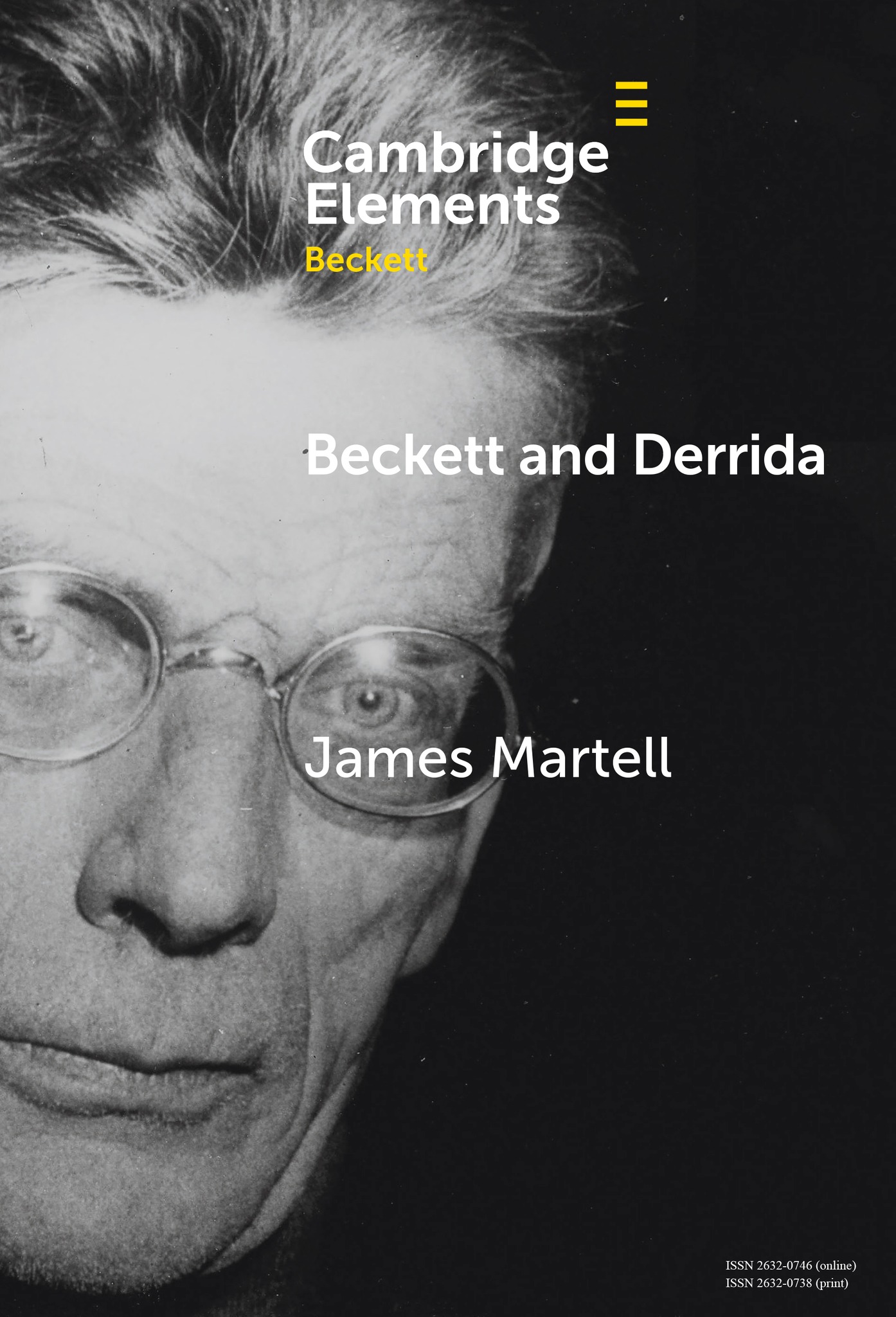
Reviewed by Douglas Atkinson
Beckett’s insistence that he was not a philosopher did little to deter philosophical readings of his work. From Cartesians to Existentialists, from Structuralists to Post-Structuralists, philosophers have been compelled to engage with Beckett—with one notable exception: Jacques Derrida claimed to have nothing to add to Beckett’s work, famously labelling it ‘too close’ to his own thinking to allow for exegesis.
It is, however, precisely because of Derrida’s famous reticence before Beckett’s work that we should be grateful for James Martell’s contribution to the Cambridge Elements series, Beckett and Derrida. Martell, who has proven himself fluent in the idiosyncratic language of both writers, somehow manages, in one fell swoop, to invigorate the Beckett-Derrida (non)relationship and demonstrate its relevance for the twenty-first century. On the topic of Beckett and Derrida, Martell is, of course, in very good company, but rather than dismissing the early works of Steven Connor, Richard Begam, or Thomas Trezise (to name but a few), Martell’s primary hermeneutic gesture is to accept their offerings and attempt to carry forward their dedication and academic rigour to the later stages of Derrida’s development.
In at least one sense, Martell has a major advantage over his predecessors, namely, the advancement not only of Derrida’s work itself, but of our understanding of his work. Where Beckett scholars of the 1990s tended to focus on a single theme or (non) concept—Connor, for example, focuses on repetition, while Begam was drawn to the play of différance—Martell includes Derrida’s more mature works, engaging with his entire oeuvre. In so doing, Martell offers not only a genuine contribution to scholarship on Derrida, but he also opens entirely new horizons from which to read Beckett.
The five chapters of Martell’s work explore a range of (im)possible encounters between Beckett and Derrida, with each chapter juxtaposing a specific theme in Derrida’s oeuvre with Beckett’s texts. As a whole, the results are insightful and well-argued, but three chapters stand out for their excellence: the second chapter on the spatiality of the Platonic/Hegelian term, khôra: “Khôra: The Space of Genesis,” the third chapter, “Hauntologies,” and the final chapter on “Deconstructing the Sovereign Subject.” This is where Martell’s mastery of both figures is most evident, and the originality of his contribution most forcefully present.
The second chapter on the unique understanding of questions of spatiality found in the notion of the khôra is, as far as I know, the only work on Beckett that raises this unequivocally central issue from this perspective. This is quite the accomplishment, given the recent outstanding works devoted to the theme of spacing/spatiality by authors such as Amanda Dennis (2021), James Little (2020), Jonathan Boulter (2020), and Anthony Cordingley (2018). As Martell demonstrates via concrete examples from The Unnamable, Texts for Nothing, and How It Is, khôratic spatiality – that is, the space of spacing itself, the space that allows for the possibility of space to happen – is at the heart of everything that Beckett is concerned with. For Plato, khôra stands for a third medium that allows for the possibility of the spatial existence of both the Forms and the sensible world – it is the space through which the spatiality of existence unfolds. Beckett’s work, as Martell clearly demonstrates, focuses on the key question of where now? that pervades all of his inquiries into language, subjectivity, and temporality. Across diverse settings, the space that allows for their possibility in general is a question that resonates within the entirety of Beckett’s writing: it is not just the space of literature, or the space of the theatre, but spatiality itself – the condition for the possibility of any embodiment, any happening, or being – that is the real concern.
The third chapter, “Hauntologies,” brings Beckett scholarship into dialogue with one of Derrida’s most important later works, Specters of Marx. As Martell makes evident, Derrida’s notion of ‘haunting’ applies to Beckett’s work in ways that are simply remarkable. The reason for this is quite simply wired into the experience of the Beckettian subject itself; always arriving too late on the scene to have a clear understanding of the meaning it finds itself enmeshed within, Beckett’s characters are haunted by histories they will never be able to claim as their own. Martell refers specifically to Footfalls and Ill Seen Ill Said, and these allusions should be seen as guiding lights through Beckett’s shrouded world, demonstrating how the temporality of the spectral subject is profoundly akin to that of the Beckettian subject.
In the fifth chapter, “Deconstructing the Sovereign Subject,” Martell brings his key points together through a reading of Beckett’s first published story, “Assumption.” I could not help but wonder if the choice of this piece was not also meant as an enactment of the subject (pun intended) in question, since Martell takes us back to the scene of the crime of Beckett’s origin only to undo any and all allusions to the formation of a static, unified, authorial voice; it’s as if Martell couldn’t resist the temptation to practice what he is preaching, leaving us with an absence at the precise point where the genealogical evidence suggests we should find the solid presence of Beckett’s origin. In so doing, Martell contemporises our understanding of Derrida’s final works on justice and sovereignty, fully demonstrating the privileged position that Derrida should hold in future studies on Beckett.
Martell’s study is valuable not only for its textual analysis, but even more so for the portals it has opened for further exploration along numerous lines of research. While questions of space and subjectivity have been a mainstay in research on Beckett, Martell’s refinement of these issues – via an emphasis on the process of spacing itself in khôra, the effects of the spectral reading of temporality and historicity on the Beckettian subject, and the consequences both of these have for re-evaluating the sovereignty of the classical subject – make this book an entirely original and highly fruitful contribution to the field.
Douglas Atkinson teaches at the Vrije Universiteit Brussel, where he lectures in critical thinking, rhetoric, and academic composition. His research focuses primarily on the philosophic import of Maurice Blanchot and his influence on the philosophy of language. His most recent publications have appeared in the Journal of Beckett Studies, Twentieth-Century Literature and Samuel Beckett Today/Aujourd’hui. He is currently working on a critical rereading of the Japanese reception of Samuel Beckett’s prose.


Leave a comment