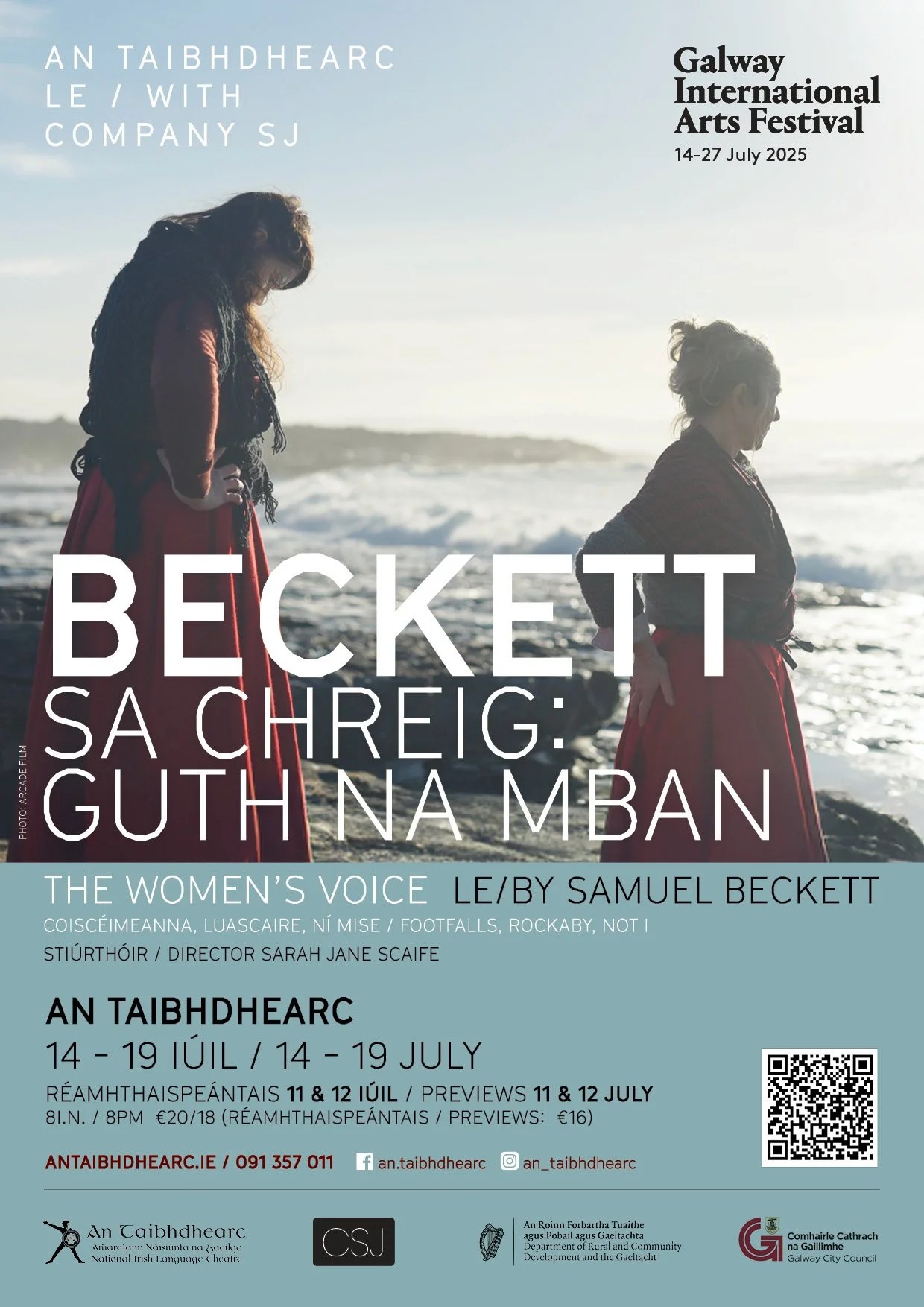
Directed by Sara Jane Scaife
Featuring: Nuala Hayes, Fiona Lucia McGarry, Caitríona Ní Mhurchú
Monday 14 July 2025
Review by Feargal Whelan
Reminded of my last visit to witness Beckett sa Chreig: Laethanta Sona in 2022 – the remarkable production of Happy Days in Irish on the Aran Island of Inis Oírr – I took a trip out west to Galway to see the latest in the series of Beckett productions from Company SJ, directed by Sarah Jane Scaife. At the time, I described the trip to the island as a kind of pilgrimage, echoing the Irish word oilthearacht, which I heard being used widely by the audience. My current excursion to see Beckett sa Chreig: Guth na mBan (Beckett in the Creig: The Women’s Voice) may have lacked the same sense of the sublime, as it was taking place in the traditional theatrical setting of An Taibhdhearc, but the experience was no less profound. The theatre, in the heart of urban Galway, is the National Irish Language theatre and was founded in 1927 with the innovative Micheál Mac Liammóir as its first Artistic Director. It also counted among its most famous productions a version of Waiting for Godot (Ag Fanacht le Godó) directed by Alan Simpson in 1971. By presenting Beckett on this stage again, the complicated history of the nation’s engagement with the language, from the constricting method of compulsory Irish in schools to the contemporary manic energy of the rap group Kneecap, was going to haunt the evening for this fluent but non-native Irish speaker.[1] In addition, as we were to hear the Women’s Voice, the depth of my relationship with Mother Ireland was to be an unavoidable presence.
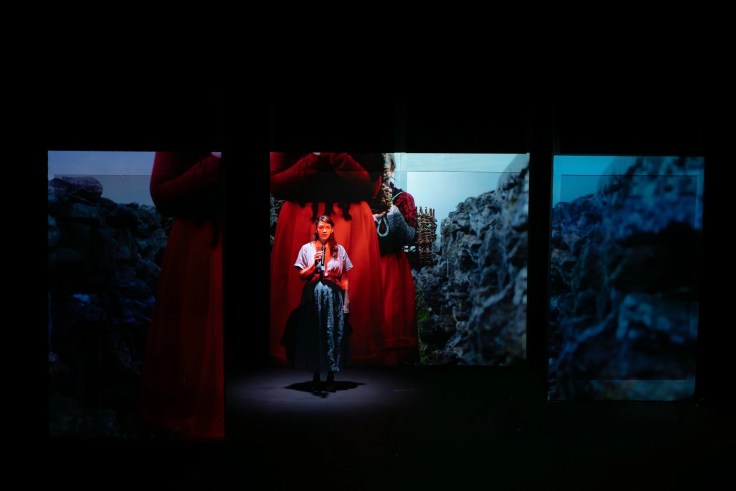
At the core of this production are the three short Beckett plays Coiscéimeanna (Footfalls), Ní Mise (Not I) and Luascaire (Rockaby). In addition there is a reading of ‘Siosarnach 4’ (‘Fizzle 4’) ‘I gave up before birth’, Beckett’s poem ‘My way is in the sand’ (Sa sruth gainimh atá mo chosán), a translation of Eavan Boland’s 1987 poem ‘Mise Éire’ and a rendition of the traditional Irish lament ‘Caoineadh na dTrí Mhuire’. All translations are by Micheál Ó Conghaile. The plays are performed according to Beckett’s staging instructions while the additional material involves one actor at a time performing on a stage comprising three large vertical panels onto which a continuous video is projected. The images are accompanied by a minimal score by Matthew Martin and a soundscape by Martin and composer Fiona Lucia McGarry. The choice of the three plays, and their presentation in this manner, privileged the themes of women’s perseverance in the face of loss and alienation. The order in which the plays appeared portrayed the protagonists ageing progressively from the younger May in Footfalls to the expiring W in Rockaby. There was also a sense in which the endurance of each protagonist was being passed on to the next and from one generation of women to another. The visual and aural framework provided by the added material prompted a broader contemplation of the issues that were being raised by the Beckett plays.
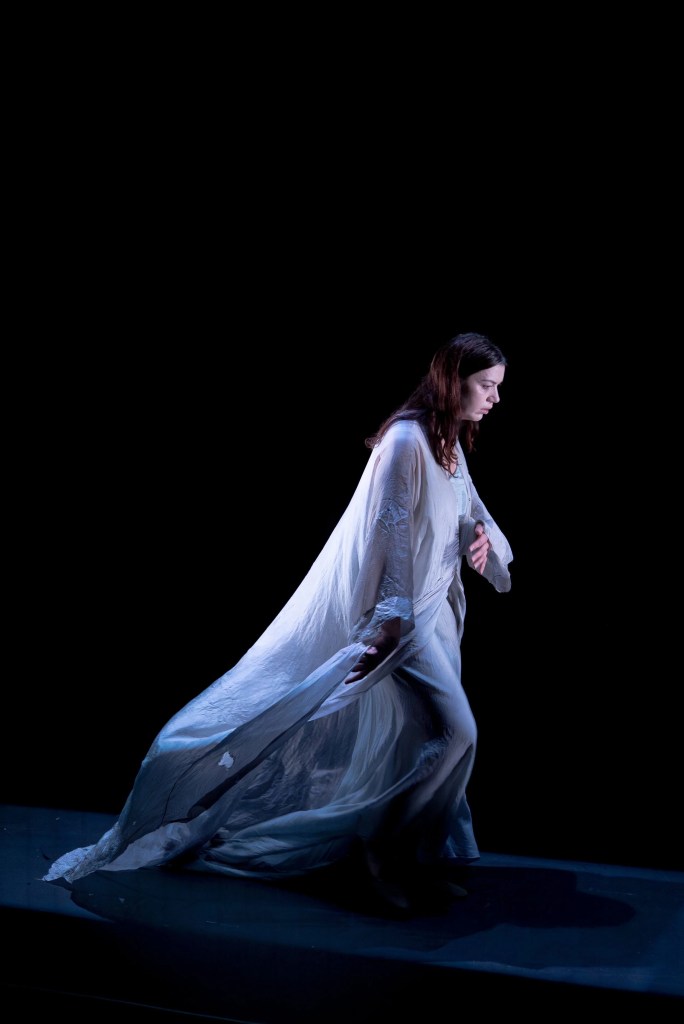
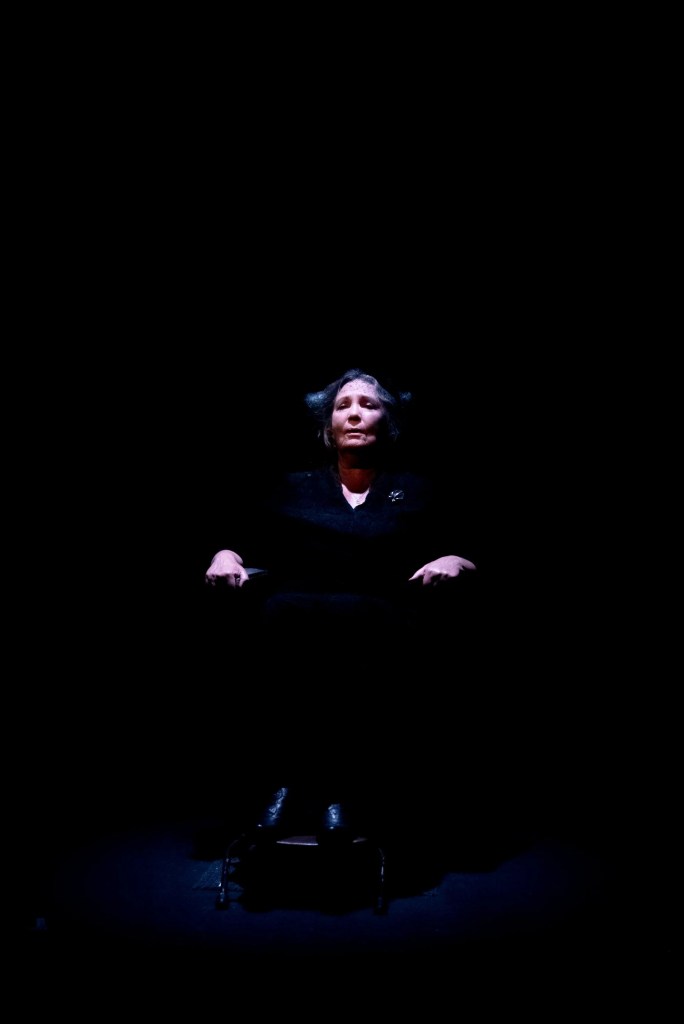
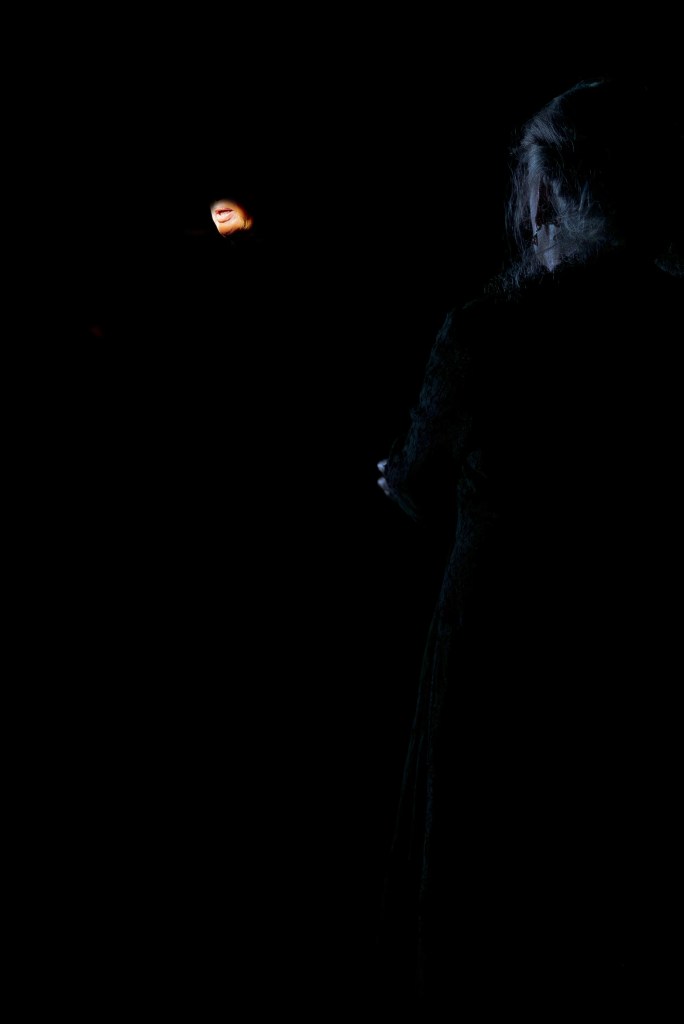
In all three of the plays, the women are in open dialogue with a listener who very well might be themselves. In Footfalls, May (Fiona Lucia McGarry) seemed almost girlish despite being ‘in your forties’. Her emotional growth stunted by service to her mother, she was physically ageing but emotionally trapped. For Not I, Mouth (Caitríona Ní Mhurchú) was elevated above the stage with Auditor (Nuala Hayes) appearing as an unhooded but dimly lit older woman. There was a strong echo of the incomplete dialogue between May and Voice from the earlier Footfalls. This time, however, the dialogue between both figures was even more fractured so that Auditor’s raising of the hands ‘in a gesture of helpless compassion’ was made more poignant by its frustrated impotence. Nuala Hayes, in her rocking chair at the window adjacent to death’s door in Rockaby, embodied such a bitterness and ferocity that the line ‘fuck life’ appeared almost as an inevitable endnote eliciting empathy rather than shock. To me, she strongly suggested a portrait of an ageing Connemara woman guttering out her days in London. When I thought later about this fancy and checked the original script, I found that the feeling had been conveyed by the word ‘soul’ in the line ‘another living soul’ being translated correctly as deoraí, a word which also commonly means an exile in Irish and which has its root in the word for a tear. In essence, when she plaintively looks for ‘another living soul/one other living soul’ she is vainly searching for another tearful exile like herself. In this one act of translation, and in keeping complete faith with the original text, the play somehow sounded the recurring beats of struggle, perseverance and isolation which bound the broader production together.
The other pieces which wrap around the three plays amplify the themes of perseverance and the long, specific history of Irish women’s endurance evoked in the visual environment of the production. By assigning a female voice to Fizzle 4, ‘I gave up before birth’, there was an envy and bitter appropriateness to the line ‘I do the impossible…it was he who had a life’ which is normally absent. Meanwhile, ‘My way is in the sand’ evoked the slow journey of the women through the island’s landscape visible in the accompanying images, while Eavan Boland’s polemical poem ‘Mise Éire’ became a complicated act of homage to the endurance of Irishwomen’s resistance. Most movingly, perhaps, was the rendition of ‘Caoineadh na dTrí Mhuire’, sung a capella by McGarry. The ‘Lament of the Three Marys’ describes the Passion of Christ and the way of the cross, each line attenuated by the refrain ‘ochón agus ochón, ó’ (a poor translation might be ‘woe is me’). It resembles Góreckí’s Third Symphony, the Symphony of Sorrows, in its depiction of a mother’s articulation of grief and bereavement through the repetition of simple phrases and a recurring musical motif. While again emphasising a mother’s pain, the refrain also reminded me of Beckett’s fondness for the word ‘ochone’, which he uses on a number of occasions, most notably in the late couplet: ‘ochone, ochone/dead and not gone’.
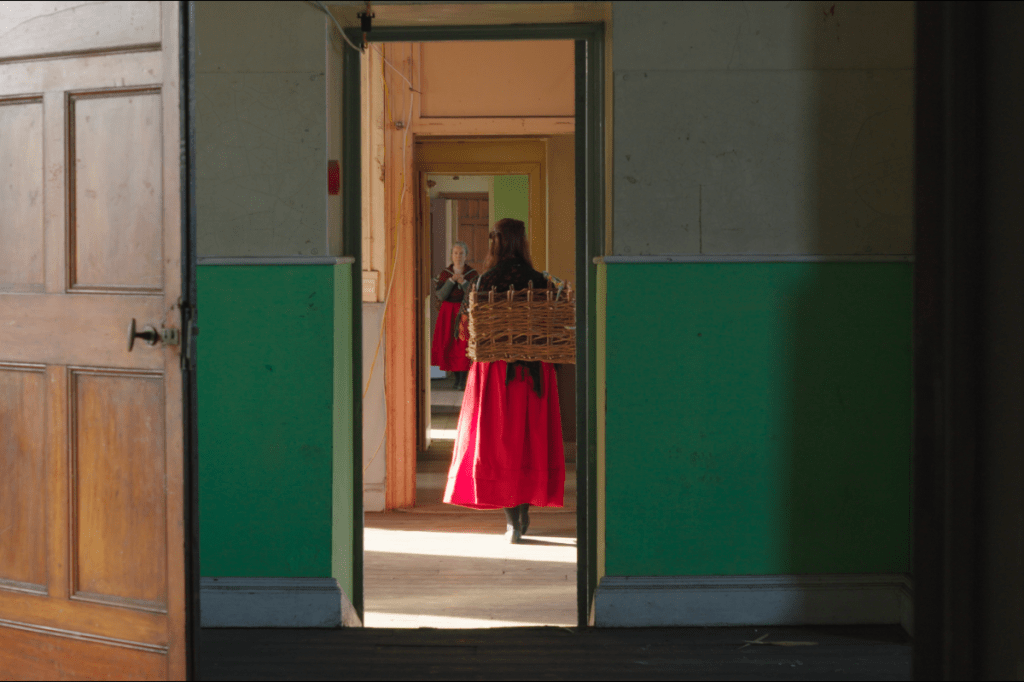
The film, which plays across all three panels and across the bodies of the performers at various times, depicts two women, one behind the other, in lockstep, passing through the landscape of Inis Oírr – by the sea, through the lanes, across the rock. Dressed in traditional Aran costume, they carry creels, collect kelp and build and dismantle small piles of stones. Seamlessly, their journey continues through the rooms and corridors of a dilapidated eighteenth-century house which is now an abandoned school. Throughout, they mirror each other’s gestures, pace and movements. Apart from offering a visual anchor to contemplating modes of endurance of Irish women specifically, the images allow for a meditation on the transmutation of traditional Irish culture and language from its marginalised habitat to the centre of the metropolis. The difficult and ambivalent relationship of Irish people with their language seemed to me so perfectly articulated by the constant building and dismantling of the island cairns in the shabby, dying schoolroom.
Beckett sa Chreig: Guth na mBan addresses profound questions for the local audience: questions of women and Ireland, the Irish language, and Ireland as an entity itself. But it also deals with huge universal ideas: motherhood, precarity, endurance, the limits of language, and the need to find expression. Scaife achieves something remarkable not just by presenting three excellent productions of Beckett plays; she also allows Beckett to become the starting point for debating the profundities of Irish life, and the wider issues of the role and status of women in society. The plays have a cohesion through being allowed to speak with each other and with the various other elements of the production. Scaife raises these issues in a non-didactic way and offers no answers in return. Rather, for this reviewer at least, the fact that they are unresolved heightens their intensity, and mirrors the ambiguity central to Beckett and his stated interest in the ‘perhaps’. More importantly, this production is as deeply moving as it is profound. A secular pilgrimage, perhaps?
Feargal Whelan is a Visiting Research Fellow and occasional lecturer at Trinity College Dublin. He has published and presented widely on the works of Samuel Beckett and on twentieth-century Irish drama. He edits The Beckett Review.
[1] See Whelan, Feargal (2017), ‘In Bantu or in Erse: Beckett and Irish Translation’, in Staging Beckett in Ireland and Northern Ireland, eds Trish McTighe and David Tucker, London: Bloomsbury for a comprehensive analysis of the issues raised by translating Beckett into Irish.


Leave a Reply