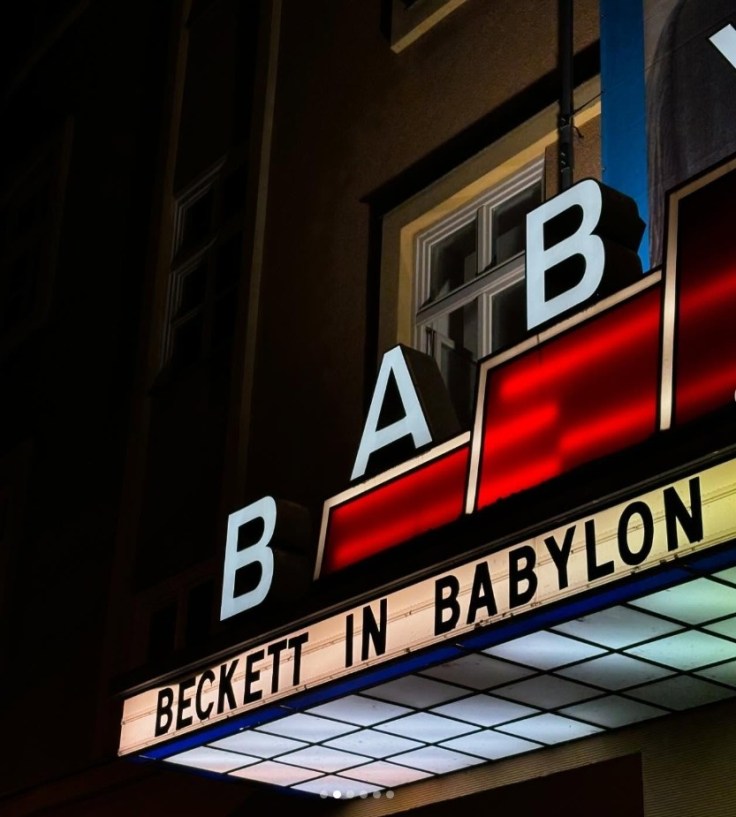
Reflecting an increasing interest in Beckett in Germany at present, two recent events celebrated the work of the author. ‘Beckett in Babylon,’ which took place at Kino Babylon (located at Rosa-Luxemburg-Straße 30, Berlin), incorporated a number of elements that were both exciting and unique. The event was officially inaugurated with a ceremony hosted by the Irish Embassy in Germany, with Ambassador Maeve Collins and the cultural attaché Candace Gordon delivering welcoming remarks. The keynote address titled ‘”German Fever”: Beckett and Germany,’ was delivered by Dr. Mark Nixon, co-director of the Samuel Beckett Research Centre at the University of Reading in England. Nixon discoursed on the subject of the German Diaries, addressing both the substance of the documents themselves and on their forthcoming publication by Suhrkamp. Nixon examined the bilingualism of the diaries in both English and German, the context of the Second World War and Europe, and the author’s discomfort when he wrote these diaries. In addition to the aforementioned literary aspects of the German Diaries, Nixon mentioned Beckett’s references to Nazism and his satirisation of specific figures of power, including Propaganda Minister Göbbels. Following the presentation, which was conducted in English, the audience was given the opportunity to pose questions, both general and specific, which were answered in detail.
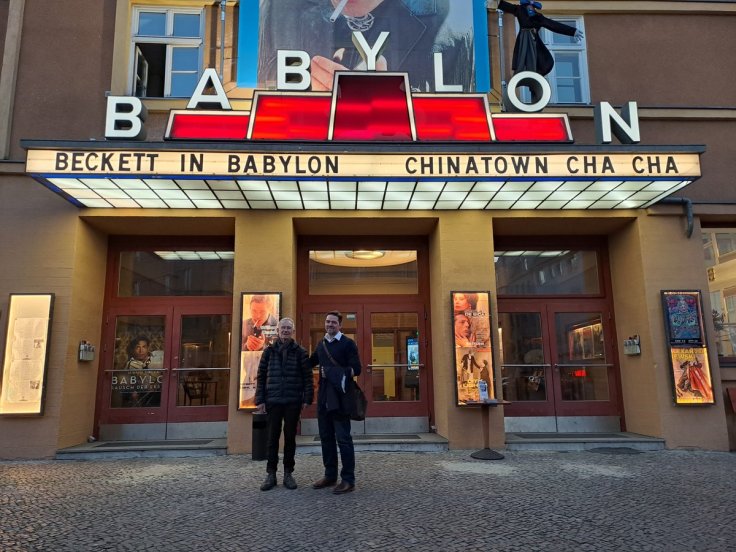
There followed a social gathering described as an ‘afternoon welcome cocktail,’ as a prelude to further activities. In this relaxed setting, the Ambassador, professors and the much-anticipated theatre director Walter Asmus chatted with each other and the attendees. Following refreshments, the film If I Fall, Don’t Pick Me Up, directed by Irish film director Declan Clarke in 2024, was presented in the cinema’s primary auditorium. The piece was commissioned by the Embassy of Ireland as part of Zeitgeist Ireland 24, an initiative of Culture Ireland and the Embassy. In this documentary, Walter Asmus, who formerly served as assistant director to Beckett in Berlin, provides a guided tour of the locations associated with the author in that city. These include hotels, theatres and the restaurant ‘La Girafe,’ which Beckett was known to frequent. In addition to urban settings, the feature film incorporates Irish landscapes that connect both Beckett and the filmmaker. These landscapes resonate with Beckett’s melancholy and the prevailing rainy climate of the island, which establishes a renewed link between the peculiarities of Ireland and Germany. Following the screening, a discussion with the film’s director, Declan Clarke, was moderated by Dr. Nicholas Johnson of Trinity College, Dublin and was followed by a question and answer session. In a surprising turn of events, Clarke employed a reference to Argentine football, a subject about which he possesses a keen interest, by citing Diego Maradona!
The following day, a dialogue took place between Walter Asmus and Mark Nixon, conducted exclusively in German, focusing on Asmus’s relationship with Beckett, their collaborative work, their theatrical aesthetics and differences, and some of Asmus’s memorable and engaging anecdotes about Beckett. He detailed the Irish author’s facility in speaking German and the manner in which he sought the expert opinion of his then-assistant director during the rehearsal process, demonstrating a sense of humility and openness to input from his colleagues. It is worth noting that Walter Asmus initiated his professional journey as Samuel Beckett’s assistant director on the production of Warten auf Godot, based on Elmar Tophoven’s German translation of En attendant Godot (1952) at the Schiller Theater in Berlin in 1975. He later assumed the role of Beckett’s assistant, progressing to the position of co-director on productions undertaken in Germany. In the subsequent Q & A, Asmus responded generously and in detail, answering questions regarding his forthcoming projects and the potential for directing a Beckett play that had not yet been staged. Asmus’s response was affirmative, thereby leaving the door open for the project, which would undoubtedly be a remarkable undertaking. The programme continued in the main cinema hall with a series of screenings of a selection of works by Beckett that had been produced for German television, specifically for Süddeutscher Rundfunk (SDR) in Stuttgart, from 1981 to 1986. Quadrat I + II (1981) was followed by Nacht und Träume (1983) and Was Wo (1986).
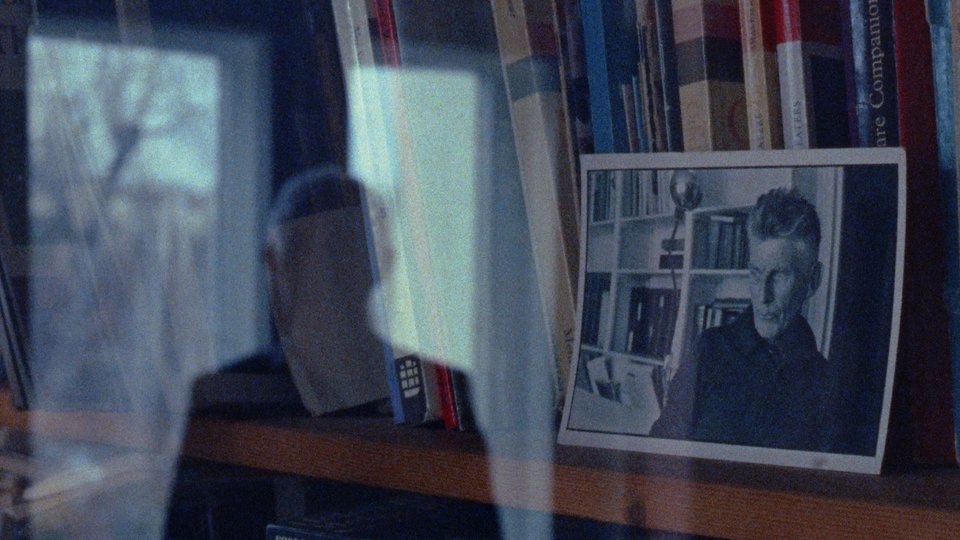
The final day of the programme concluded with a screening of other works by Beckett for German television (SDR) from the period between 1966 and 1977. The works included He Joe (1966) starring Deryk Mendel and featuring the female voice of Nancy Illig; Geistertrio (1977) starring Klaus Herm and featuring the female voice of Irmgard Först; and …nur noch Gewölk… (1977) with Klaus Herm and Kornelia Boje in the cast.
‘Beckett in Babylon’ represented a significant milestone in the academic, scientific and artistic domains in Germany, and served as a prelude to the publication of the German Diaries, which is eagerly anticipated by the Beckett community.
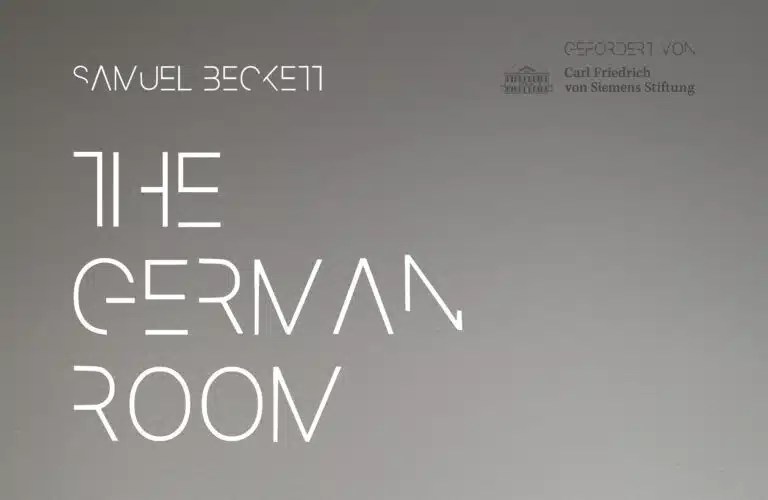
As the publication date has been announced for August 2026, the year 2026 opened with a flurry of activities centred on the ‘German Beckett.’ Beckett’s first play, the unproduced Mittelalterliches Dreieck, written in German in 1936, is to be performed by the Beckett Laboratory, TCD, directed by Nicholas Johnson. The play will receive an authorised translation into Spanish by Vanesa Cotroneo in the Argentine journal Beckettiana. Preceding this was the exhibition ‘Samuel Beckett: The German Room,’ which began in September 2025 and runs to July 2026 at the Library of the University of Regensburg, Bavaria. The inauguration was officiated by Dr. Georgina Nugent (convenor), Dr. André Schüller-Zwierlein (librarian), and a number of eminent scholars, including Prof. Dr. Jochen Petzold, Dr. James Little, and Dr. Adriaan van der Weel.
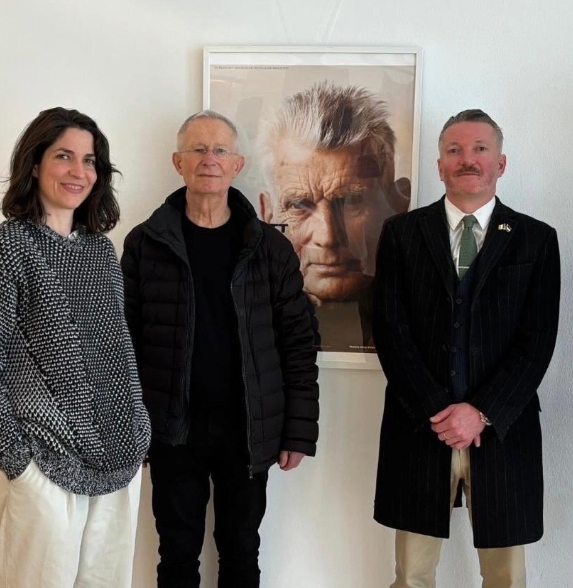
On Monday, January 19, 2026, a special event featured presentations by leading specialists in Beckett Studies, who contributed insightful observations, before an audience that included delegates from the Irish Embassy in Germany. Following an optional city tour, Dr. Nugent, of University College Cork, delivered the opening remarks. She addressed the study of Samuel Beckett against a traditional division, which would explain the significance of approaching the work of an Irishman from the German context, following the paths the author himself explored. Subsequently, Dr. André Schüller-Zweierlein, the incumbent director of the University Library of Regensburg, offered an analysis of Beckett’s oeuvre from the perspective of enclosed spaces, emphasising the pivotal role of language in Beckett’s oeuvre, thus designating him as a trilingual writer.
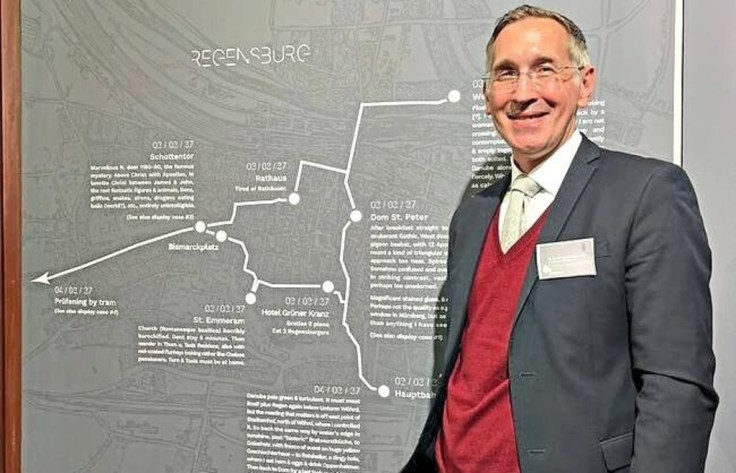
Professor Dr. Oliver Lubrich, a specialist in the field of comparative literature from the University of Bern, Switzerland, and one of the co-editors of Samuel Beckett’s German Diaries, referred to Beckett as a participant observer during his formative journey through Nazi Germany in 1936-7. The scholar then went on to present ten crucial points for understanding the German Diaries, emphasising that Beckett’s trip was primarily focused on studying the German language and paintings. However, as his time in Germany progressed, the nature of the trip underwent a transformation, acquiring an increasingly political character. For this reason, an ethnographic method emerges as central to the composition of Beckett’s diaries. Lubrich’s analysis of Beckett’s methodology reveals an active observer, who engages in meticulous observation, conducts in-depth interviews, and undergoes thorough research into documents. Furthermore, an examination of the entries in his German Diaries reveals a pronounced interest in Nazi rhetoric, with the diaries addressing this subject in depth. The focus on the role of the narrator in Beckett’s oeuvre, a subject that has been a point of interest for many scholars, was instrumental in the development of both Lubrich’s and Nugent’s expositions. Nugent adopted the label of ‘tender narrator,’ a concept she borrowed from Olga Tokarczuk, that refers to the decentralisation of the narrator’s ‘self,’ making it ex-centric and heterodiegetic. Nugent suggested that the pronominal variations and the decentering of the self in Beckett’s writing serve to expand literary boundaries in terms of genre and spatial boundaries, thus connecting the author to the notion of universality, as opposed to omnipotence.
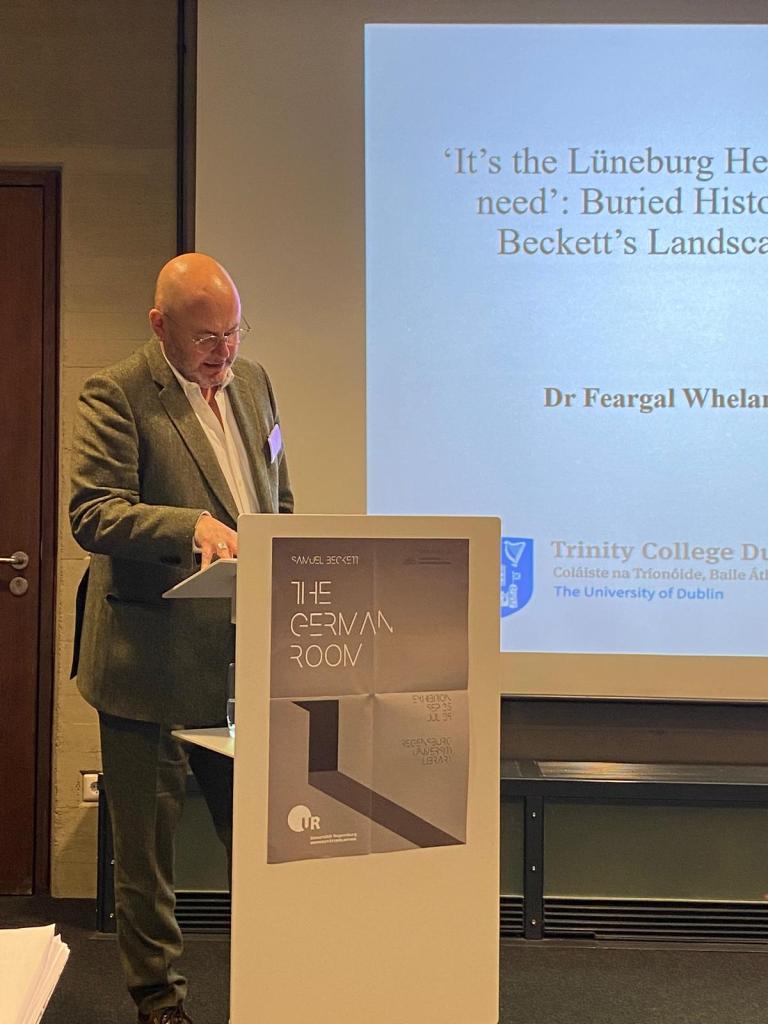
Dr. Megan Girdwood of the University of Edinburgh expounded on Beckett’s portrayals of discernible ‘eurhythmic’ archetypes in Dream of Fair to Middling Women, as influenced by the Ausdruckstanz, a German expressionist dance genre, and Mary Wigman’s Hexentanz (witch dance). Girdwood hypothesised that Beckett’s cousin Peggy Sinclair frequently engaged in serpentine dances, a practice that may have exerted a significant influence on the author’s literary output during this period or in subsequent works. In the ensuing presentation, ‘”It’s the Lüneburg Heath you need”: Buried History in Beckett’s Landscapes,’ Feargal Whelan from Trinity College Dublin examined the formation of history through the medium of memory, accentuating Ireland’s turbulent past and the limitations of language in articulating the truth. For Whelan, Beckett’s references to specific locations in Europe must be considered as meaningful, rather than meaningless, reflections of the importance of those places within the context of his writing. For instance, in his 1946 work The Expelled, Beckett explicitly references ‘Lüneburg Heath,’ the location of the German surrender in the Second World War and the site where Heinrich Himmler committed suicide prior to the Nuremberg Trials. In circumstances where spatial location is lacking, Beckett emphasises memory, Whelan observed.
Finally, theatre director Dr. Sarah Jane Scaife, from Trinity College Dublin, presented ‘Beckett sa Chreig: Guth na mBan, (Beckett on the Rock: The Voice of Women): an analysis of Beckett’s shorter plays for women in conversation with the language, landscape, and culture of Inis Oirr,’ in which she posited the idea of territory as the DNA of an Irish person. The director presented excerpts from her plays, including those from The Women Speak and Laethanta Sona/ Happy Days, which were performed on the Irish island of Inis Oirr. In the former, she emphasised the use of costumes as a form of mourning, while in the latter, she underscored the significance of the rock as a symbol of life and presence.
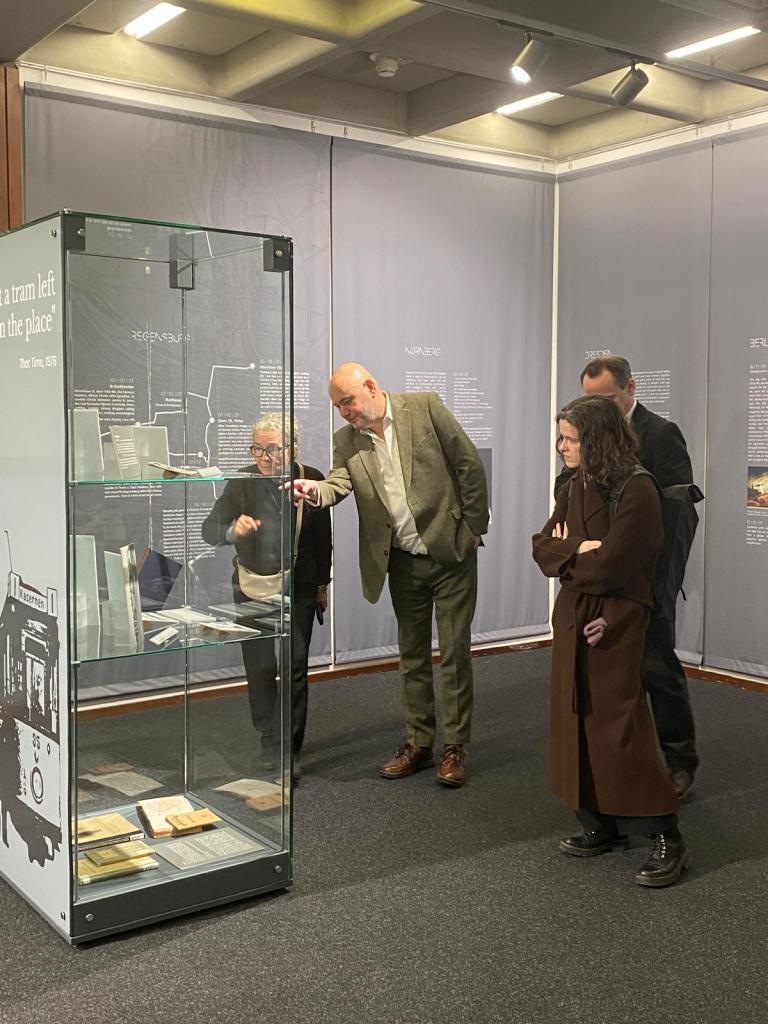
Subsequent to the series of presentations, the audience was cordially invited to partake in a tour of The German Room exhibition. Guided by Dr. Schüller-Zwierlein, the exhibition comprises four themes: ‘Beckett in German’ which concentrates on the subject of translations of the author’s oeuvre into German; ‘Beckett in Germany,’ focusing on Beckett’s activities and visits in the country, from his formative trip in the 1930s and the writing of the German Diaries, to his work with Süddeutscher Rundfunk and the Akademie der Künste in Berlin in relation to the Schiller Theater; ‘Beckett and German Literature,’ detailing the presence of German authors, but also musicians and painters, in the Irishman’s work; and ‘Beckett’s German publishers,’ which looks at Suhrkamp, and also Roland Hänßler’s Stuttgart publishing house, whose correspondence with the author is held in the Library of the University of Regensburg. In collaboration with the Tophoven Archive in the city of Straelen, The German Room transformed the audience into silent companions of Samuel Beckett himself during his travels through Germany.
We are grateful for the invitation extended to us and the cordial welcome that was offered throughout the day. It can be posited that the present moment is witnessing the emergence of a ‘German Beckett,’ a phenomenon that, given its generated expectations, can be featured as a Beckett for the 21st century.
[i] I would like to express my sincere gratitude to José Francisco Fernández, incoming President of The Samuel Beckett Society; to Esteban Cuya, who is now retired and formerly served as the representative for the city of Nuremberg’s relations with Latin America; and to the Mexican writer Arandy Kir, for their sponsorship of the translation.
Vanesa Cotroneo is a PhD Candidate in Theatre Studies at the Ludwig Maximilian University of Munich, where she works as a Fellow Researcher in the ERC project T-Migrants. She is currently finishing her specialisation in literary and theatre translation at the University of Buenos Aires. She earned her Master’s in Comparative Literature (UNLP, with honours and recommended for publication) on the topic of ‘Samuel Beckett in Germany: languages and technologies,’ and has several publications about theatre and comparative literature to her name. Vanesa is a board member of Beckettiana Journal and an elected member of the Executive Committee of the International Federation for Theatre Research (IFTR).


Leave a comment