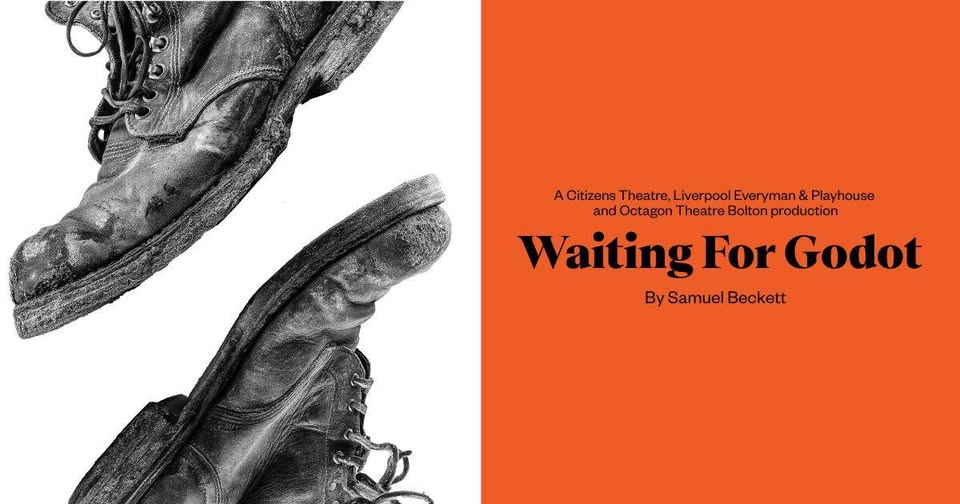
Directed by Dominic Hill
Featuring George Costigan (Vladimir), Matthew Kelly (Estragon), Michael Hodgson (Lucky), Gbolahan Obisesan (Pozzo), Rejoice Ogunyemi (Boy).
February 25th 2026
Review by Umar Shehzad
Dominic Hill’s new production of Waiting for Godot does not come across as a faithful revival, nor does it present itself as a radical intervention. It joins, instead, the now long and unruly tradition of Godots that work by reiteration with difference – a tradition shaped by Beckett’s own dogged efforts to police his play. One thinks of Beckett’s personal intervention to stop a production with an all-female cast by a Dutch theatre company in 1988. Failing to prevent it from going ahead, Beckett moved on to institute a blanket ban on all productions of the play in the Netherlands that stayed in place for a short while (Knowlson 1996: 610). This stricture did not, however, dissuade further attempts at experimental productions of the play. Some examples include Pontedera Theatre’s 2006 production in Italy, in which near-identical twin sisters played Vladimir and Estragon; Anwer Jafri’s 2008 Urdu adaptation, featuring mixed-gender staging at the Karachi Literary Festival in Pakistan; and, more recently, Oberlin College Theatre Department’s proposed 2019 production with an all-female cast, which was halted by the Beckett Estate. While Hill’s version defers to the play’s gender orthodoxy and remains sufficiently aligned with the dramatist’s spare yet rather stringent stage directions, it is no less subversive in its finer details.
An immediately legible intervention is casting. Matthew Kelly’s Estragon and George Costigan’s Vladimir, white and ageing, are flanked by a mixed-race pair of Gbolahan Obisesan’s Pozzo and Michael Hodgson’s Lucky. Both acts are punctuated by Rejoice Ogunyemi as the Boy. Although Beckett did not specify race in his stage directions, most early productions tended toward uniformity of one kind or another – the 1956 American premiere of the play in New York, performed by an all-white cast, followed by the landmark 1957 all-Black Broadway production, come to mind. Hill’s mixed-race staging adds a further dimension to the politics of the play. Obisesan’s young, black and flamboyantly dressed Pozzo is a bustling presence on the stage. Bold and throaty, this Pozzo sustains the persona of the dominant master through both visual and vocal flare-ups. The contrast between his flowing purple-and-yellow garment and the rags on Lucky’s almost denuded body heightens the intensity of the performance.
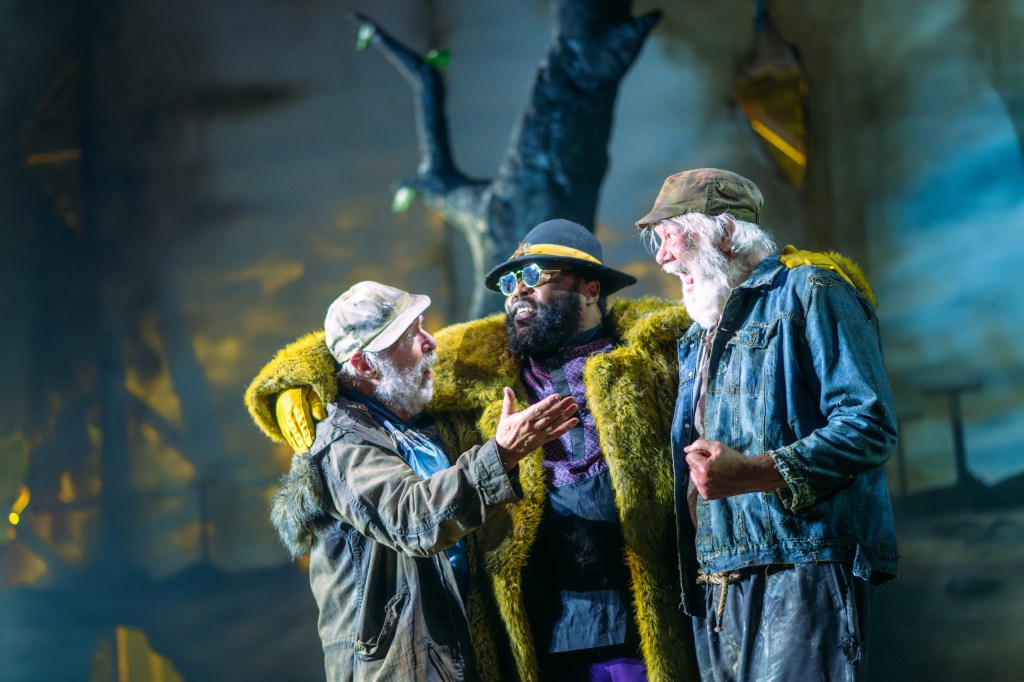
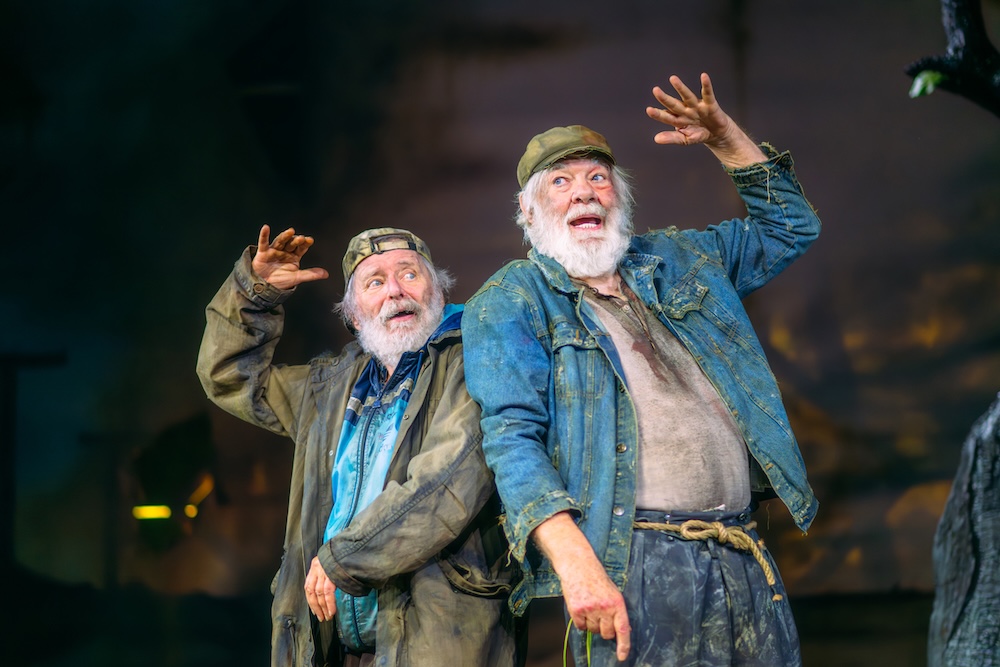
Age, however, is the production’s most sustained departure. Kelly and Costigan’s Estragon and Vladimir, respectively, are unmistakably old men: grey, bearded, and worn. This is a Godot that sits squarely within the demographic reality of contemporary Britain. With their grey, grizzled beards, Gogo and Didi are no longer the vaguely ‘non-descript’ tramps of the imagination; they belong recognisably to an ageing UK – indeed Scottish – population. Waiting here is not metaphysical abstraction but the slow attrition of breath, energy, and bodily functions, brought about by age and infirmity. When Pozzo asks Vladimir, ‘What age are you, if it’s not a rude question. Sixty? Seventy?’, the question lands with a different weight than it would for a ‘non-descript’ tramp.
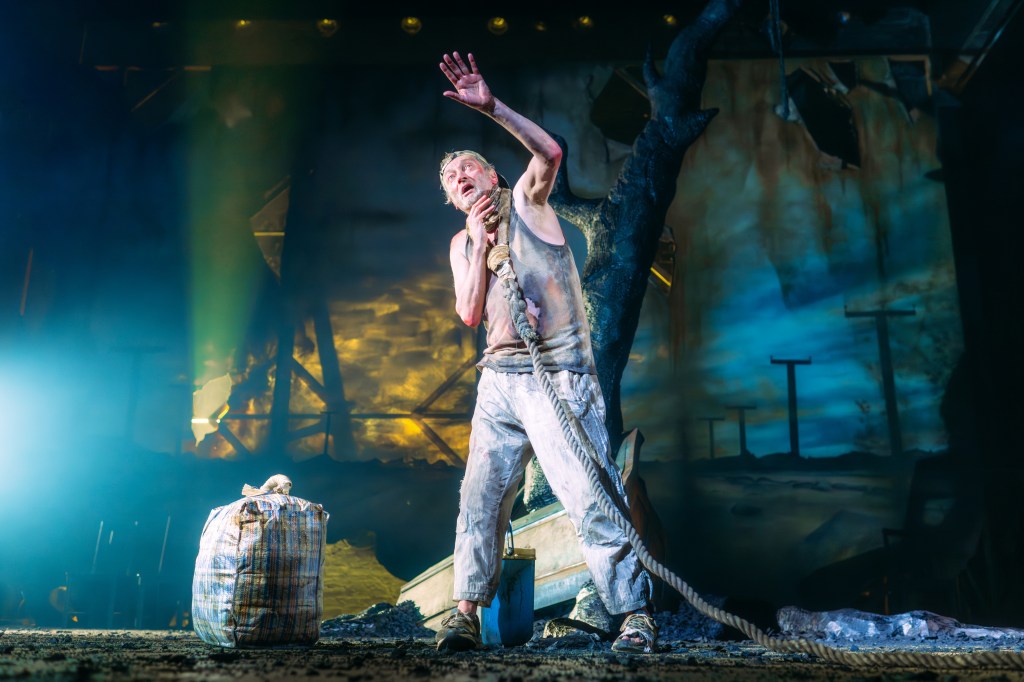
Though Hodgson’s Lucky may not be in the same age bracket as Kelly and Costigan’s Estragon and Vladimir, the sense of physical attrition reaches its most vivid realisation in his portrayal. Hodgson’s Lucky is wheezing, slobbering, breathless, constantly on the verge of collapse. This Lucky is visibly medicalised. Halfway through the great speech, he pauses to spray an inhaler down his throat. The moment is awkward and oddly impressive against the backdrop of the general disdain towards his unstoppable outburst. Exhaustion here is not metaphorical; it is embodied. Yet this comes at a cost. Because of this physical constraint, Lucky’s asthmatic delivery lacks the terrifying speed and manic accumulation that the speech can generate. The ideas pile up, but not quite fast enough to overwhelm.
Notwithstanding Lucky’s protracted speech, the production is keyed up visually, rhythmically, and theatrically. With a brisk to-and-fro between the tramps and the dialogue delivered at a slightly quickened pace, Hill pushes Godot even closer to the vaudevillian tradition that the play recalls. Kelly and Costigan’s Estragon and Vladimir, surprisingly nimble, strike one as almost quick-witted. This approach works – up to a point. The first act, in particular, is pacy, perhaps too much so. Due to their incessant tête-à-tête, one finds Kelly and Costigan’s Estragon and Vladimir unfailingly hilarious and resourceful. The actors’ long friendship, spanning many decades, certainly helped. Yet Godot is also a play about the depletion of words, thought, and communicative resources. Here, the rapid delivery does not quite sustain the sense that Vladimir and Estragon are running out of things to say. The verbal resources never quite seem to dry up, yet a sense of mellowing develops later in the second act, when time seems finally to thicken. By and large, with its exuberant flourishes, the production emphasises its own theatricality, inviting us not to sink into existential gloom but to watch the machinery of performance whirr and clank. If the play is a tragicomedy, the accent in this performance falls on the comedy.
There are smaller moments that land beautifully. Estragon chewing on a comically small radish, mumbling through the effort, catches the play’s humour at exactly the right pitch. Similarly, as Vladimir launches into one of his lengthier dialogues by asking, ‘What are we doing here?’, the auditorium suddenly lights up, dragging the audience into the action of the play. The intensity of the delivery becomes palpable as Costigan, earnest and wide-eyed, turns to face the audience directly. His address to the audience, punctuated by the house lights coming fully up, is delivered with relish. Put on the spot by the lights and Vladimir’s admonishment, ‘Let us not waste our time in idle discourse!’, the audience is forced into an existential reflection. His vehement injunction, ‘Let us do something, while we have the chance!’ comes across almost didactic but his declaration ‘at this place, at this moment of time, all mankind is us, whether we like it or not’ sounds more plausible.
Jean Chan’s gritty stage set – including a pile of speakers, decaying pieces of furniture and the backcloth torn into tatters – paints a post-apocalyptic landscape. With a decaying car door at the base of the tree, the set gestures to an anthropogenic urban environment. The speakers, stray furniture and a coat stand with a few dresses hanging on it nibble at the illusion of ‘a country road’. Paired with the dead tree, it is neither an inside nor an outside. The tree, though appropriately craggy and bare, is rather too substantial. Against the massive trunk of an almost charred-black tree, Gogo’s quip – ‘Looks to me more like a bush’ – loses its piquancy. When Estragon proposes, ‘Let’s hang ourselves immediately!’ and Vladimir responds with a matching (un)seriousness, ‘From a bough? I wouldn’t trust it’, the proposition seems less absurd considering that this tree could, in theory, bear the weight of a hanging body. Similarly, when Estragon hides behind it, he is less comically exposed than Beckett would have intended. At the same time, Chan’s stage design testifies to her ingenuity. As wars and disasters become part of everyday reality, this contemporary reimagining of the set design broadens the scope of the play, giving it a new immediacy and resonance.
Hill’s Godot is not definitive, but it is alive. It breathes, wheezes, hurries, occasionally overreaches. In refusing both museum-piece fidelity and gimmickry, it offers a Godot that feels worked through, argued with, and made urgent again. Novel enough to be refreshing, the production does not go so far as to break with the play’s sanctioned dramaturgical tradition.
Fogel, Aly (2019), ‘All-Female “Waiting for Godot” Cancellation Sparks “Collective Rage”’, The Oberlin Review, 15 Nov 2019, https://oberlinreview.org/19883/arts/all-female-waiting-for-godot-cancellation-sparks-collective-rage/
Knowlson, James (1996), Damned to Fame: The Life of Samuel Beckett, New York: Simon & Schuster.
McMahon, Barbara (2006), ‘Beckett estate fails to stop women waiting for Godot’, The Guardian, 4 Feb 2006, https://www.theguardian.com/world/2006/feb/04/arts.italy
Nasir, Muhammad Saeed and Shehzad, Umar (2022), Gendering Waiting for Godot in the Socio-Political Context of Pakistan. Samuel Beckett Today / Aujourd’hui, 34 (1): 63–78.
Reside, Douglas (2025), ‘The 1957 All-Black Broadway Cast of ‘Waiting For Godot’ in the Archives’, The New York Public Library for the Performing Arts, 20 Nov 2025, https://www.nypl.org/blog/2025/11/20/1957-all-black-broadway-cast-waiting-godot-archives
Umar Shehzad is in the final phase of his doctoral project on the presentation of the face in modern literature at the University of Edinburgh. His short monograph, provisionally titled The Face in Samuel Beckett’s Work, is under contract with Cambridge UP in its Elements series on Beckett and is slated for 2026. His work has appeared in the Journal of Modern Literature and Samuel Beckett Today.


Leave a Reply